Sterling Climbs While UK Unemployment Falls and BoE Rate-Hike Expectations Rise
8 min read
Share


Sterling strengthened on Tuesday following better-than-expected UK labour-market figures, while expectations for a November Bank of England (BoE) interest-rate increase remained elevated. According to the Office for National Statistics (ONS), unemployment fell to 4.7% in the three months to August from 4.9%, while regular earnings growth reached 3.7% annually, exceeding expectations of 3.6%. Employment increased by 102,000, although declining vacancies and rising benefit claims indicated that labour-market conditions remained mixed.
GBP/USD climbed towards 1.3400 during Tuesday's session, while EUR/GBP declined towards 0.8395, its lowest level since May 2025. Interest-rate markets assigned approximately a 95% probability to a quarter-percentage-point BoE increase in November. Separately, BoE policymaker Megan Greene warned that inflation risks from higher energy prices were greater than previously estimated and supported taking action before broader price pressures became entrenched.
Meanwhile, the euro recovered modestly against the weaker dollar despite disappointing European investor sentiment. Germany's ZEW expectations index fell to 28.1 in October, while the eurozone reading declined to 18.5. The US Dollar Index (DXY) weakened towards 101.71 as US Treasury yields and oil prices eased.
September's UK Consumer Price Index (CPI), scheduled for release on Wednesday reporting cut-off, could further influence BoE interest-rate expectations.
GBP: Sterling Gains Amid UK Labour Data and BoE Rate-Hike Expectations
GBP/USD: 1.3376 | EUR/GBP: 0.8389
Sterling strengthened against the US dollar during Tuesday's session, with GBP/USD briefly moving above 1.3400 to reach its highest level in approximately five weeks. The advance followed stronger-than-expected UK employment figures and coincided with broader US dollar weakness. However, the pair eased towards 1.3376 during early Wednesday trading as investors awaited fresh UK inflation data and reassessed the outlook for interest rates.
According to the ONS, UK employment increased by 102,000 in the three months to August, compared with a rise of 67,000 in the previous period. Regular earnings excluding bonuses increased 3.7% annually, above the 3.6% forecast. However, the wider labour-market picture remained mixed. Job vacancies declined by 21,000 to 691,000 in the three months to September, while the number of people claiming unemployment-related benefits increased by approximately 30,300 in September, exceeding expectations of 19,400. These figures suggest that hiring demand remained subdued despite improvements in employment and wage growth.
BoE policymaker Megan Greene warned that inflation risks associated with higher energy prices were greater than previously estimated. She supported taking proactive measures to prevent rising costs from becoming embedded in wage settlements and broader inflation expectations. Interest-rate markets subsequently assigned approximately a 95% probability to a 25-basis-point increase at the BoE's November meeting, although this remained a market expectation rather than a confirmed policy decision.
Against the euro, sterling also advanced, with EUR/GBP declining towards 0.8389 during Tuesday's session, around its lowest level since May 2025. The movement coincided with stronger UK labour-market figures alongside continued uncertainty surrounding European economic conditions. September's UK CPI release, scheduled for Wednesday reporting cut-off, could provide further evidence on inflation pressures and influence expectations for the BoE's next decision.
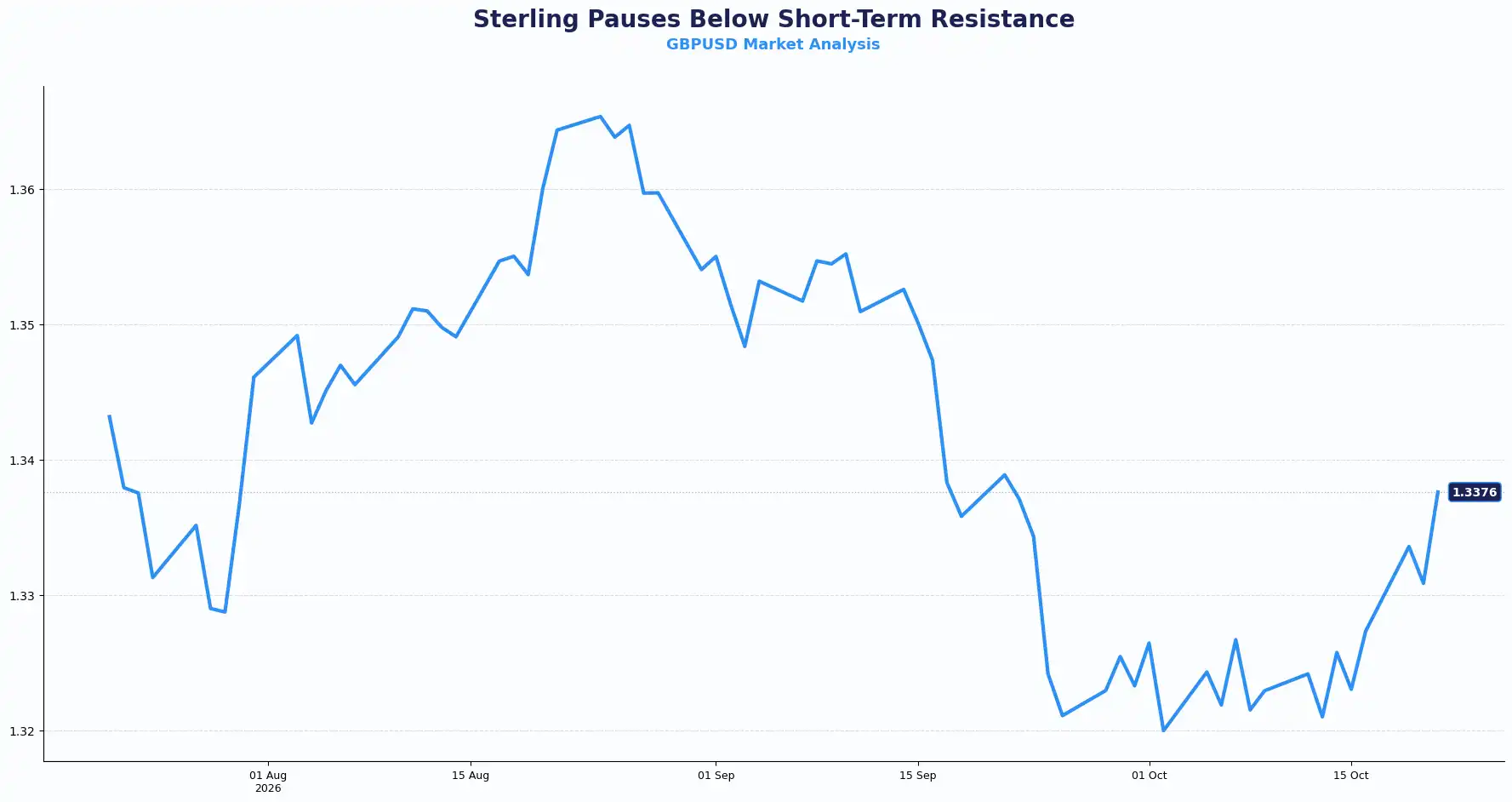
Key technical reference levels for GBP/USD: Resistance sits near 1.3390, followed by 1.3407, while support sits around 1.3365, followed by 1.3255.
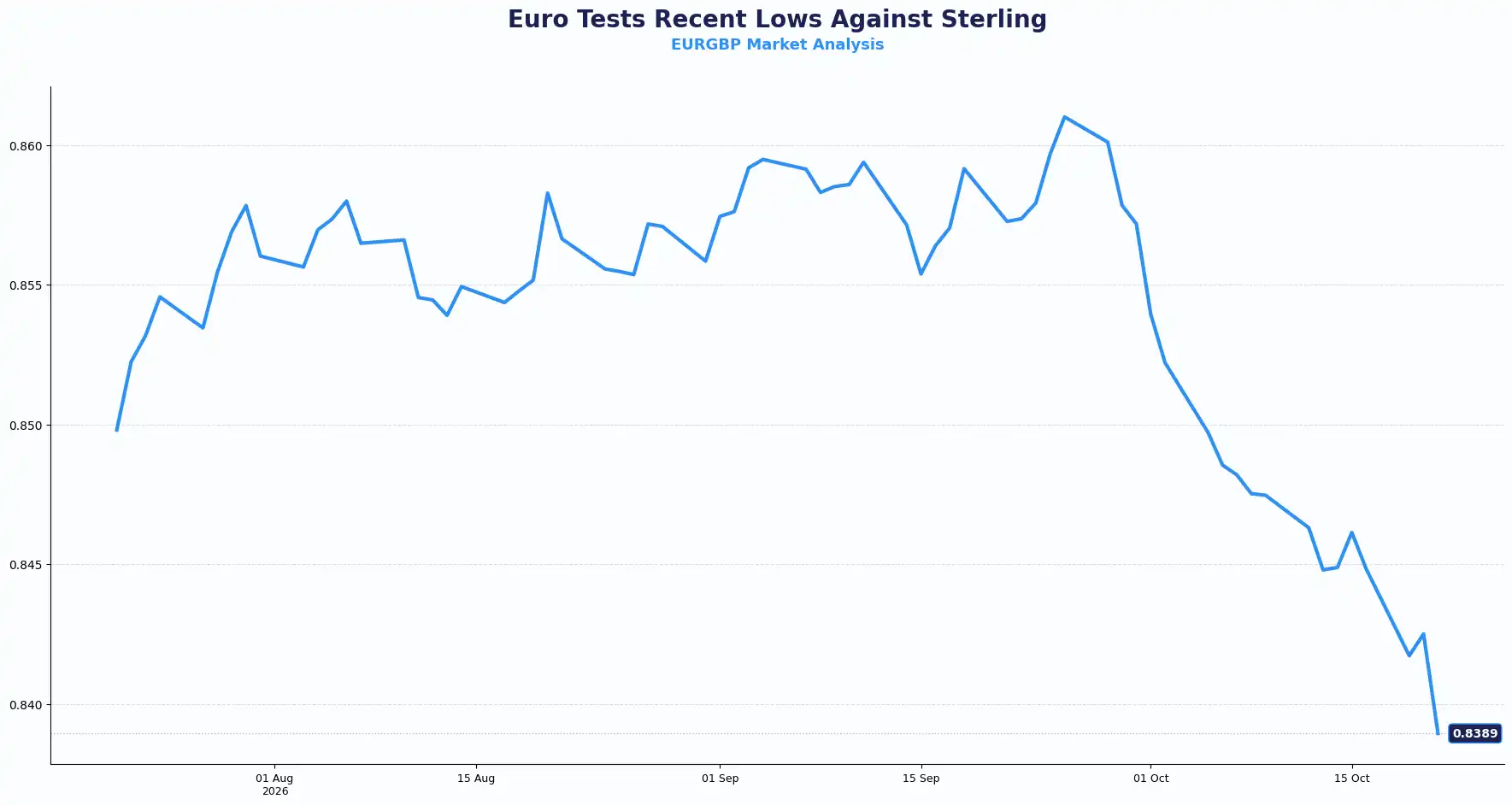
Key technical reference levels for EUR/GBP: Resistance sits near 0.8407, followed by 0.8455, while support sits around 0.8393, followed by 0.8365.
EUR: Euro Pares Gains While German & Eurozone Sentiment Weakens
EUR/USD: 1.1225
The euro recovered modestly against the US dollar during Tuesday's session, with EUR/USD climbing from approximately 1.1200 to above 1.1250 before retreating towards 1.1225 in early Wednesday trading. The recovery coincided with broader dollar weakness and declining US Treasury yields, although weaker European economic sentiment and concerns surrounding government bond markets remained relevant to the currency's outlook.
According to the Leibniz Centre for European Economic Research (ZEW), Germany's economic sentiment index declined to 28.1 in October from 34.7 in September, falling below market expectations. However, the assessment of current economic conditions improved to -35.9 from -47.1, suggesting that economic expectations weakened even as perceptions of present conditions became less negative.
Eurozone economic sentiment also deteriorated, with the ZEW expectations index falling to 18.5 from 25.8, against forecasts of 24.2. ZEW President Achim Wambach said elevated energy prices were putting pressure on household purchasing power, increasing production costs and contributing to persistent inflation. The findings may point to challenges facing the eurozone's economic recovery, although no sustained direct EUR/USD reaction to the survey was established.
Meanwhile, currency strategists at Scotiabank identified elevated French-German government bond yield spreads, near 150 basis points, as an additional constraint on the euro. The combination of weaker economic expectations and tighter financial conditions could complicate the European Central Bank's (ECB) assessment of future interest-rate requirements.
Attention now turns to scheduled ECB policymaker remarks on Wednesday and Friday's preliminary eurozone Purchasing Managers' Index (PMI) figures, which could provide further evidence of economic activity ahead of the ECB's October policy meeting.
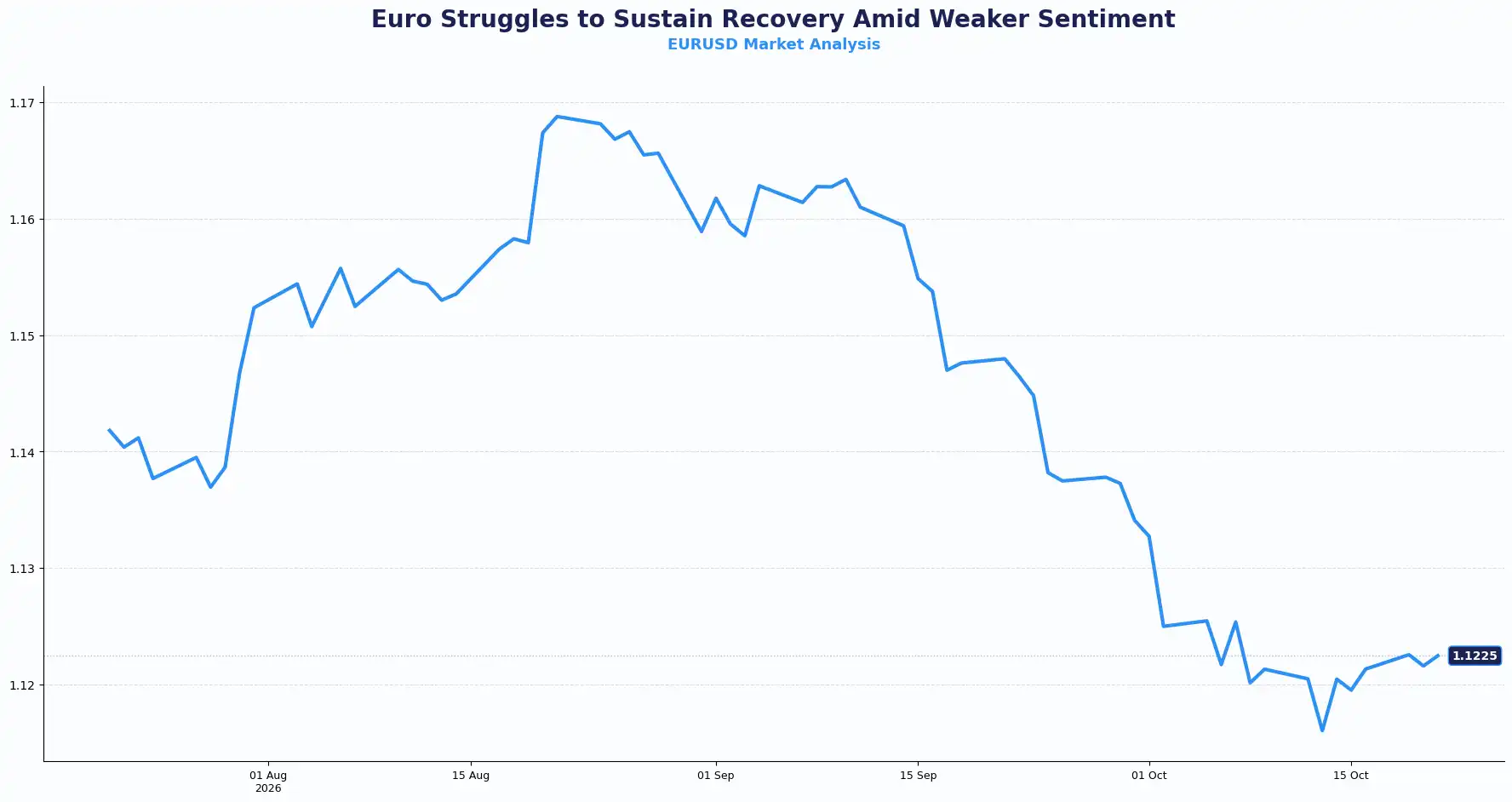
Key technical reference levels for EUR/USD: Resistance sits near 1.1250, followed by 1.1392, while support sits around 1.1200, followed by 1.1115.
USD: Dollar Steadies Amid Weak US Housing Data and Growth Concerns
DXY: 101.80
The US dollar weakened during Tuesday's session, with DXY declining approximately 0.25% towards 101.71 before stabilising near 101.80 in early Wednesday trading. The decline coincided with easing US Treasury yields and volatile oil prices as investors assessed developments surrounding potential US–Iran negotiations. Reports of diplomatic progress were subsequently disputed, leaving uncertainty over energy supplies and inflation risks. The dollar remained close to its recent three-week low, while renewed oil-price increases coincided with some stabilisation during early Wednesday trading.
Fresh US housing figures pointed to weaker housing-market activity amid elevated borrowing costs. According to the National Association of Realtors (NAR), pending home sales declined 7.3% month-on-month in September, compared with economists' expectations for a 0.5% contraction. The index fell to 66.0, its lowest level since records began in 2001, while annual pending sales declined 11.3%. Separately, the US Commerce Department reported that single-family housing starts fell 4.6% in September, with building permits declining 4.0%, highlighting weaker construction activity.
Additional labour-market figures also suggested moderating hiring demand. According to Automatic Data Processing (ADP), private employers added an average of 18,500 jobs per week during the four weeks ending 3 October, down from the previous reading of 24,750. The figures indicated slower private-sector employment growth, although they did not establish an immediate currency-market reaction.
Meanwhile, a Reuters survey found that 94 of 100 economists expected the Fed to leave interest rates unchanged at its October meeting. Separately, CME FedWatch pricing indicated an approximately 83.9% market-implied probability of unchanged rates. These expectations reflected uncertainty over the timing of further tightening, particularly as elevated energy prices continued to present inflation risks.
Other Currencies: Australian Dollar Strengthens While RBA Signals Inflation Concerns
AUD/USD: 0.7013 | NZD/USD: 0.5680 | USD/JPY: 158.30 | GBP/JPY: 211.70
The Australian dollar advanced against the US dollar during early Wednesday trading, with AUD/USD holding above 0.7000 and approaching a three-week high. The movement followed comments from Reserve Bank of Australia (RBA) Deputy Governor Andrew Hauser, who warned that the inflation outlook had deteriorated compared with the central bank's August forecasts. Hauser identified higher oil prices and persistent domestic price pressures as significant concerns, despite signs of slower consumption and easing labour-market conditions. His remarks may have contributed to increased expectations of a potential interest-rate increase at the RBA's 3 November meeting, although the decision remained uncertain. Australia's upcoming quarterly inflation figures could provide further guidance on the need for additional tightening.
Meanwhile, the Japanese yen weakened modestly against the dollar during early Wednesday trading, with USD/JPY moving towards 158.30 following Japanese trade figures showing exports below expectations. September exports increased 16.7% annually, below expectations of 20.1%, while imports rose 18.9%. Japan recorded a trade deficit of ¥536.6 billion, considerably wider than the ¥181 billion shortfall forecast by economists. Separately, Bank of Japan (BoJ) Deputy Governor Ryozo Himino warned that delaying policy adjustments could increase inflation risks, noting that underlying inflation was approaching the central bank's 2% target. A Reuters survey indicated that most economists expected the BoJ to increase interest rates to 1.50% in December, although an October pause remained widely anticipated.
The New Zealand dollar edged lower against the US dollar, with NZD/USD retreating towards 0.5680 during Wednesday's Asian session after four consecutive days of gains. Interest-rate swap markets indicated an approximately 80% probability of a Reserve Bank of New Zealand (RBNZ) rate increase at its next policy meeting. Investors also awaited Thursday's third-quarter inflation figures, which could influence expectations for further monetary tightening as elevated energy costs continued to complicate the inflation outlook.
Current Rate Table
| Currency Pair | Rate | Trend |
|---|---|---|
| GBP/USD | 1.3376 | Bullish short-term |
| EUR/GBP | 0.8389 | Bearish short-term |
| EUR/USD | 1.1225 | Consolidation |
| USD/JPY | 158.30 | Mildly bullish USD |
| AUD/USD | 0.7013 | Mildly bullish AUD |
| NZD/USD | 0.5680 | Mildly bearish NZD |
| USD/CAD | 1.4067 | Bearish short-term |
| GBP/JPY | 211.70 | Mildly bullish GBP |
Market Lookahead
Wednesday, Oct 21
- GBP Consumer Price Index & Core CPI (Sep)
- NZD Consumer Price Index (Q3)
Thursday, Oct 22
- EUR Eurozone Consumer Confidence (Oct)
- USD Initial Jobless Claims
Friday, Oct 23
- JPY National CPI & Core CPI (Sep)
- GBP Retail Sales (Sep)
- EUR Germany & Eurozone HCOB Composite & Services PMI (Oct)
- GBP S&P Global Composite & Services PMI (Oct)
- USD S&P Global Composite & Services PMI (Oct)
Stay Ahead in the Currency Game
Whether you're a daily FX trader or handle international transactions regularly, our 'Currency Pulse' newsletter delivers the news you need to make more informed decisions. Receive concise updates and in-depth insights directly in your LinkedIn feed.
Subscribe to 'Currency Pulse' now and never miss a beat in the currency markets!
Ready to act on today’s insights? Get a free quote or give us a call on: +44 (0)20 7740 0000 to connect with a dedicated portfolio manager for tailored support.
Important Disclaimer: This blog is for informational purposes only and should not be considered financial advice. Currency Solutions does not take into account the investment objectives, financial situation, or specific needs of individual readers. We do not endorse or recommend any specific financial strategies, products, or services mentioned in this content. Forward contracts can help businesses manage foreign exchange exposure by providing greater certainty over future exchange rates, although they may also mean that businesses do not benefit from favourable exchange-rate movements. Businesses should consider their individual circumstances and speak with their dealer to understand how forward contracts may support their specific foreign exchange requirements. All information is provided “as is” without any representations or warranties, express or implied, regarding its accuracy, completeness, or timeliness.