Euro Edges Lower Amid Unrest and Political Uncertainty in France
8 min read
Share


The euro edged lower in early Monday trading amid reports of violence during weekend protests in France and continued political uncertainty. EUR/USD fell approximately 0.1% towards 1.1225, while the US Dollar Index (DXY) held near 101.83. French government bond spreads could be one channel through which developments in France influence the euro, particularly if yield spreads against German debt widened.
French President Emmanuel Macron condemned the violence on Sunday after demonstrations over the cost of living. Separately, Eurostat reported that the eurozone recorded a €16.1 billion goods-trade deficit in August, compared with a €10.7 billion surplus in July. No immediate currency reaction to the trade figures was established.
Sterling was broadly steady against the dollar. UK property website Rightmove reported that asking prices rose 1.0% in October, below the 1.3% increase normally recorded for the month, amid concerns about affordability linked to higher mortgage rates.
In the US, the Federal Reserve reported that industrial production increased 0.7% in September. Meanwhile, China's National Bureau of Statistics reported annual economic growth of 4.5% in the third quarter, exceeding the 4.4% consensus forecast and coinciding with Australian-dollar gains.
Upcoming UK employment and inflation data could influence Bank of England (BoE) interest-rate expectations.
GBP: Sterling Holds Steady as UK Housing Market Faces Pressure
GBP/USD: 1.3318 | EUR/GBP: 0.8415
Sterling remained broadly steady against the US dollar during early Monday trading, with GBP/USD hovering near 1.3318 after recovering from the 1.3300 area. The pair made limited further gains while the US dollar stabilised following its recent decline. Expectations of a possible BoE interest-rate increase in November remained relevant to sterling, although investors were cautious ahead of fresh UK employment and inflation figures.
New UK housing-market data highlighted the growing effect of elevated borrowing costs. According to property website Rightmove, average asking prices increased 1.0% month-on-month in October, below the typical seasonal rise of 1.3%, although higher than September's 0.7% increase. Rightmove said rising mortgage costs were beginning to affect affordability, with buyers adjusting their budgets and sellers facing greater pressure to price properties competitively. The figures suggest that higher financing costs may be moderating housing demand, although asking prices do not necessarily reflect completed transactions.
Against the euro, sterling retained much of its recent strength, with EUR/GBP trading near 0.8415. Renewed political unrest in France may have added to uncertainty surrounding the euro, with currency-market analysts identifying French government bond spreads as an important channel through which developments could affect the currency. However, relative interest-rate expectations and wider currency-market conditions also remained relevant, and no direct reaction to individual political developments was established.
Attention now turns to Tuesday's UK labour-market figures, including employment, unemployment and wage growth, followed by Wednesday's September Consumer Price Index (CPI). Both releases could influence market expectations for the BoE's November interest-rate decision.
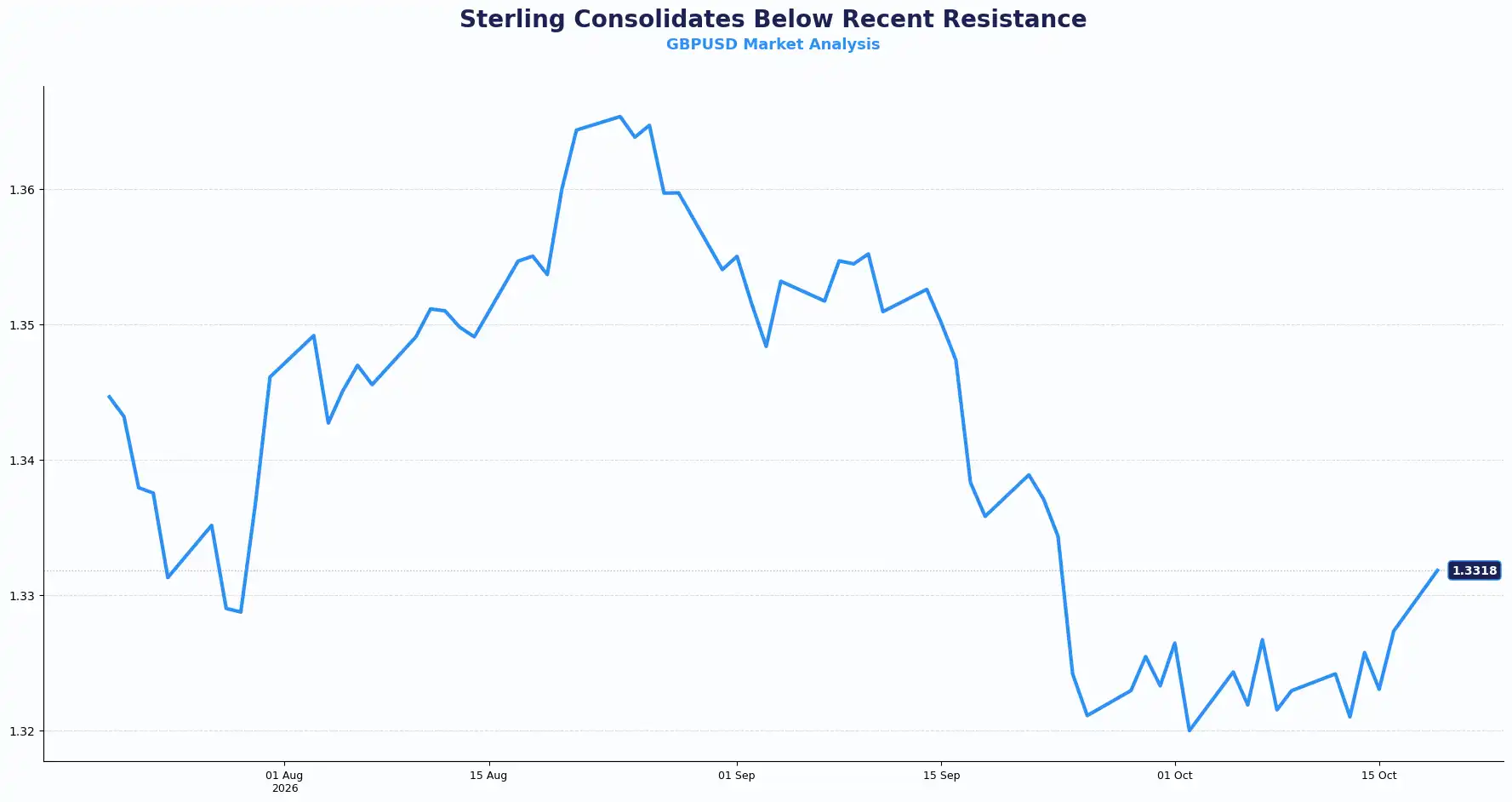
Key technical reference levels for GBP/USD: Resistance sits near 1.3343, followed by 1.3390, while support sits around 1.3265, followed by 1.3138.
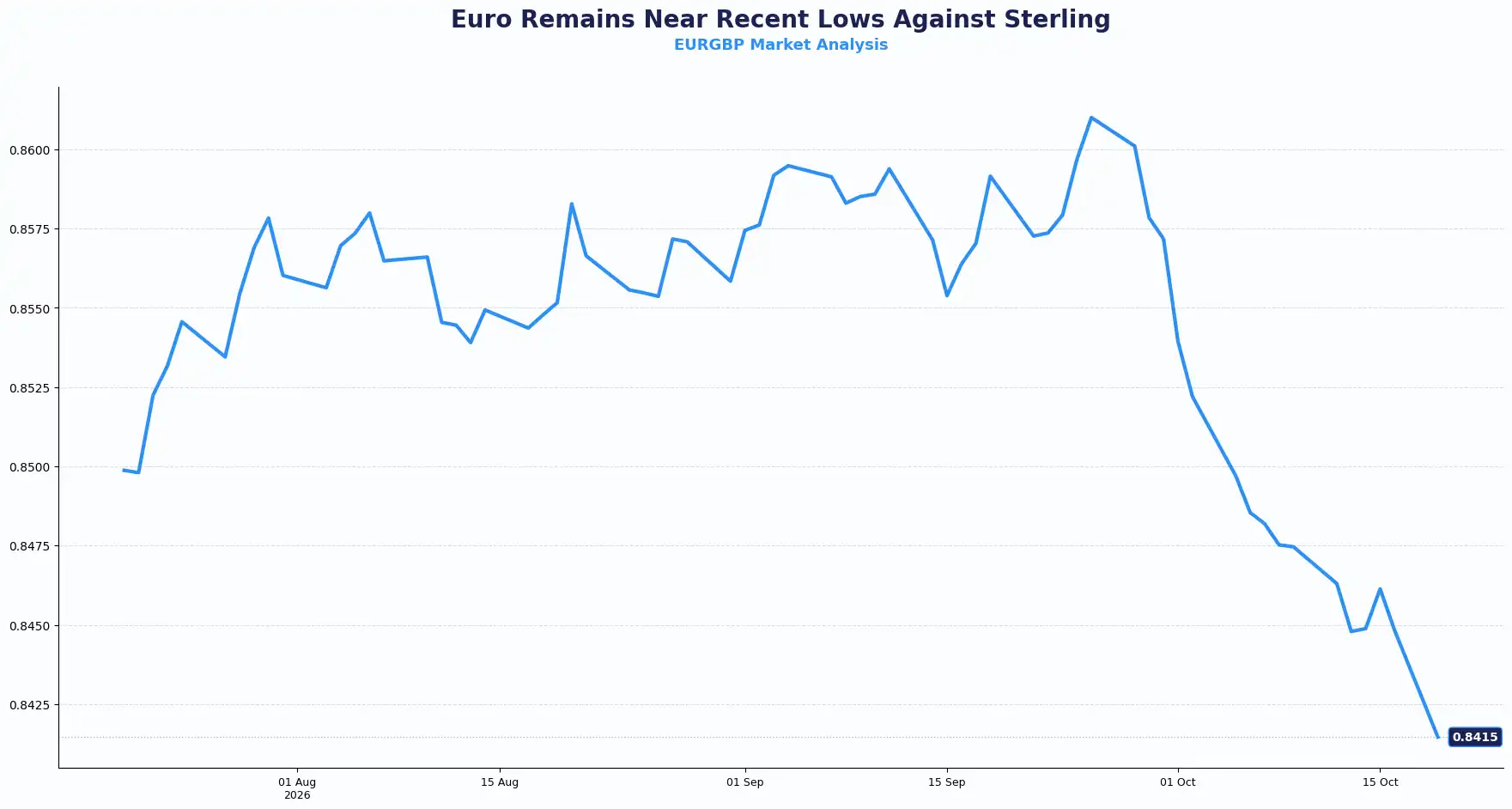
Key technical reference levels for EUR/GBP: Resistance sits near 0.8457, followed by 0.8490, while support sits around 0.8400, followed by 0.8365.
EUR: Euro Edges Lower Amid French Unrest & Bond-Market Uncertainty
EUR/USD: 1.1212
The euro weakened modestly against the US dollar during early Monday trading, with EUR/USD slipping approximately 0.1% towards 1.1212 amid reports of violence during protests in France over the weekend. French President Emmanuel Macron condemned the unrest on Sunday, while investors assessed the potential implications for the country's political stability and government borrowing costs. French government bond markets could provide a channel through which developments in France influence the euro, particularly with the yield spread between French and German 10-year bonds already near 140 basis points.
Fresh European Central Bank (ECB) commentary also highlighted the influence of rising borrowing costs on eurozone monetary policy. ECB President Christine Lagarde said on Saturday that the recent bond-market sell-off had tightened financing conditions beyond the assumptions made in September's economic projections. She indicated that higher long-term interest rates could weaken economic activity and eventually reduce inflation pressures. Her remarks highlighted the competing considerations facing policymakers as elevated inflation persists alongside concerns about growth.
Meanwhile, Eurostat reported that the eurozone recorded a €16.1 billion goods-trade deficit in August, compared with a revised €10.7 billion surplus in July. Exports increased 9.9% year-on-year to €227.7 billion, while imports rose 16.7% to €243.8 billion. The figures highlighted an increase in imports relative to exports, although no immediate EUR/USD reaction to the release was established.
Attention now turns to further developments in French government bond markets and upcoming ECB communication. Executive Board member Frank Elderson is scheduled to speak later on Monday, while changing expectations for Federal Reserve (Fed) interest rates could also influence EUR/USD.
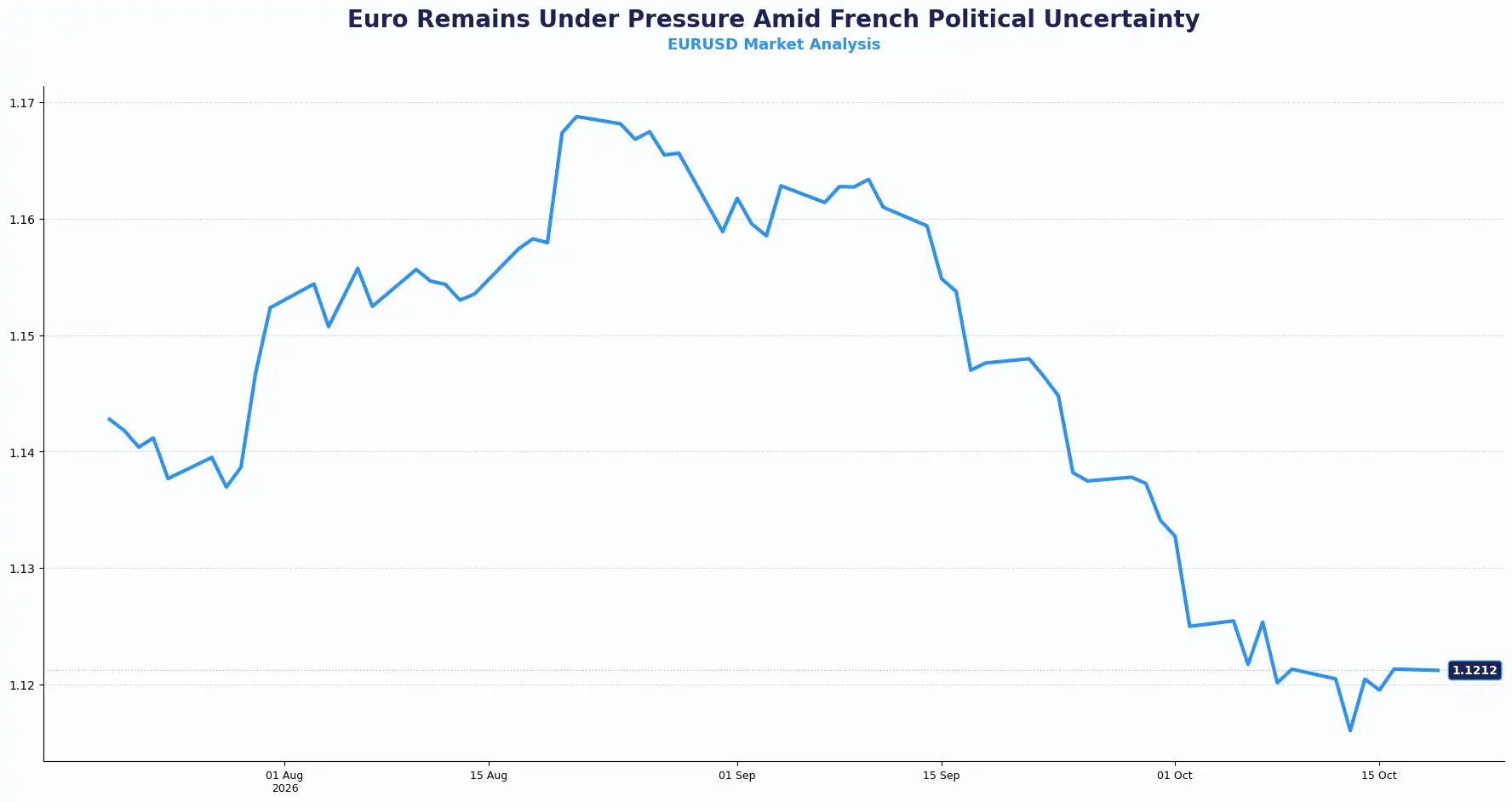
Key technical reference levels for EUR/USD: Resistance sits near 1.1270, followed by 1.1353, while support sits around 1.1151, followed by 1.1105.
USD: Dollar Holds Steady Amid Expectations of a Fed Rate Pause
DXY: 101.82
The US dollar remained broadly steady during early Monday trading, with the DXY hovering near 101.82 after briefly climbing towards 102.01. The initial advance coincided with renewed uncertainty in France, and weakness in the euro. However, the dollar subsequently gave back its gains amid concerns surrounding artificial intelligence investment and broader financial-market conditions. The index remained close to its recent lows following last week's decline.
Fresh US economic figures provided a mixed assessment of industrial activity. According to the Fed, industrial production increased 0.7% month-on-month in September, following a 0.1% rise in August. Manufacturing output increased 0.3%, matching economists' expectations and recovering from a revised 0.2% decline in the previous month. Capacity utilisation also increased to 76.9% from 76.4%, indicating a greater use of available industrial resources.
However, quarterly figures pointed to slower manufacturing momentum. Factory output expanded at an annualised rate of just 0.7% in the third quarter, compared with 5.6% in the second quarter. Higher energy costs, supply-chain disruptions and elevated borrowing costs remained important challenges, while investment in artificial intelligence infrastructure continued to support certain manufacturing industries.
Meanwhile, Fed funds futures indicated an approximately 87% market-implied probability of unchanged interest rates at the Fed's October meeting, broadly consistent with Friday's pricing. The dollar showed limited movement ahead of the next policy decision, while incoming economic data and developments in global financial markets remained in focus.
Other Currencies: Australian Dollar Gains on Chinese Growth as BoJ Assesses Inflation
AUD/USD: 0.6970 | NZD/USD: 0.5655 | USD/JPY: 158.09 | GBP/JPY: 210.72
The Australian dollar strengthened against the US dollar during early Monday trading, with AUD/USD rising towards 0.6970 following stronger-than-expected Chinese economic figures. According to China's National Bureau of Statistics, the economy expanded 4.5% year-on-year in the third quarter, exceeding market expectations of 4.4% and improving from 4.3% in the previous quarter. September industrial production increased 5.5% annually, while retail sales rose 1.1%, both exceeding forecasts. The figures may have been viewed positively given Australia's economic links with China, while broader US dollar movements also coincided with AUD/USD's gains.
Meanwhile, Reserve Bank of Australia (RBA) Assistant Governor Christopher Kent acknowledged signs that Australian labour-market conditions were easing faster than previously expected. He cautioned against drawing firm conclusions from a single month's employment figures but said financial markets had reasonably reduced expectations for further tightening. Interest-rate markets assigned approximately a 30% probability to a November RBA rate increase, while expectations for a December increase stood near 50%. Kent indicated that upcoming quarterly inflation figures would help policymakers assess the balance between employment conditions and persistent price pressures.
The Japanese yen remained relatively stable against the US dollar, with USD/JPY trading near 158.09. Bank of Japan (BoJ) Governor Kazuo Ueda said underlying inflation was approaching the central bank's 2% target, supported by a tight labour market and continued economic recovery. He also warned that delaying appropriate interest-rate adjustments could contribute to higher long-term bond yields. His comments indicated that further tightening remained possible, although they did not establish the timing of the BoJ's next decision.
The New Zealand dollar was broadly unchanged near 0.5655 against the US dollar, with no separate domestic development establishing a material currency reaction during the reporting window. Attention remains on upcoming central-bank decisions and economic data that could influence broader currency markets.
Current Rate Table
| Pair | Rate | Trend |
|---|---|---|
| GBP/USD | 1.3318 | Consolidation |
| EUR/GBP | 0.8415 | Bearish EUR |
| EUR/USD | 1.1212 | Mildly bearish EUR |
| USD/JPY | 158.09 | Consolidation |
| AUD/USD | 0.6970 | Mildly bullish AUD |
| NZD/USD | 0.5655 | Consolidation |
| USD/CAD | 1.4120 | Mildly bearish USD |
Market Lookahead
Monday, Oct 19
- CAD Consumer Price Index & Core CPI (Sep)
Tuesday, Oct 20
- GBP Average Earnings (Aug)
- GBP Unemployment Rate (Aug)
Wednesday, Oct 21
- GBP Consumer Price Index & Core CPI (Sep)
- NZD Consumer Price Index (Q3)
Thursday, Oct 22
- EUR Eurozone Consumer Confidence (Oct)
- USD Initial Jobless Claims
Friday, Oct 23
- JPY National CPI & Core CPI (Sep)
- GBP Retail Sales (Sep)
- EUR Germany & Eurozone HCOB Composite & Services PMI (Oct)
- GBP S&P Global Composite & Services PMI (Oct)
- USD S&P Global Composite & Services PMI (Oct)
Stay Ahead in the Currency Game
Whether you're a daily FX trader or handle international transactions regularly, our 'Currency Pulse' newsletter delivers the news you need to make more informed decisions. Receive concise updates and in-depth insights directly in your LinkedIn feed.
Subscribe to 'Currency Pulse' now and never miss a beat in the currency markets!
Ready to act on today’s insights? Get a free quote or give us a call on: +44 (0)20 7740 0000 to connect with a dedicated portfolio manager for tailored support.
Important Disclaimer: This blog is for informational purposes only and should not be considered financial advice. Currency Solutions does not take into account the investment objectives, financial situation, or specific needs of individual readers. We do not endorse or recommend any specific financial strategies, products, or services mentioned in this content. Forward contracts can help businesses manage foreign exchange exposure by providing greater certainty over future exchange rates, although they may also mean that businesses do not benefit from favourable exchange-rate movements. Businesses should consider their individual circumstances and speak with their dealer to understand how forward contracts may support their specific foreign exchange requirements. All information is provided “as is” without any representations or warranties, express or implied, regarding its accuracy, completeness, or timeliness.