Bank of England Raises Rates Amid European Fiscal Concerns
6 min read
Share


The Bank of England (BoE) raised its benchmark interest rate by 25 basis points to 4.00% on Thursday, its first rate hike since 2023, as policymakers responded to persistent inflation pressures. Eight members supported the increase, while one preferred a larger move. Sterling initially strengthened following the decision before retreating against the US dollar in early Friday trading.
Meanwhile, political and fiscal concerns continued across Europe. Nationwide protests in France increased pressure on the government as it struggled to agree on spending reductions for its 2027 budget. Belgium also faced political uncertainty after coalition budget negotiations broke down, raising questions about the government's future. European Central Bank (ECB) policymaker Isabel Schnabel warned that rising public debt could complicate monetary policy and increase risks to financial stability.
The US dollar recovered amid a global sell-off in technology shares and increased demand for perceived haven assets. The US Dollar Index (DXY) traded near 101.74, while EUR/USD declined towards 1.1184. Thursday's US initial jobless claims fell to 189,000, below expectations of 196,000, although lower Treasury yields limited the dollar's gains. Investors now await Friday's US employment report for further indications of the Federal Reserve's (Fed) interest-rate outlook.
GBP: Sterling Mixed Following BoE Rate Hike
GBP/USD: 1.3399 | EUR/GBP: 0.8347
Sterling's recent advance against the US dollar lost momentum following Thursday's interest-rate announcement, with GBP/USD trading near 1.3399 early Friday after retreating from levels above 1.3500. The rate hike had been widely expected, although sterling weakened following the announcement. However, UK two-year government bond yields rose by approximately three basis points to 4.77% following the decision, amid expectations of further monetary tightening.
Attention has now shifted to how much further the BoE may raise rates. The central bank expects inflation to peak at 4.8% in the second quarter of 2027, with a return to its 2% target not anticipated until the third quarter of 2028. Governor Andrew Bailey indicated that another rate hike could be necessary if energy prices remain elevated, although future decisions will depend on economic conditions. This leaves uncertainty over the number and timing of additional increases, particularly as financial markets have priced in more tightening than some economists anticipate.
Against the euro, sterling remained relatively firm, with EUR/GBP near 0.8347. The contrasting movements were consistent with broader US dollar strength rather than uniform sterling weakness across currency pairs. Investors are now awaiting Friday's US employment report, which could influence Fed rate expectations and the near-term direction of GBP/USD.
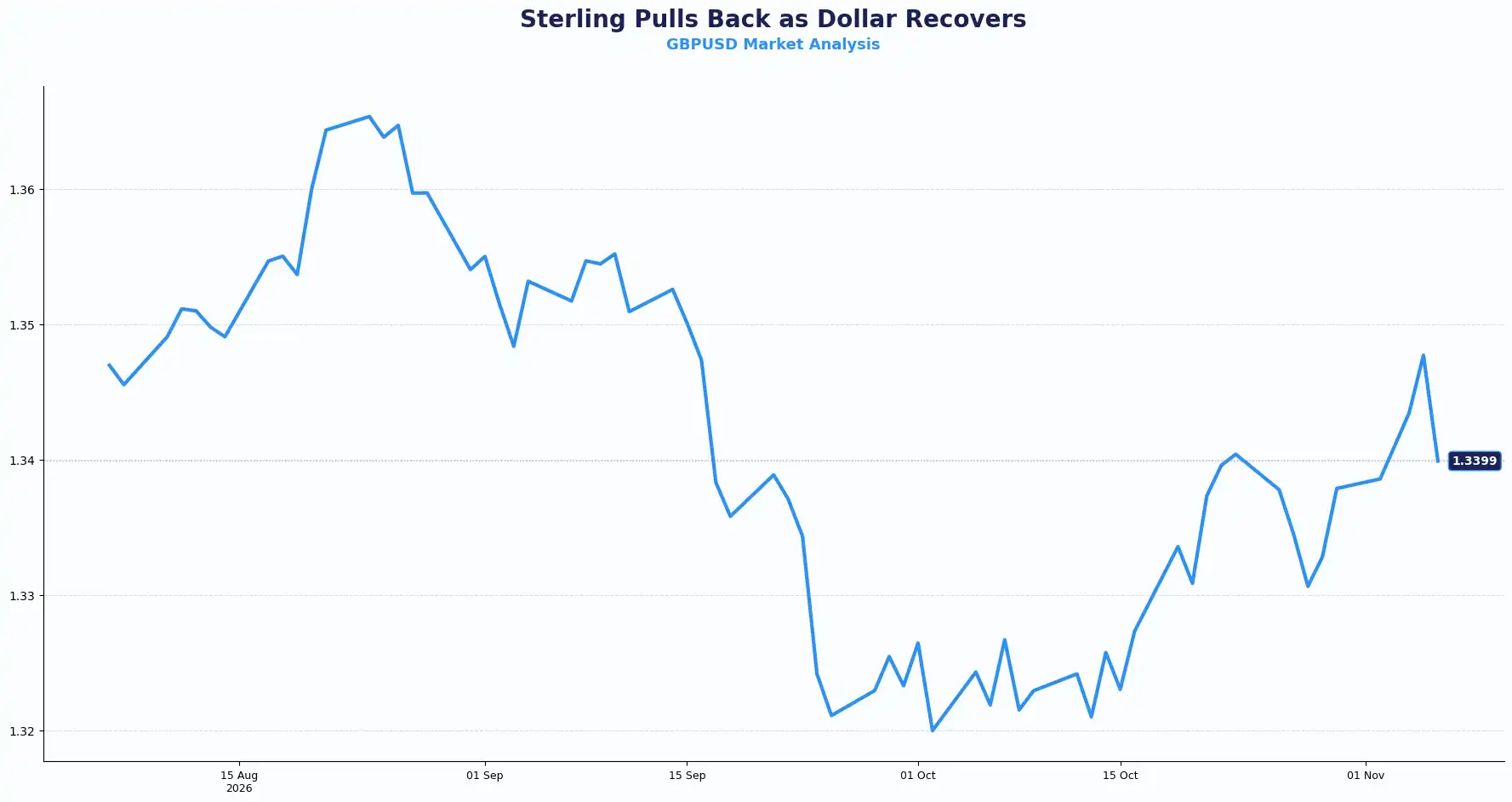
Key technical reference levels for GBP/USD: Resistance sits near 1.3472, followed by 1.3562, while support sits around 1.3409, followed by 1.3372.
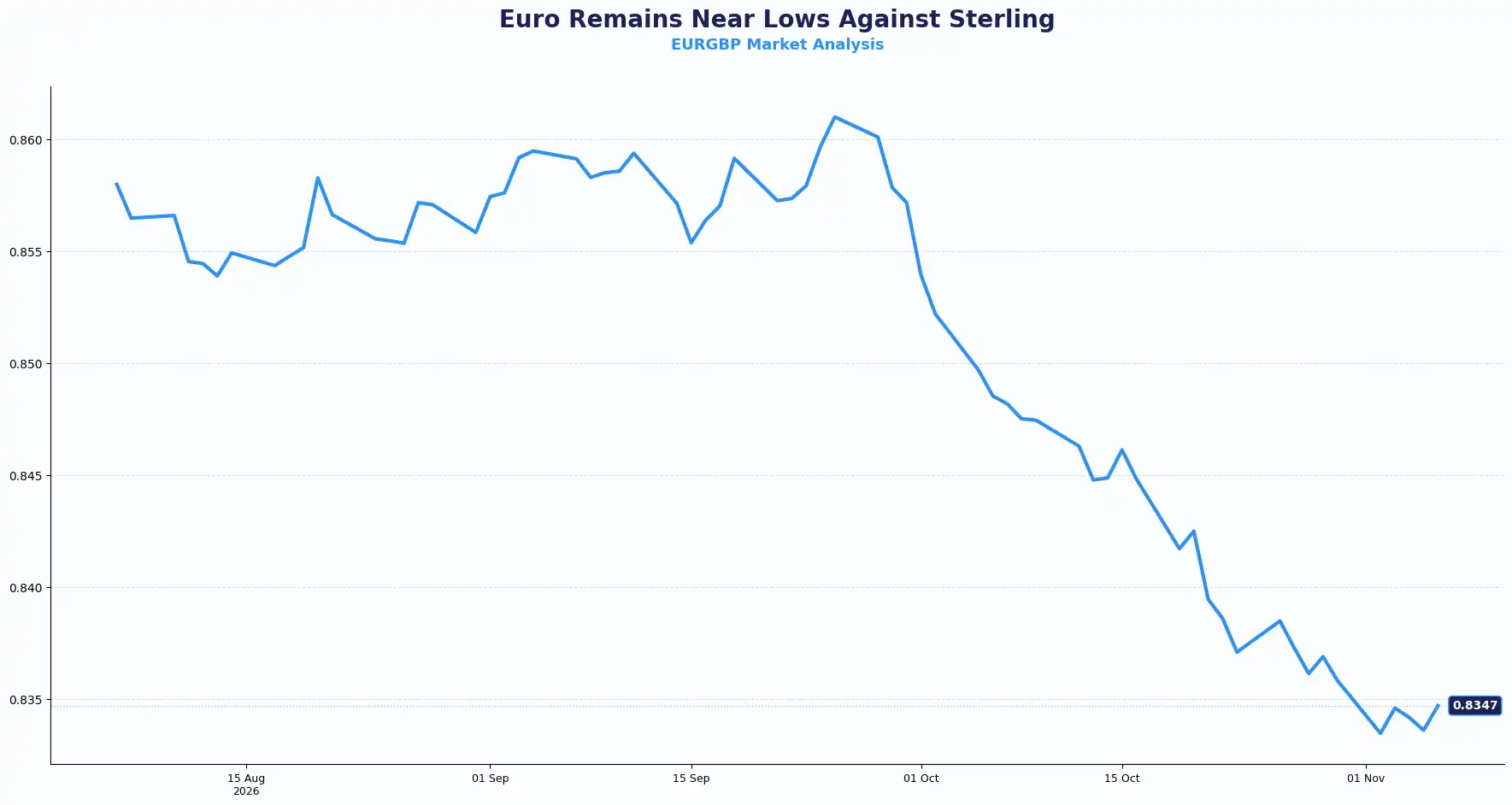
Key technical reference levels for EUR/GBP: Resistance sits near 0.8363, followed by 0.8380, while support sits around 0.8335, followed by 0.8320.
EUR: Euro Slips Amid European Fiscal Uncertainty
EUR/USD: 1.1184
The euro weakened against the US dollar early Friday, with EUR/USD falling approximately 0.2% to 1.1184. The decline came as a global sell-off in technology shares increased demand for the US dollar as a haven asset. Despite Friday's weakness, the euro remained on course for a modest weekly gain.
In France, nationwide protests over living costs and public services added pressure on the government as it struggled to secure parliamentary support for its 2027 budget. French 10-year government bond yields stood near 4.79% on Thursday, compared with 3.24% in Germany, reflecting continued concerns about France's fiscal position. Meanwhile, Belgium faced increased political uncertainty after coalition parties failed to agree on measures to address a €10 billion budget shortfall. Prime Minister Bart De Wever was due to meet King Philippe on Friday to discuss the government's future.
European Central Bank (ECB) policymaker Isabel Schnabel also warned that rising public debt and the growing involvement of non-bank investors in bond markets could complicate monetary policy and increase financial instability risks. Investors are now awaiting eurozone retail sales figures and Friday's US employment report, both of which could influence the near-term direction of EUR/USD.
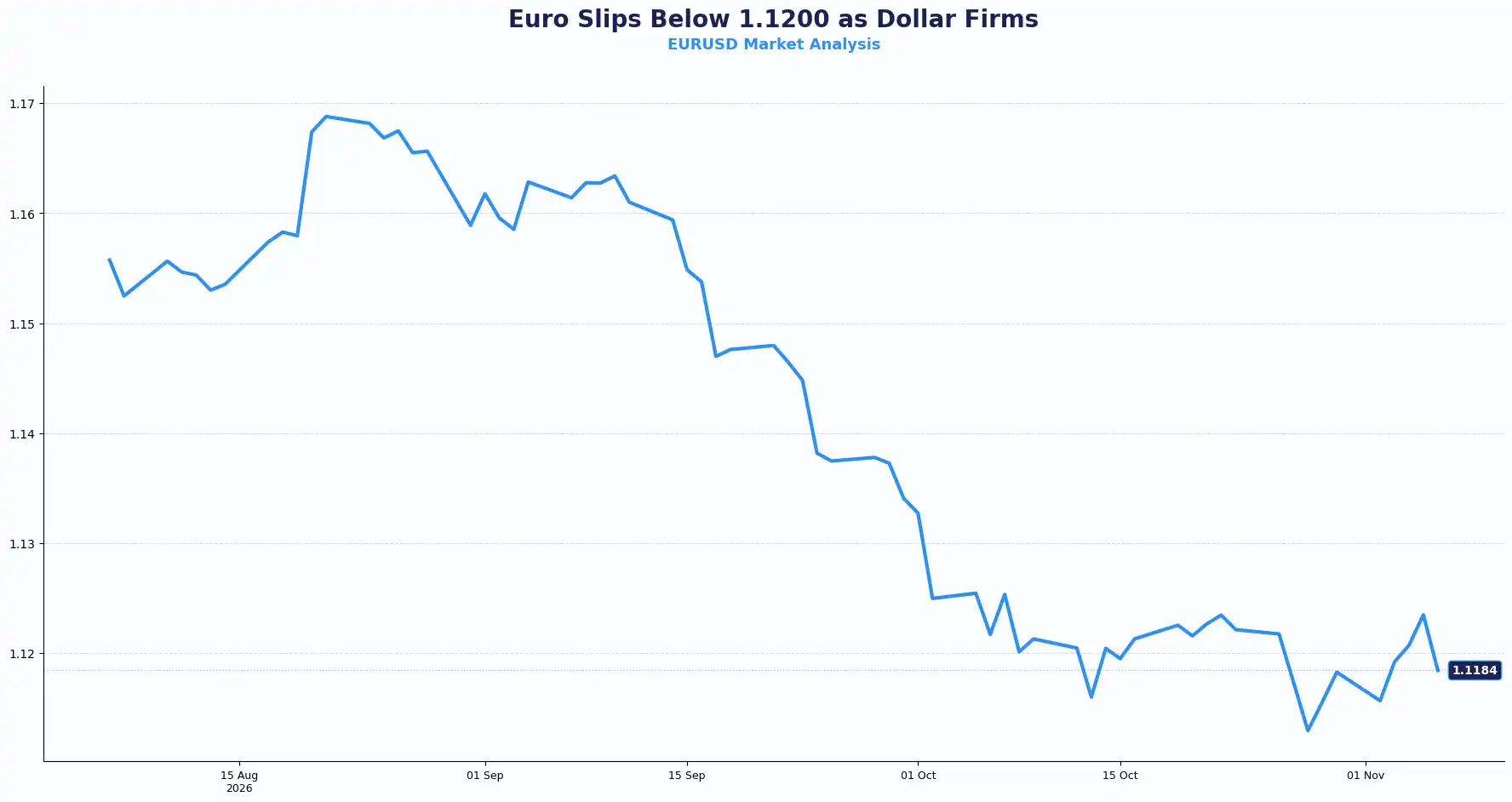
Key technical reference levels for EUR/USD: Resistance sits near 1.1255, followed by 1.1353, while support sits around 1.1132, followed by 1.1100.
USD: Dollar Recovers Ahead of Payrolls
DXY: 101.76
The US dollar recovered on Friday, with DXY rising approximately 0.25% to 101.76. Investors increased their demand for haven assets following sharp losses in global technology shares. However, lower US Treasury yields limited the dollar's gains. The two-year Treasury yield fell by around 10 basis points overnight to its lowest level since September, while the 10-year yield declined by nearly six basis points.
Futures pricing indicated that market-implied expectations for a December Fed rate hike had eased, with the estimated probability falling to approximately 70% from more than 80% on Wednesday. Despite the change in expectations, Fed policymakers continued to highlight inflation concerns. Cleveland Fed President Beth Hammack indicated that further action was needed to bring inflation towards the 2% target, while Richmond Fed President Tom Barkin supported a gradual approach to additional rate hikes.
Attention now turns to Friday's US non-farm payrolls (NFP) report. Economists expect approximately 65,000 new jobs in October, compared with 29,000 in September, while unemployment is forecast to remain at 4.2%. Employment and wage figures could influence expectations for the Fed's December decision and the near-term direction of the US dollar.
Other Currencies: Australian and New Zealand Dollars Weaken
AUD/USD: 0.6910 | NZD/USD: 0.5585 | USD/JPY: 157.81 | GBP/JPY: 211.98
The Australian dollar weakened against the US dollar, with AUD/USD trading near 0.6910 early Friday after losing more than 1% on Thursday. Although the Reserve Bank of Australia (RBA) raised interest rates to 4.85% earlier this week, its divided policy vote and less aggressive guidance may have tempered expectations for further rate hikes. RBA Deputy Governor Andrew Hauser nevertheless indicated on Thursday that inflationary pressures remained elevated.
The New Zealand dollar also declined, with NZD/USD falling towards 0.5585. New Zealand's unemployment rate increased to 5.7% in the third quarter from 5.6%, reaching its highest level since 2015. The weaker employment figures may have dampened expectations of a December rate hike by the Reserve Bank of New Zealand (RBNZ). Political uncertainty added another consideration, with New Zealand's general election scheduled for Saturday and opinion polls indicating a closely contested result.
Meanwhile, the Japanese yen benefited from increased demand for haven assets as global equity markets declined. USD/JPY briefly fell to 157.27 before recovering towards 157.81, while GBP/JPY traded around 211.98. Expectations of further tightening by the Bank of Japan (BoJ) also remained relevant, while movements in US Treasury yields and global risk sentiment may have been more influential in the yen's near-term performance.
Current Rate Table
| Currency Pair | Rate | Trend |
|---|---|---|
| GBP/USD | 1.3399 | Mildly bearish GBP |
| EUR/GBP | 0.8347 | Mildly bearish EUR |
| EUR/USD | 1.1184 | Bearish EUR |
| USD/JPY | 157.81 | Mildly bullish USD |
| AUD/USD | 0.6910 | Bearish AUD |
| NZD/USD | 0.5585 | Bearish NZD |
| USD/CAD | 1.4050 | Bullish USD |
Market Lookahead
Friday, Nov 06
- CAD Employment Change & Unemployment Rate (Oct)
- US Average Hourly Earnings (Oct)
- US Nonfarm Payrolls (Oct)
Stay Ahead in the Currency Game
Whether you're a daily FX trader or handle international transactions regularly, our 'Currency Pulse' newsletter delivers the news you need to make more informed decisions. Receive concise updates and in-depth insights directly in your LinkedIn feed.
Subscribe to 'Currency Pulse' now and never miss a beat in the currency markets!
Ready to act on today’s insights? Get a free quote or give us a call on: +44 (0)20 7740 0000 to connect with a dedicated portfolio manager for tailored support.
Important Disclaimer: This blog is for informational purposes only and should not be considered financial advice. Currency Solutions does not take into account the investment objectives, financial situation, or specific needs of individual readers. We do not endorse or recommend any specific financial strategies, products, or services mentioned in this content. Forward contracts can help businesses manage foreign exchange exposure by providing greater certainty over future exchange rates, although they may also mean that businesses do not benefit from favourable exchange-rate movements. Businesses should consider their individual circumstances and speak with their dealer to understand how forward contracts may support their specific foreign exchange requirements. All information is provided “as is” without any representations or warranties, express or implied, regarding its accuracy, completeness, or timeliness.