Euro Edges Up Against Dollar Amid ECB Hold and Lagarde’s Early Departure
6 min read
Share


The euro edged up against the US dollar early Friday, trading around $1.1197 after briefly reaching its lowest level since May 2025 on Thursday. The European Central Bank (ECB) held its deposit rate at 2.50%, warning that higher energy costs could add to inflation while tighter financing conditions may weaken growth. ECB President Christine Lagarde also announced that she would step down on 7 February 2027, eight months before her term was due to end.
The decision leaves a December rate hike possible, although the ECB has not committed to a particular path. Lagarde said policymakers had discussed raising rates immediately but wanted more economic evidence before acting. Higher energy prices and elevated government borrowing costs present competing risks for the eurozone, complicating the next policy decision.
The euro's recovery coincided with a softer US dollar, increased demand for US Treasuries and lower yields amid renewed concerns about artificial intelligence spending. Thursday's US releases showed gross domestic product (GDP) growing at an annualised 3.4% in the third quarter and annual Personal Consumption Expenditures (PCE) inflation accelerating to 3.6% in September. Sterling strengthened towards $1.3400, while the yen gained after the Bank of Japan (BoJ) held interest rates unchanged.
GBP: Sterling Strengthens Against Dollar While UK Mortgage Approvals Decline
GBP/USD: 1.3403 | EUR/GBP: 0.8345
Sterling traded higher against the US dollar early Friday, with GBP/USD near 1.3403 amid lower US Treasury yields and broader dollar weakness. Against the euro, EUR/GBP remained close to 0.8345, near its lowest levels in around 17 months. Sterling's relative strength against the euro continued, although movements in the cross were more limited than the recovery in GBP/USD.
Fresh Bank of England (BoE) data showed that UK mortgage approvals fell to 53,443 in September from 54,814 in August, their lowest since December 2023. Net mortgage lending also declined to £3.866 billion, its weakest since May, against a backdrop of elevated borrowing costs and weaker housing demand. Meanwhile, annual unsecured consumer lending growth reached 9.8%, its fastest pace since April 2018, highlighting mixed conditions across household borrowing.
Money markets continued to anticipate a 25-basis-point BoE rate hike at the 5 November meeting, which would take the policy rate from 3.75% to 4.00%. Thursday's limited market reaction to the UK Budget left those expectations broadly unchanged. The upcoming BoE decision remains an important event for sterling, particularly as investors assess the balance between persistent inflation pressures and signs of weaker household demand.
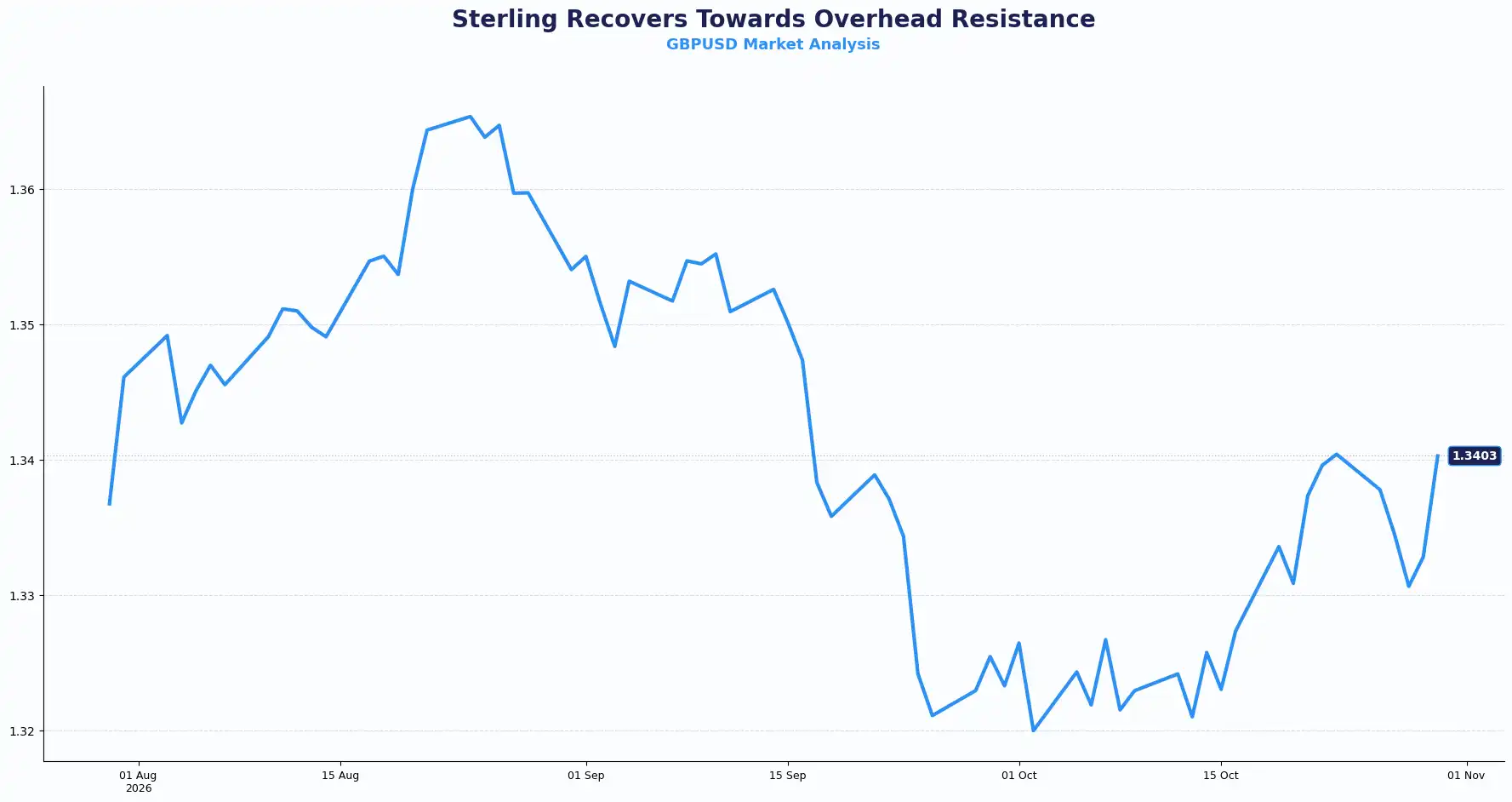
Key technical reference levels for GBP/USD: Resistance sits near 1.3400, followed by 1.3435, while support lies around 1.3300, followed by 1.3272.
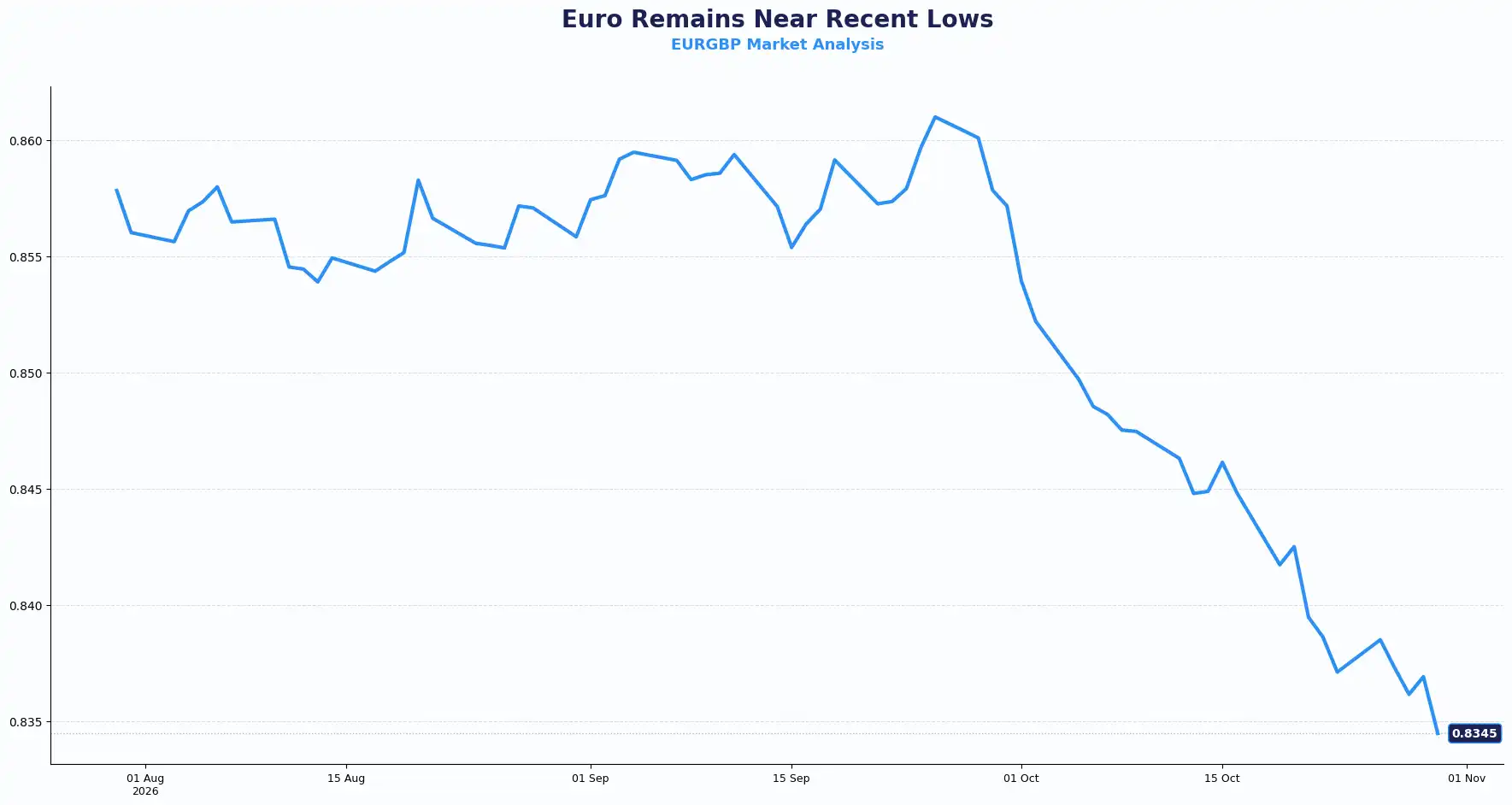
Key technical reference levels for EUR/GBP: Resistance sits near 0.8400, followed by 0.8430, while support lies around 0.8355, followed by 0.8320.
EUR: Euro Recovers Amid ECB Hold and December Rate-Hike Expectations
EUR/USD: 1.1189
The euro recovered against the US dollar early Friday, after falling towards 1.1130 during Thursday's European Central Bank (ECB) announcement, its weakest level since May 2025. The recovery coincided with broader US dollar weakness but did not reverse the euro's monthly decline of approximately 1.2%. EUR/USD also remained below its 100-day moving average, leaving the recent rebound below a widely watched technical reference point.
The ECB's decision to maintain its deposit rate at 2.50% followed discussions about whether an immediate rate hike was necessary. Interest-rate markets indicated approximately a 67% probability of a December hike following the announcement. Policymakers face competing pressures, with elevated energy costs increasing inflation risks while higher borrowing costs could restrain economic activity. Incoming economic data could influence whether the ECB considers further monetary tightening appropriate.
French government borrowing costs added another challenge, with the country's 10-year bond yield premium over Germany reaching approximately 155 basis points. Christine Lagarde's planned February departure also introduces a leadership transition, although analysts described the initial market reaction as limited. Preliminary German and eurozone growth figures scheduled for Friday could provide further evidence of how higher borrowing costs and energy prices are affecting economic activity.
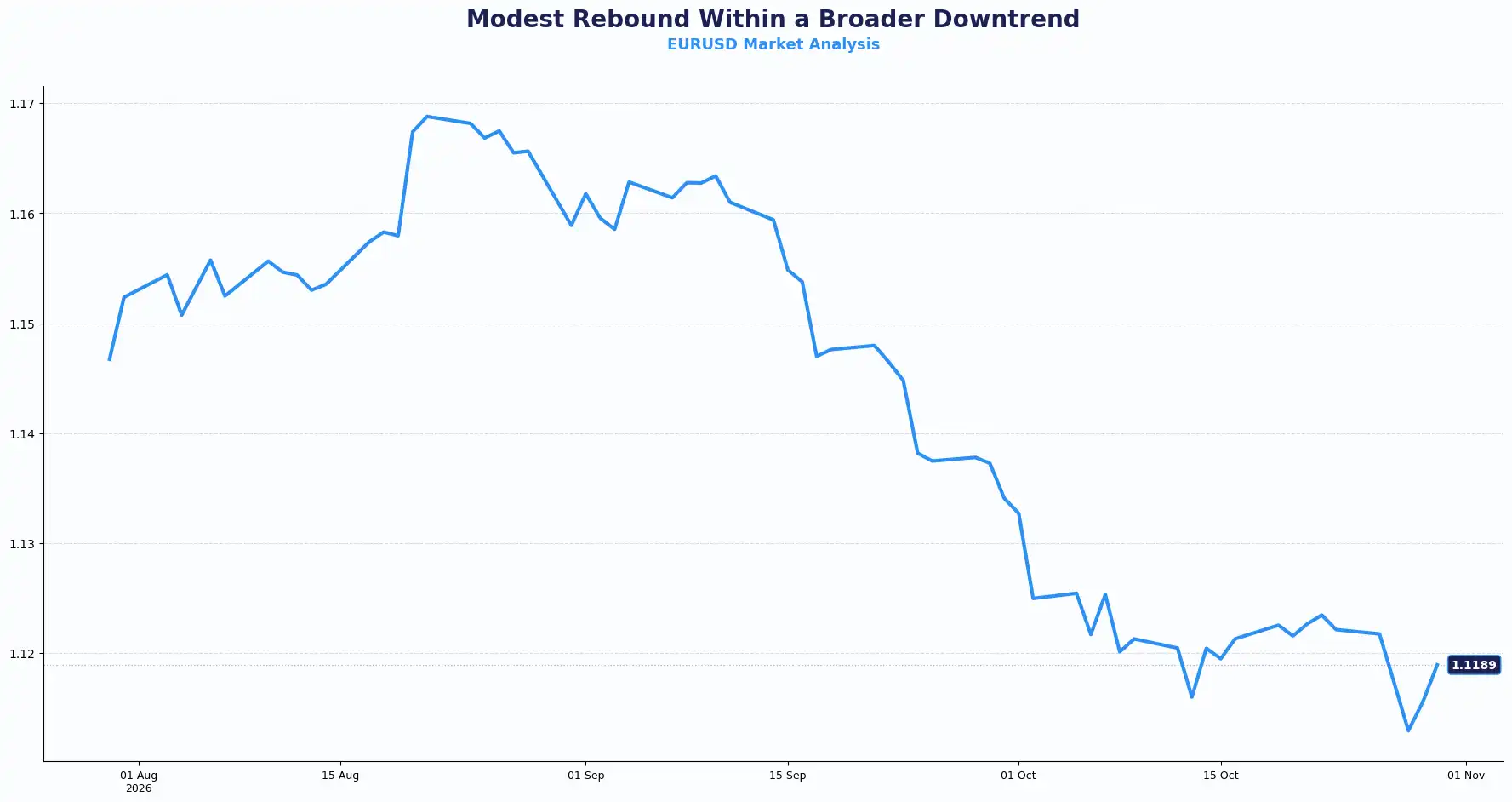
Key technical reference levels for EUR/USD: Resistance sits near 1.1200, followed by 1.1265, while support lies around 1.1135, followed by 1.1100.
USD: Dollar Retreats Despite Strong Economic Data
DXY: 101.77
The US dollar weakened for a third consecutive session, with the US Dollar Index (DXY) trading around 101.77 early Friday. Renewed concerns about artificial intelligence investment coincided with increased demand for US Treasuries, while the benchmark 10-year yield moved towards 4.90%, its lowest level in more than a month. Falling yields weighed on the dollar despite stronger US economic data, although the index remained on course for a second consecutive monthly gain.
Consumer spending expanded at an annualised rate of 3.8% in the third quarter, while business investment in equipment surged 20.9%, contributing to stronger-than-expected economic growth. However, September's inflation-adjusted consumer spending remained unchanged, while real disposable income fell 0.3%. These figures suggest that economic activity remained resilient during the third quarter, although household spending momentum weakened towards its end.
Interest-rate markets continued to anticipate a December Federal Reserve (Fed) rate hike, although the implied probability eased to approximately 75% from 84.2% a day earlier. The dollar's pullback coincided with declining Treasury yields and changing rate expectations, while inflation pressures remained elevated. Upcoming US labour-cost data could provide further direction for Fed rate expectations.
Other Currencies: Yen Strengthens Following BoJ Rate Hold
AUD/USD: 0.7042 | NZD/USD: 0.5640 | USD/JPY: 157.20 | GBP/JPY: 210.65
The Japanese yen strengthened on Friday after the Bank of Japan (BoJ) held its policy rate at 1.25% while signalling that further tightening remains possible. The decision passed by an 8-1 vote, with one policymaker supporting an immediate rate hike. USD/JPY briefly fell towards 157.12, while GBP/JPY traded around 210.65 as the yen's gains partly offset sterling's recovery against the US dollar.
Tokyo's October core inflation stood at 2.6%, remaining above the BoJ's 2% target. The central bank also raised its core inflation forecast for the fiscal year ending March 2028 to 2.6% from 2.4%. These developments may have influenced expectations of another rate hike, while the yen's gains coincided with declining US Treasury yields.
Elsewhere, the Australian dollar gained approximately 0.2% against the US dollar. Australian producer prices rose 1.1% during the September quarter and 3.6% annually, keeping inflation pressures in focus ahead of next week's Reserve Bank of Australia decision. The New Zealand dollar also edged higher to approximately $0.5640 amid broader US dollar weakness.
Current Rate Table
| Currency Pair | Rate | Trend |
|---|---|---|
| GBP/USD | 1.3403 | Mildly bullish GBP |
| EUR/GBP | 0.8345 | Bearish EUR |
| EUR/USD | 1.1189 | Mildly bullish EUR |
| USD/JPY | 157.20 | Mildly bearish USD |
| AUD/USD | 0.7042 | Mildly bullish AUD |
| NZD/USD | 0.5640 | Consolidation |
| USD/CAD | 1.3970 | Bearish short-term |
Market Lookahead
Friday, 30 October
- Eurozone GDP (Q3, Preliminary)
- Germany CPI/HICP (October, Preliminary)
- US Employment Cost Index (Q3)
Monday, 2 November
- US ISM Manufacturing PMI (October)
Stay Ahead in the Currency Game
Whether you're a daily FX trader or handle international transactions regularly, our 'Currency Pulse' newsletter delivers the news you need to make more informed decisions. Receive concise updates and in-depth insights directly in your LinkedIn feed.
Subscribe to 'Currency Pulse' now and never miss a beat in the currency markets!
Ready to act on today’s insights? Get a free quote or give us a call on: +44 (0)20 7740 0000 to connect with a dedicated portfolio manager for tailored support.
Important Disclaimer: This blog is for informational purposes only and should not be considered financial advice. Currency Solutions does not take into account the investment objectives, financial situation, or specific needs of individual readers. We do not endorse or recommend any specific financial strategies, products, or services mentioned in this content. Forward contracts can help businesses manage foreign exchange exposure by providing greater certainty over future exchange rates, although they may also mean that businesses do not benefit from favourable exchange-rate movements. Businesses should consider their individual circumstances and speak with their dealer to understand how forward contracts may support their specific foreign exchange requirements. All information is provided “as is” without any representations or warranties, express or implied, regarding its accuracy, completeness, or timeliness.