US Inflation Rises to 3.7% While US Dollar Reverses Earlier Gains
8 min read
Share


The US dollar initially strengthened on Wednesday after US annual inflation rose to 3.7% in September, up from 3.4% in August and above expectations of 3.6%. Core inflation also increased to 2.6%, potentially influencing expectations of further Federal Reserve (Fed) tightening. The US Dollar Index (DXY) climbed towards 102.90 following the release before reversing its gains and falling towards 101.99 in early Thursday trading as US Treasury yields declined.
San Francisco Fed President Mary Daly said further interest-rate increases may be necessary but indicated there was no urgency to act at the October meeting. Meanwhile, the Fed's Beige Book reported intensifying price pressures, particularly from higher fuel costs, while businesses remained cautious about hiring. These developments highlighted continued inflation risks alongside uncertainty over the timing of further tightening.
Sterling recovered against the dollar in early Thursday trading, with GBP/USD moving towards 1.3230. Bank of England (BoE) Chief Economist Huw Pill questioned market expectations for four interest-rate increases over the coming year. The euro also recovered, with EUR/USD approaching 1.1215 after falling towards 1.1100 during Wednesday's session.
Thursday's US producer-price and retail-sales figures could provide further direction for Fed rate expectations and major currency pairs.
GBP: Sterling Recovers as BoE's Pill Questions Rate-Hike Expectations
GBP/USD: 1.3252 | EUR/GBP: 0.8462
Sterling recovered against the US dollar during early Thursday trading, with GBP/USD climbing towards 1.3252 after falling below 1.3150 on Wednesday. The earlier decline followed stronger-than-expected US inflation figures, which increased expectations for further Fed interest-rate tightening. However, the sterling subsequently recovered alongside a retreat in US Treasury yields and more cautious Fed commentary, although broader uncertainty over interest-rate expectations remained.
BoE Chief Economist Huw Pill questioned market expectations for four interest-rate increases over the coming year. While acknowledging that underlying UK inflation remained elevated and economic activity had demonstrated resilience, Pill expressed scepticism about the scale of tightening reflected in market pricing. Interest-rate markets continued to anticipate a quarter-percentage-point BoE increase in November, followed by further increases during 2027. His remarks highlighted uncertainty over how quickly UK borrowing costs may need to rise, particularly as higher energy prices continue to affect inflation.
Against the euro, sterling remained close to its strongest levels in approximately 16 months, although EUR/GBP recovered towards 0.8462 in early Thursday trading after reaching 0.8434 on Wednesday. At Thursday's 07:00 BST reporting cut-off, fresh UK GDP figures showed that the economy grew by 0.1% in August, exceeding expectations of a 0.1% contraction. Production increased by 0.8%, while services output was unchanged. The figures provide additional evidence of economic resilience, although the initial currency reaction falls outside the reporting window. Thursday's US producer-price and retail-sales figures could also influence GBP/USD through changes in Fed rate expectations.
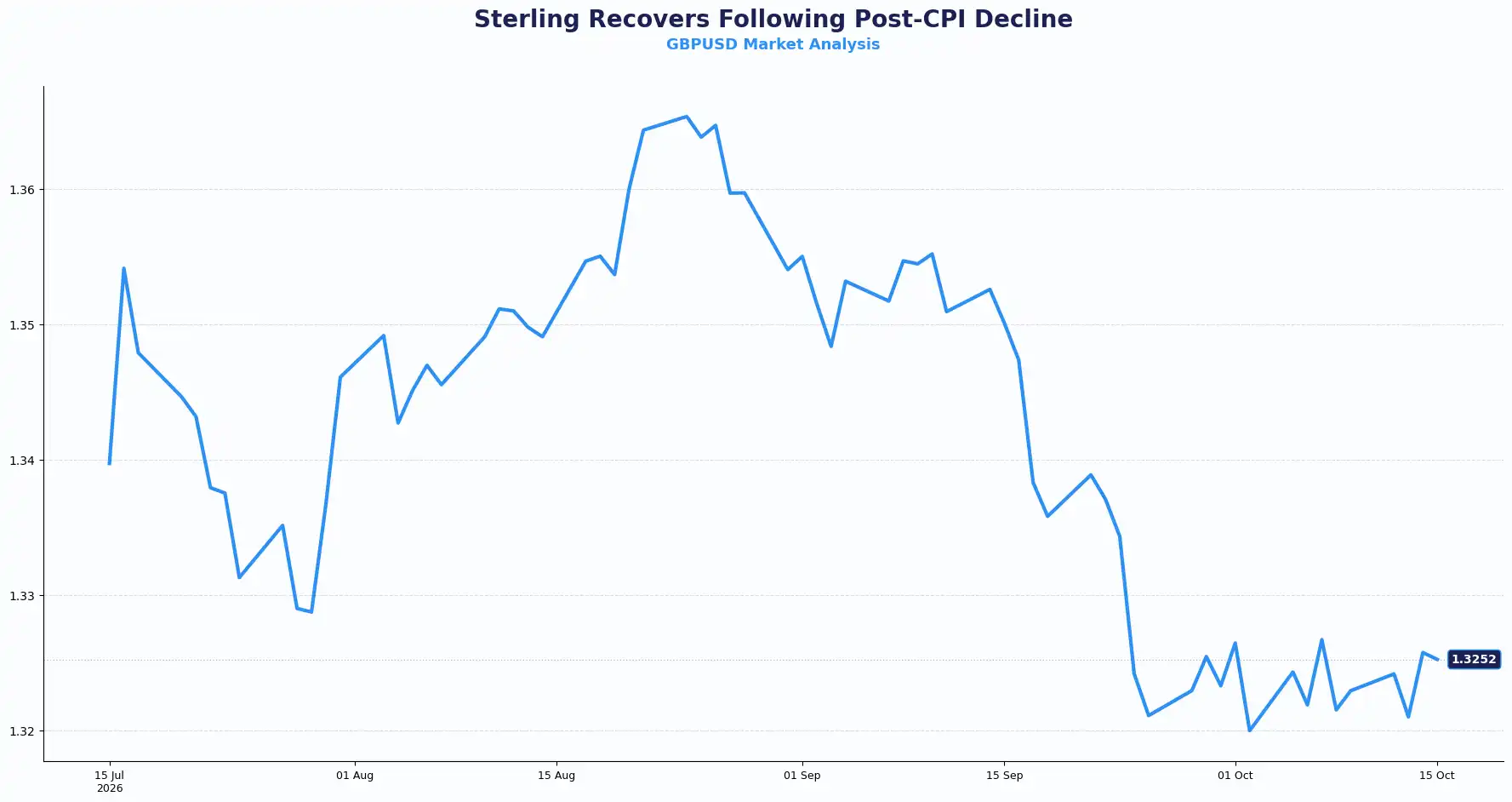
Key technical reference levels for GBP/USD: Resistance sits near 1.3255, followed by 1.3360, while support sits around 1.3200, followed by 1.3145.
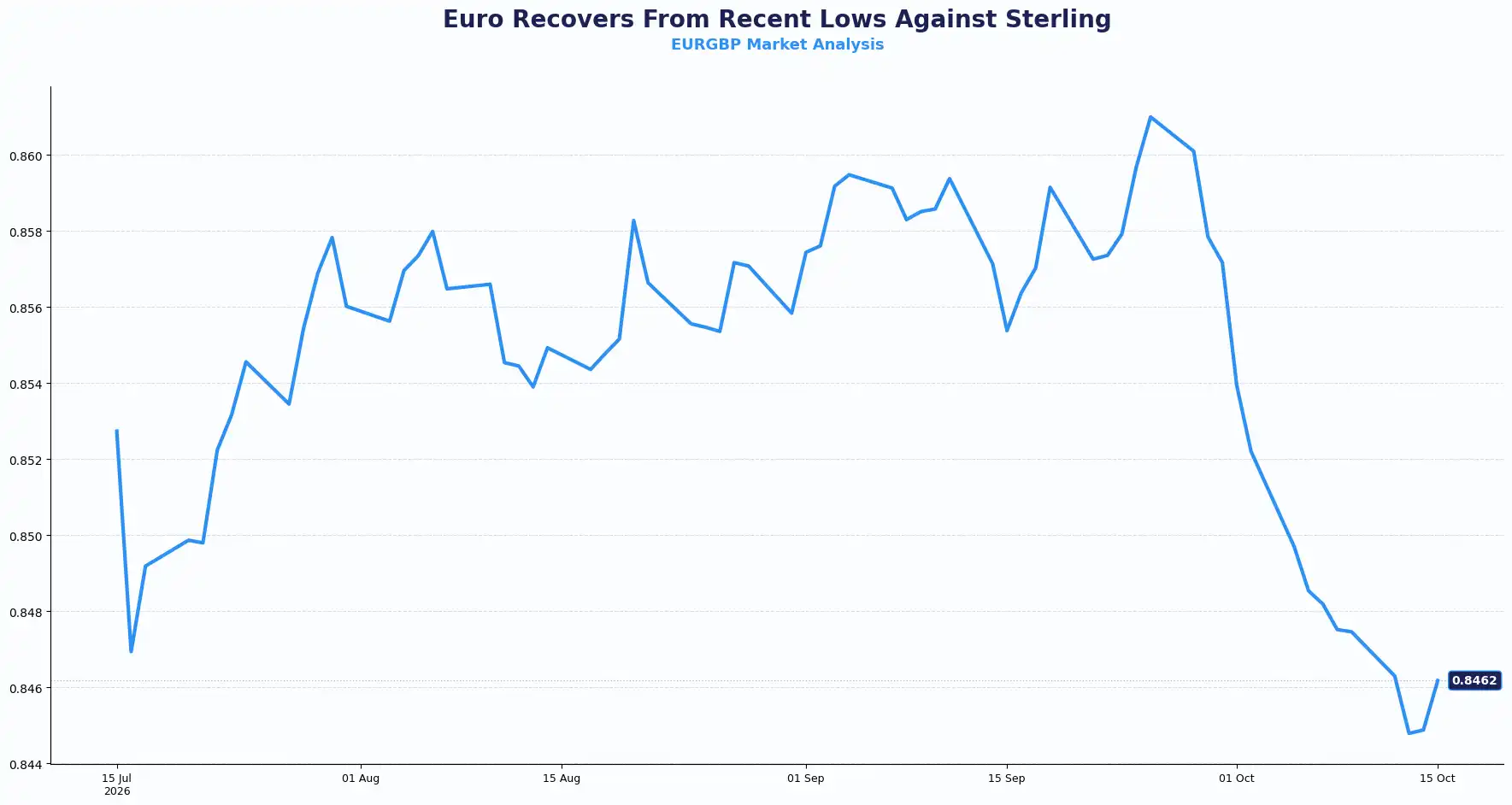
Key technical reference levels for EUR/GBP: Resistance sits near 0.8500, followed by 0.8527, while support sits around 0.8434, followed by 0.8405.
EUR: Euro Recovers as ECB Weighs Inflation and Tighter Financial Conditions
EUR/USD: 1.1216
The euro recovered against the US dollar during early Thursday trading, with EUR/USD climbing towards 1.1216 after falling to just above 1.1100 on Wednesday, its lowest level in approximately 17 months. The earlier decline followed stronger-than-expected US inflation figures, which increased market expectations for further Fed interest-rate tightening. However, the subsequent decline in US Treasury yields and more cautious comments from Fed policymakers coincided with the euro's recovery, although uncertainty surrounding future US interest rates remained.
European Central Bank (ECB) Governing Council member Primož Dolenc said that tighter financial conditions could reduce the need for additional monetary-policy action. He noted that financial markets had undergone considerable repricing and suggested that the ECB was approaching restrictive territory, although he did not consider that point fully reached. His remarks highlighted how rising borrowing costs could influence future interest-rate decisions, alongside the ECB's assessment of inflation and economic activity.
Fresh European inflation data also highlighted continued price pressures. Spain's National Statistics Institute reported that annual harmonised inflation increased to 5.0% in September from 4.6% in August, while core inflation rose to 3.1% from 2.9%. Separately, Germany's Federal Statistical Office reported that wholesale prices increased 1.9% month-on-month in September, compared with a 0.9% rise in August, partly reflecting higher energy and intermediate-goods costs. These figures add to the inflation evidence being assessed ahead of the ECB's next policy decision, although they do not establish an immediate market reaction.
Attention now turns to Thursday's US producer-price and retail-sales figures, followed by Friday's final eurozone inflation data. These releases could influence expectations for future Fed and ECB interest-rate decisions and the near-term direction of EUR/USD.
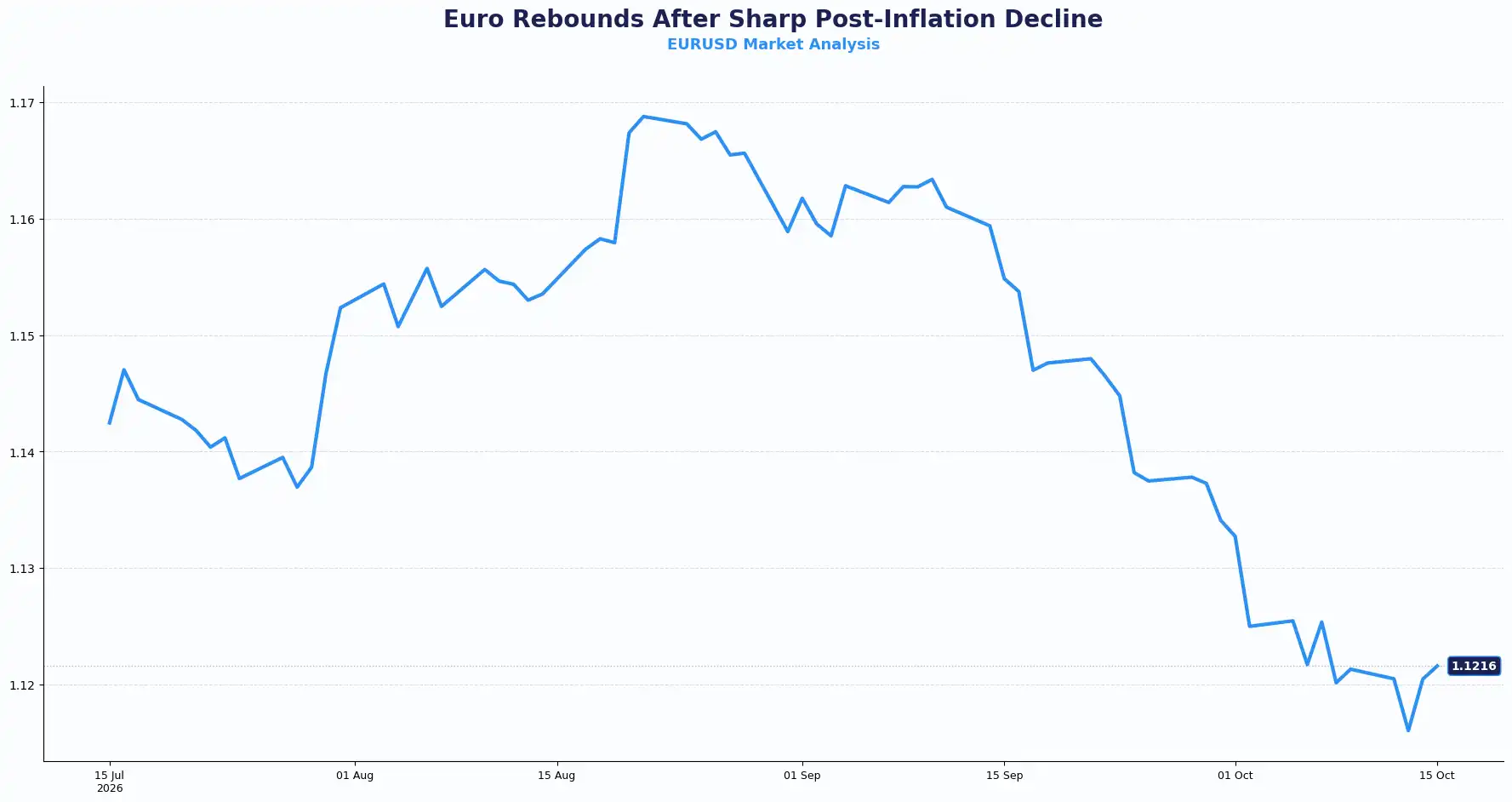
Key technical reference levels for EUR/USD: Resistance sits near 1.1220, followed by 1.1270, while support sits around 1.1150, followed by 1.1100.
USD: Dollar Retreats as Treasury Yields Fall Despite Higher Inflation
DXY: 101.99
The US dollar reversed its earlier gains following Wednesday's stronger-than-expected inflation report, with the DXY falling towards 101.99 in early Thursday trading after reaching approximately 102.95 during the previous session. The reversal coincided with a decline in US Treasury yields, with the 10-year yield easing towards 5.10% as demand for government bonds increased amid weakness in technology stocks. Lower yields reduced some of the support previously provided to the dollar by expectations of further Fed tightening.
Although September's inflation figures initially increased expectations for an October Fed rate rise, subsequent market pricing indicated a more cautious assessment. According to CME FedWatch-based estimates, the market-implied probability of an October increase rose sharply immediately after the release but had moderated to approximately 27% by early Thursday, compared with around 22% before the figures were published. The change suggested that investors continued to distinguish between persistent inflation pressures and the timing of the Fed's next policy decision.
San Francisco’s Fed said further interest-rate increases would probably be required to contain inflation but indicated there was no urgency to act at the October meeting. Fed Vice Chair Michelle Bowman similarly argued that policymakers had time to assess economic and financial developments before making further adjustments. Their comments reflected individual policy assessments rather than a confirmed decision by the Fed.
Meanwhile, the Fed's latest Beige Book reported intensifying price pressures linked to higher fuel costs, particularly across transport, agriculture and other energy-sensitive industries. Employment conditions remained broadly stable, although businesses were limiting recruitment rather than undertaking widespread layoffs. These findings highlighted persistent inflation risks alongside a cautious labour-market environment.
Thursday's US Producer Price Index (PPI) and retail-sales figures could provide further evidence on inflation pressures and consumer demand, potentially influencing Fed rate expectations and the dollar's near-term direction.
Other Currencies: Australian Dollar Falls While Yen Strengthens
AUD/USD: 0.6953 | USD/JPY: 157.60
The Australian dollar weakened against the US dollar during early Thursday trading, with AUD/USD falling towards 0.6953 following a sharper-than-expected decline in Australian employment. According to the Australian Bureau of Statistics (ABS), employment fell by 39,300 in September, compared with market expectations for an increase of approximately 20,000. The unemployment rate stood at 4.7%, while the participation rate declined to 66.8%, indicating softer labour-market conditions.
The employment decline was concentrated in part-time positions, which fell by 73,700, partly offset by an increase of 34,400 full-time jobs. Following the release, interest-rate markets reduced expectations for further Reserve Bank of Australia (RBA) tightening, with the market-implied probability of a November rate increase falling to approximately 10%. Expectations for a December increase also moderated to around 32%. The figures introduced additional uncertainty around the RBA's next policy decision, particularly as policymakers continue to assess elevated inflation alongside signs of weaker employment growth.
Meanwhile, the Japanese yen strengthened against the US dollar, with USD/JPY declining towards 157.60 during early Thursday trading. The movement coincided with falling US Treasury yields and fresh comments from Bank of Japan (BoJ) policy board member Junko Koeda, who cautioned against excessive hesitation in raising interest rates. Koeda highlighted upside inflation risks from yen depreciation, stronger global artificial intelligence demand and Middle East developments, while maintaining that Japanese financial conditions remained accommodative.
Koeda also said interest rates should be adjusted in a timely manner according to economic and inflation conditions, without committing to a specific timetable. Her remarks added to the discussion surrounding potential further BoJ tightening, although they did not represent a formal policy decision. Attention now turns to upcoming US economic releases and the BoJ's October policy meeting, which could influence interest-rate expectations and USD/JPY movements.
Current Rate Table
| Pair | Rate | Trend |
|---|---|---|
| GBP/USD | 1.3252 | Mildly bullish GBP |
| EUR/GBP | 0.8462 | Mildly bullish EUR |
| EUR/USD | 1.1216 | Mildly bullish EUR |
| USD/JPY | 157.60 | Bearish USD short-term |
| AUD/USD | 0.6953 | Bearish AUD |
| NZD/USD | 0.5635 | Mildly bullish NZD |
| USD/CAD | 1.4210 | Mildly bearish USD |
Market Lookahead
Thursday, 15 October
- US Producer Price Index & Core PPI (September)
- US Retail Sales & Core Retail Sales (September)
- US Fed Officials Bowman and Hammack Remarks
Friday, 16 October
- BoE Governor Andrew Bailey Remarks
- US Fed Chair Kevin Warsh Remarks
- Eurozone HICP & Core HICP (September, Final)
- US Industrial Production (September)
Stay Ahead in the Currency Game
Whether you're a daily FX trader or handle international transactions regularly, our 'Currency Pulse' newsletter delivers the news you need to make more informed decisions. Receive concise updates and in-depth insights directly in your LinkedIn feed.
Subscribe to 'Currency Pulse' now and never miss a beat in the currency markets!
Ready to act on today’s insights? Get a free quote or give us a call on: +44 (0)20 7740 0000 to connect with a dedicated portfolio manager for tailored support.
Important Disclaimer: This blog is for informational purposes only and should not be considered financial advice. Currency Solutions does not take into account the investment objectives, financial situation, or specific needs of individual readers. We do not endorse or recommend any specific financial strategies, products, or services mentioned in this content. Forward contracts can help businesses manage foreign exchange exposure by providing greater certainty over future exchange rates, although they may also mean that businesses do not benefit from favourable exchange-rate movements. Businesses should consider their individual circumstances and speak with their dealer to understand how forward contracts may support their specific foreign exchange requirements. All information is provided “as is” without any representations or warranties, express or implied, regarding its accuracy, completeness, or timeliness.