European Bond Sell-Off Adds Pressure to Sterling and Euro
6 min read
Share


European bond markets came under renewed pressure on Thursday, while sterling and the euro also weakened as government borrowing costs moved higher. In the UK, the 30-year gilt yield rose above 6% for the first time since 1998, while longer-dated French yields also climbed amid continued market attention on the country’s fiscal position.
The pressure was reflected in currency markets. GBP/USD fell below 1.3200 during the session, while EUR/USD slipped towards its weakest levels since May 2025. The French-German 10-year yield spread also widened further, consistent with heightened investor concern around France’s public finances, while the euro also weakened.
In the US, fresh data showed continued strength in parts of the economy. Initial Jobless Claims fell to 197,000, while the ISM Manufacturing PMI remained in expansion territory at 54.5. The survey’s Prices Paid component also rose to 77.9, indicating continued input-cost pressures, while the US dollar remained near recent highs.
Attention now turns to Friday’s Eurozone inflation figures and US labour-market data, including Nonfarm Payrolls, Average Hourly Earnings and the Unemployment Rate, which may influence near-term market expectations for European Central Bank (ECB) and Federal Reserve (Fed) policy.
GBP: Sterling Trades Near Recent Lows as UK Borrowing Costs Rise
GBP/USD: 1.3212 | EUR/GBP: 0.8523
Sterling remained close to recent lows against the US dollar on Friday morning after GBP/USD fell below 1.3200 during Thursday’s session. The move coincided with a broader rise in government borrowing costs, with the UK 30-year gilt yield climbing above 6% for the first time since 1998 and the 10-year yield reaching its highest level since 2007.
Bank of England (BoE) policymaker Catherine Mann said that real financial conditions remained insufficiently tight, and said that part of the rise in market interest rates reflected higher inflation-risk and policy-uncertainty premia. Her comments represented her individual assessment and did not necessarily reflect the view of the Monetary Policy Committee as a whole.
UK manufacturing provided limited support, with the final September Manufacturing PMI came in at 51.9, slightly below the earlier flash estimate of 52.0, while remaining above the 50 level associated with expansion under the survey methodology. The next significant scheduled external release for sterling is Friday’s US labour-market report, which may affect Federal Reserve rate expectations, the US dollar and GBP/USD.
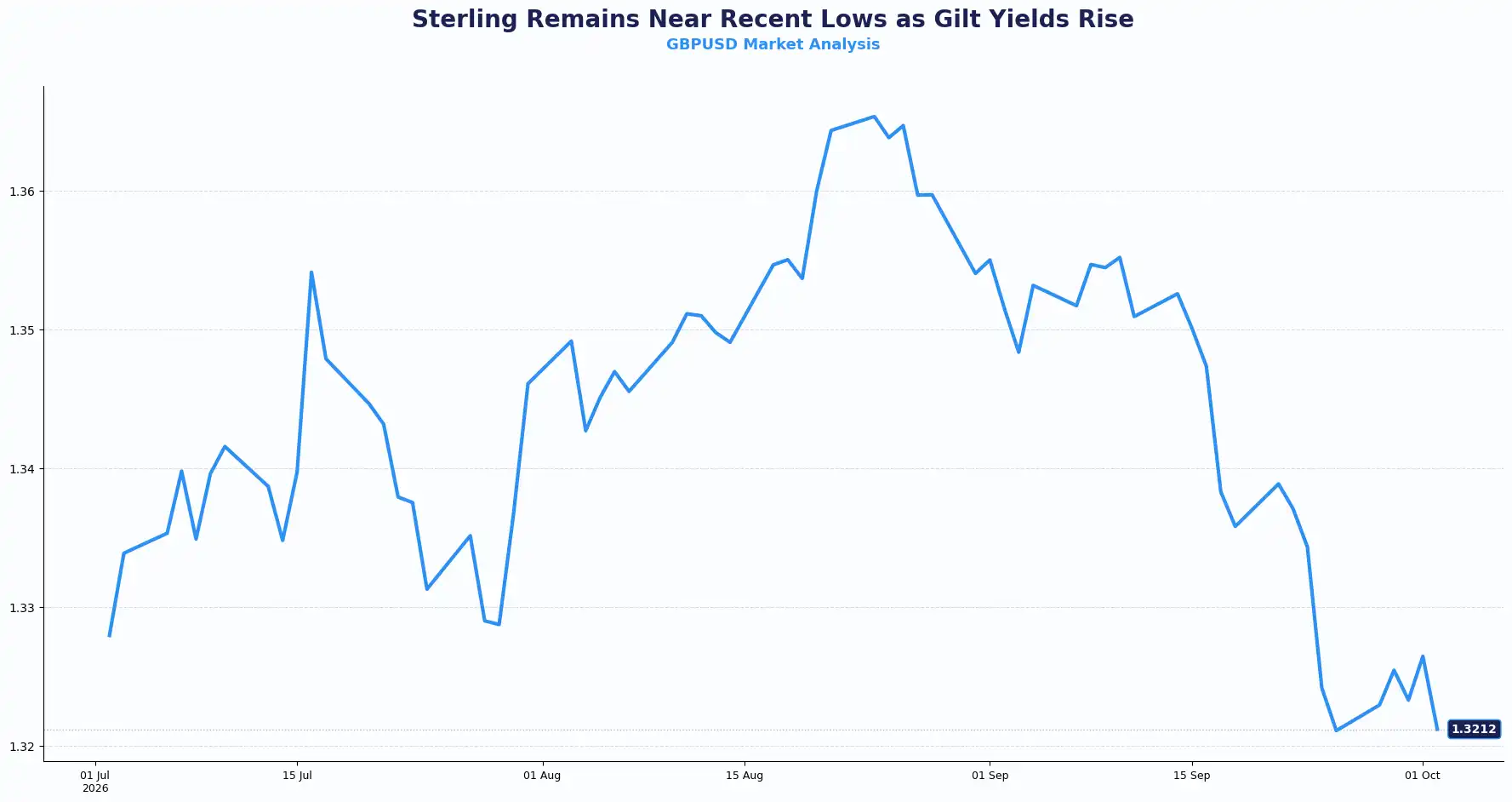
Key technical reference levels for GBP/USD: Resistance sits near 1.3250, followed by 1.3300, while support sits around 1.3140, followed by 1.3100.
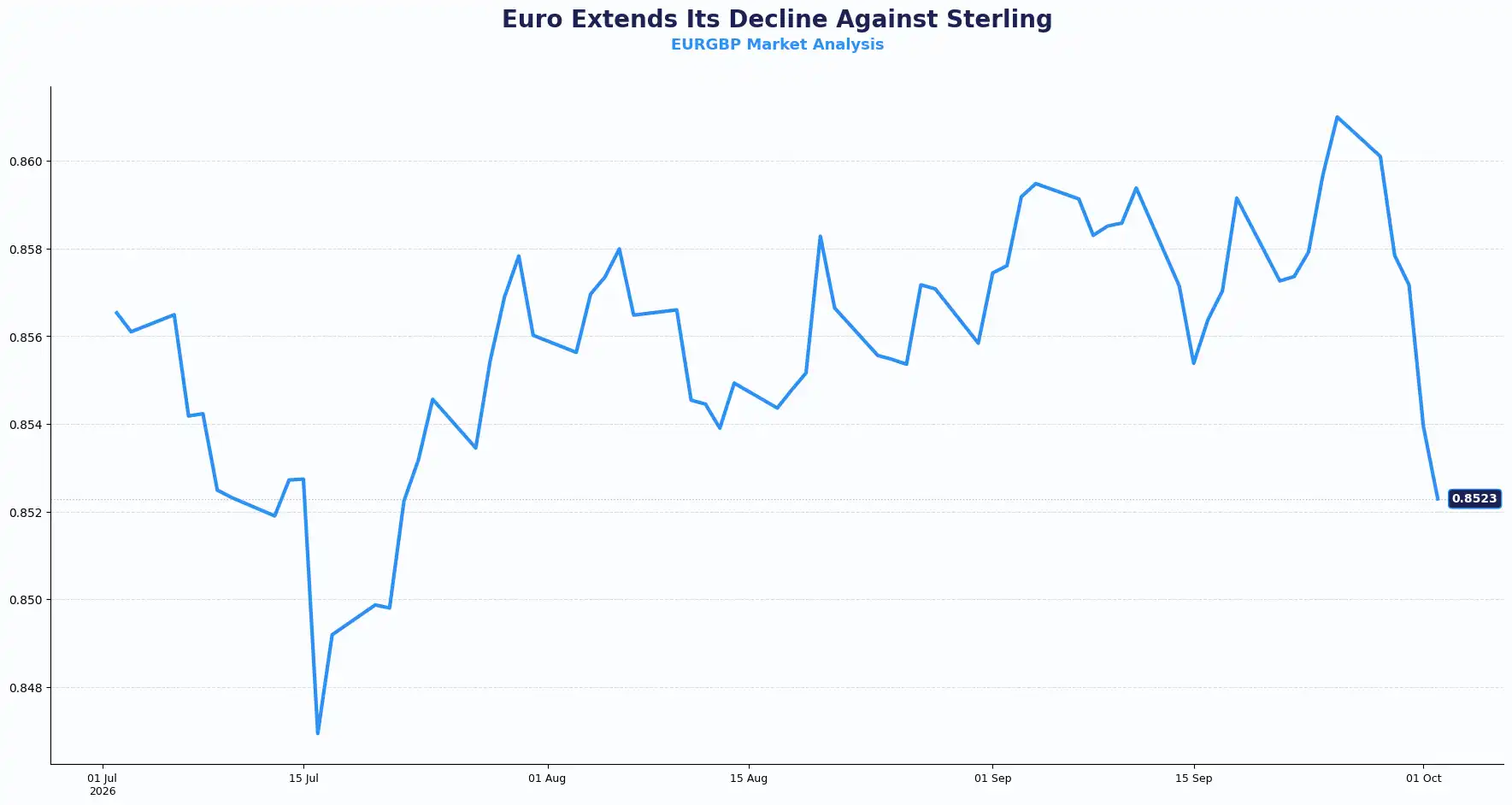
Key technical reference levels for EUR/GBP: Resistance sits near 0.8530, followed by 0.8550, while support sits around 0.8515, followed by the 0.8480-0.8490 area.
EUR: Euro Trades Near Recent Lows as French Fiscal Concerns Persist
EUR/USD: 1.1263
The euro remained under pressure against the US dollar on Friday morning after EUR/USD fell to around 1.1215 during Thursday’s session, its lowest level since May 2025. France’s fiscal position remained a focus for market participants, with the spread between French and German 10-year government bond yields widening to around 133 basis points, around its widest level since the euro-area debt crisis.
ECB policymaker Joachim Nagel said the central bank remains focused on maintaining price stability rather than targeting individual sovereign bond spreads. The comments came as investors assessed the possible implications of wider French borrowing costs for euro-area financial conditions.
Eurozone manufacturing data showed a further improvement, with the September Manufacturing PMI rising to 52.9 from 52.7, its highest level since May 2022. The euro nevertheless remained near recent lows against the US dollar. Attention now turns to Friday’s preliminary Eurozone inflation figures, which may influence near-term market expectations for ECB policy.
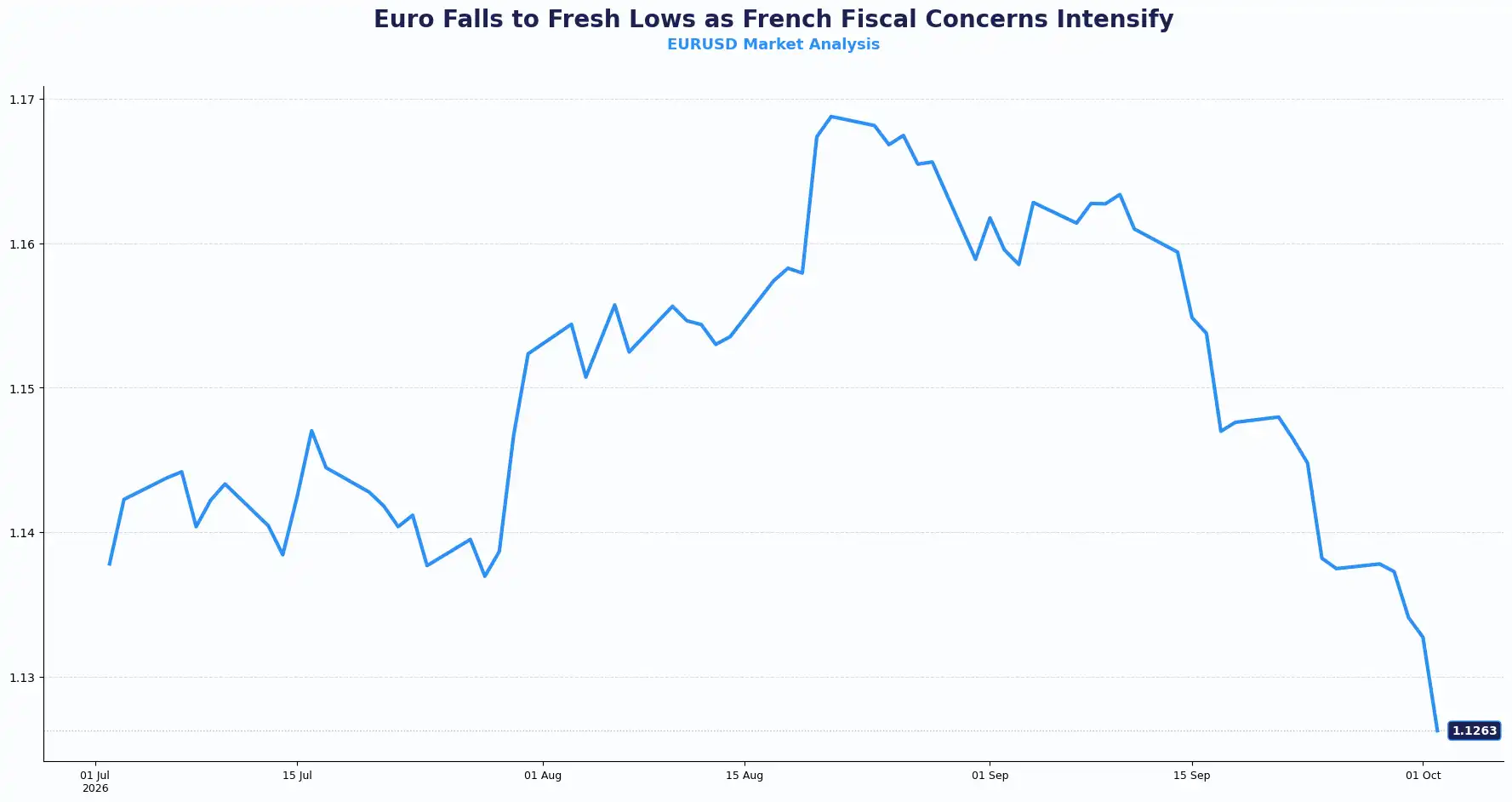
Key technical reference levels for EUR/USD: Resistance sits near 1.1325, followed by 1.1423, while support sits around 1.1200, followed by 1.1100.
USD: Dollar Trades Near Recent Highs Following US Data
DXY: 101.9
The US dollar remained close to a 17-month high on Friday morning after fresh economic data showed continued strength in parts of the US economy. Initial Jobless Claims fell to 197,000 in the latest week, while announced layoffs also declined in September, while announced layoffs also declined in September.
Manufacturing data also showed a faster increase in reported input prices. The ISM Manufacturing PMI came in at 54.5 in September, remaining above the 50 level that separates expansion from contraction, while the Prices Paid component rose to 77.9 from 71.1. The releases coincided with the dollar remaining near recent highs during Thursday’s session.
Despite the stronger data, market-implied expectations for an October Fed rate increase declined following recent Federal Reserve commentary. At the relevant market-data snapshot, interest-rate markets implied approximately a 28% probability of an October increase, although such market-implied probabilities can change rapidly.
Attention now turns to September’s US labour-market report, including Nonfarm Payrolls, Average Hourly Earnings and the Unemployment Rate. The figures may influence market expectations for future Fed policy.
Other Currencies: Yen Firms Following Tokyo Inflation Data
AUD/USD: 0.6942 | NZD/USD: 0.5613 | USD/JPY: 157.58 | GBP/JPY: 208.55
USD/JPY has eased towards 157.80 as the yen strengthened following Tokyo inflation data that exceeded the reported market consensus. Core CPI, which excludes fresh food, accelerated to 2.7% year-on-year in September from 1.8% in August, exceeding expectations of 2.4% and reaching its highest annual rate in ten months.
A separate measure excluding both fresh food and fuel rose to 3.0% from 2.0%, showing a faster annual increase in the measure excluding fresh food and fuel. The figures are among the data the Bank of Japan (BoJ) may consider when assessing its inflation outlook and future policy decisions as it assesses the risk of inflation remaining above its target. Market expectations for the timing of any subsequent rate increase have shifted, and remain subject to incoming economic data and central-bank communication.
AUD/USD is trading around 0.6937 after falling to a three-month low during a period of broader US-dollar strength. The move occurred alongside higher global bond yields and elevated energy prices.
NZD/USD is trading near 0.5613 after touching its lowest level since November 2025. The New Zealand dollar also weakened during a period of US-dollar strength and elevated global yields, although it recovered modestly during Friday’s Asian session. Both AUD/USD and NZD/USD remained close to recent lows ahead of the US labour-market report.
Current Rates
| Pair | Rate | Trend |
|---|---|---|
| GBP/USD | 1.3212 | Bearish short-term |
| EUR/GBP | 0.8523 | Mildly bearish EUR |
| EUR/USD | 1.1263 | Bearish |
| USD/JPY | 157.58 | Mildly bearish USD |
| AUD/USD | 0.6942 | Bearish |
| NZD/USD | 0.5613 | Bearish |
| USD/CAD | 1.4223 | Bullish USD |
Market Lookahead
Friday, Oct 02
- EUR Eurozone HICP & Core HICP (Sep)
- US Nonfarm Payrolls (Sep)
- US Average Hourly Earnings (Sep)
- US Unemployment Rate (Sep)
Monday, Oct 05
- EUR Eurozone Services PMI (Sep, Final)
- GBP UK Services PMI (Sep, Final)
- US ISM Services PMI (Sep)
Stay Ahead in the Currency Game
Whether you're a daily FX trader or handle international transactions regularly, our 'Currency Pulse' newsletter delivers the news you need to make more informed decisions. Receive concise updates and in-depth insights directly in your LinkedIn feed.
Subscribe to 'Currency Pulse' now and never miss a beat in the currency markets!
Ready to act on today’s insights? Get a free quote or give us a call on: +44 (0)20 7740 0000 to connect with a dedicated portfolio manager for tailored support.
Important Disclaimer: This blog is for informational purposes only and should not be considered financial advice. Currency Solutions does not take into account the investment objectives, financial situation, or specific needs of individual readers. We do not endorse or recommend any specific financial strategies, products, or services mentioned in this content. Forward contracts can help businesses manage foreign exchange exposure by providing greater certainty over future exchange rates, although they may also mean that businesses do not benefit from favourable exchange-rate movements. Businesses should consider their individual circumstances and speak with their dealer to understand how forward contracts may support their specific foreign exchange requirements. All information is provided “as is” without any representations or warranties, express or implied, regarding its accuracy, completeness, or timeliness.