Oil Falls on Hormuz Reopening Hopes as Sterling Remains Under Pressure
6 min read
Share


Oil prices extended their decline as markets assessed fresh signs that the Strait of Hormuz could reopen. Iran has indicated that shipping through the strait could resume within seven days if the United States eases military pressure and its economic blockade, while President Donald Trump said talks with Iran were continuing. Brent crude has moved below $100 a barrel, with expectations of improved Middle East supply conditions also cited as a possible factor in the move.
Sterling remains under pressure despite the fall in energy prices, with GBP/USD trading below 1.3350 and close to its lowest level since late July. Lower oil prices could reduce some of the energy-driven inflation pressure facing the UK, which may influence expectations for further Bank of England (BoE) tightening. At the same time, the US dollar has remained firm alongside expectations of another Federal Reserve (Fed) rate increase, with the Dollar Index (DXY) trading near 100.70.
Interest-rate markets currently imply a little over a 50% probability of another Fed rate increase in October. Attention now turns to preliminary UK, Eurozone and US PMI readings, which may provide a further indication of how higher borrowing costs and recent energy-price movements are affecting economic activity.
GBP: Sterling Near July Lows as Rate Expectations Adjust
GBP/USD: 1.3312 | EUR/GBP: 0.8581
GBP/USD is trading close to 1.3312 after falling towards 1.3320 during Tuesday’s session, its lowest level since late July. Sterling has now struggled to regain the 1.3400 area for several sessions, while expectations for further Fed tightening have coincided with continued relative strength in the US dollar.
For the UK, the focus is increasingly on how the recent fall in energy prices affects expectations for the Bank of England (BoE). Interest-rate pricing has reflected lower expectations for further tightening as oil prices have moved lower, although another BoE rate increase before the end of the year is still being considered. Sterling may therefore remain sensitive to incoming UK data, particularly anything that changes the balance between inflation pressure and economic growth.
Today’s preliminary UK PMI readings may provide further information on the UK economic outlook. The Services PMI is expected at 52.0, down from 52.5, while the Manufacturing PMI is expected at 51.4, compared with 51.7 previously. The services reading may be particularly relevant to market participants assessing the outlook for BoE policy, given the BoE’s focus on domestic price pressures. A clearer slowdown in activity could reduce expectations for further tightening, while resilient readings may keep another rate increase under consideration.
EUR/GBP is trading around 0.8581, with the euro recovering some ground against sterling during Tuesday’s session. With both the UK and Eurozone releasing preliminary PMIs today, the cross may take direction from how the two sets of business-activity figures compare.
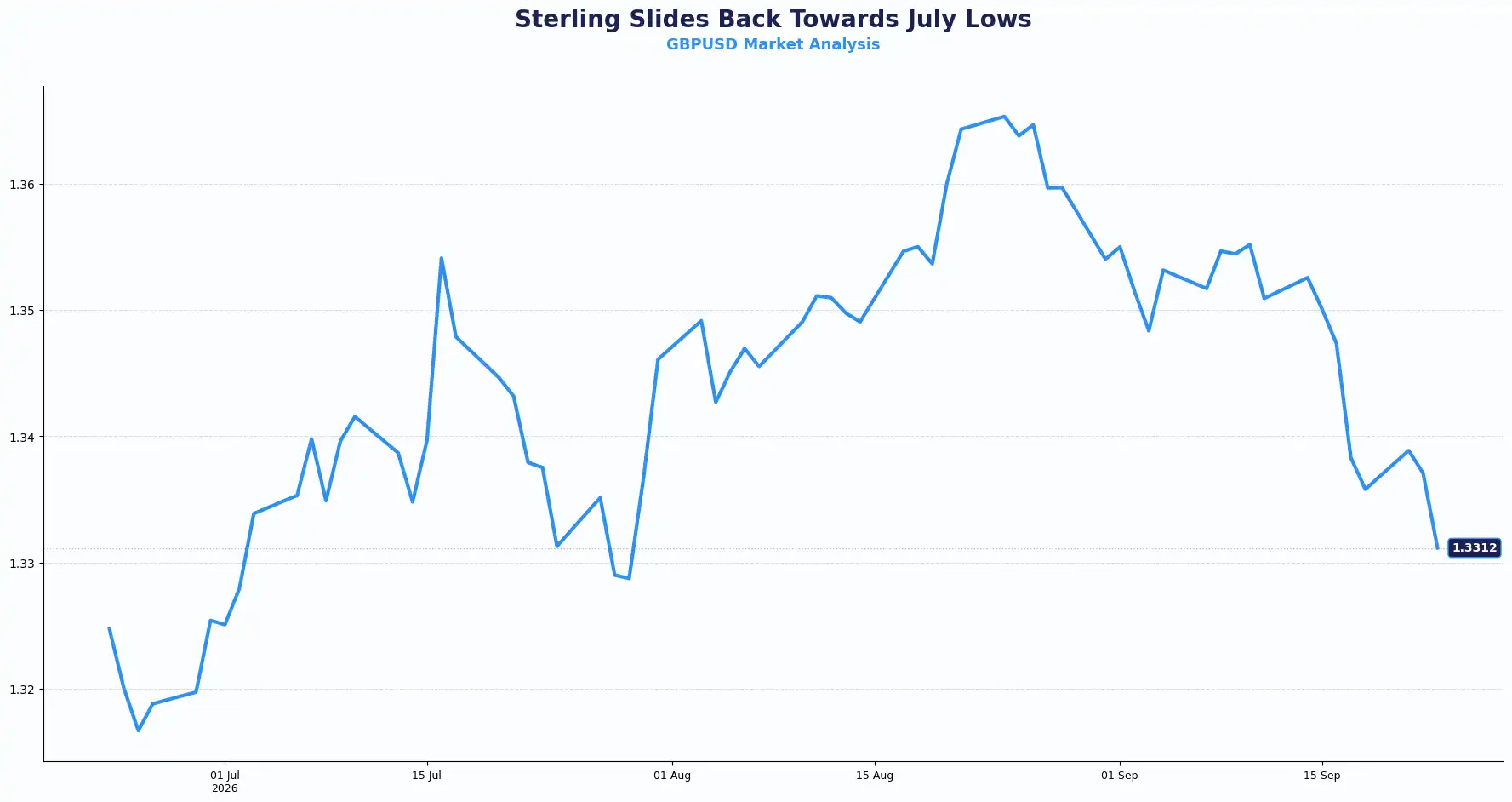
Key technical reference levels for GBP/USD: resistance sits near 1.3400, followed by 1.3450, while support sits around 1.3300, followed by 1.3200.
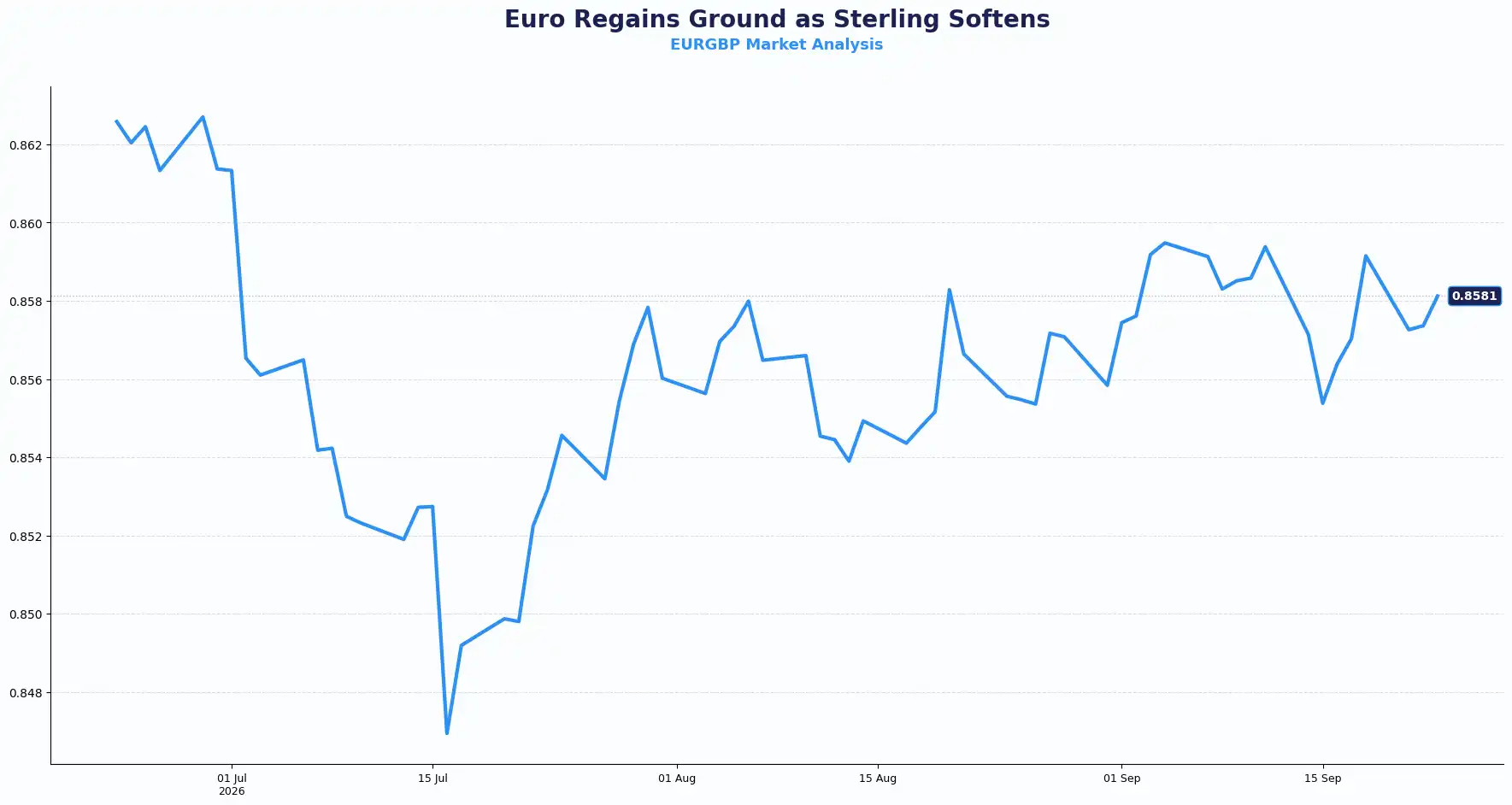
Key technical reference levels for EUR/GBP: resistance sits near 0.8593, followed by 0.8604, while support sits around 0.8578, followed by 0.8559.
EUR: German Export Pressures Add to Euro Concerns
EUR/USD: 1.1427
EUR/USD is trading close to 1.1425, its lowest level since late July, after extending its decline for a third session. The pair remains under pressure as expectations for further Fed tightening continue to support the US dollar, while domestic concerns in Europe have also coincided with pressure on the euro.
A fresh European Central Bank (ECB) assessment has highlighted growing competitive pressure from China on European manufacturers, with Germany particularly exposed because of its reliance on machinery, transport equipment and other export-heavy industries. The ECB noted that Europe has lost global export share in sectors where China has become more competitive, adding to concerns around Germany’s industrial outlook.
Eurozone consumer confidence also slipped to -16.5 in September, compared with expectations of -16.0, adding to signs that households remain cautious. At the same time, political developments in Germany have also been cited as a source of uncertainty following recent regional election setbacks for the governing CDU.
Attention now turns to today’s preliminary German and Eurozone PMI readings. The Eurozone Composite PMI is expected at 51.5, down from 52.0 previously. A weaker set of readings could add to concerns around growth, while stronger activity could help offset some of the recent pressure on the euro.
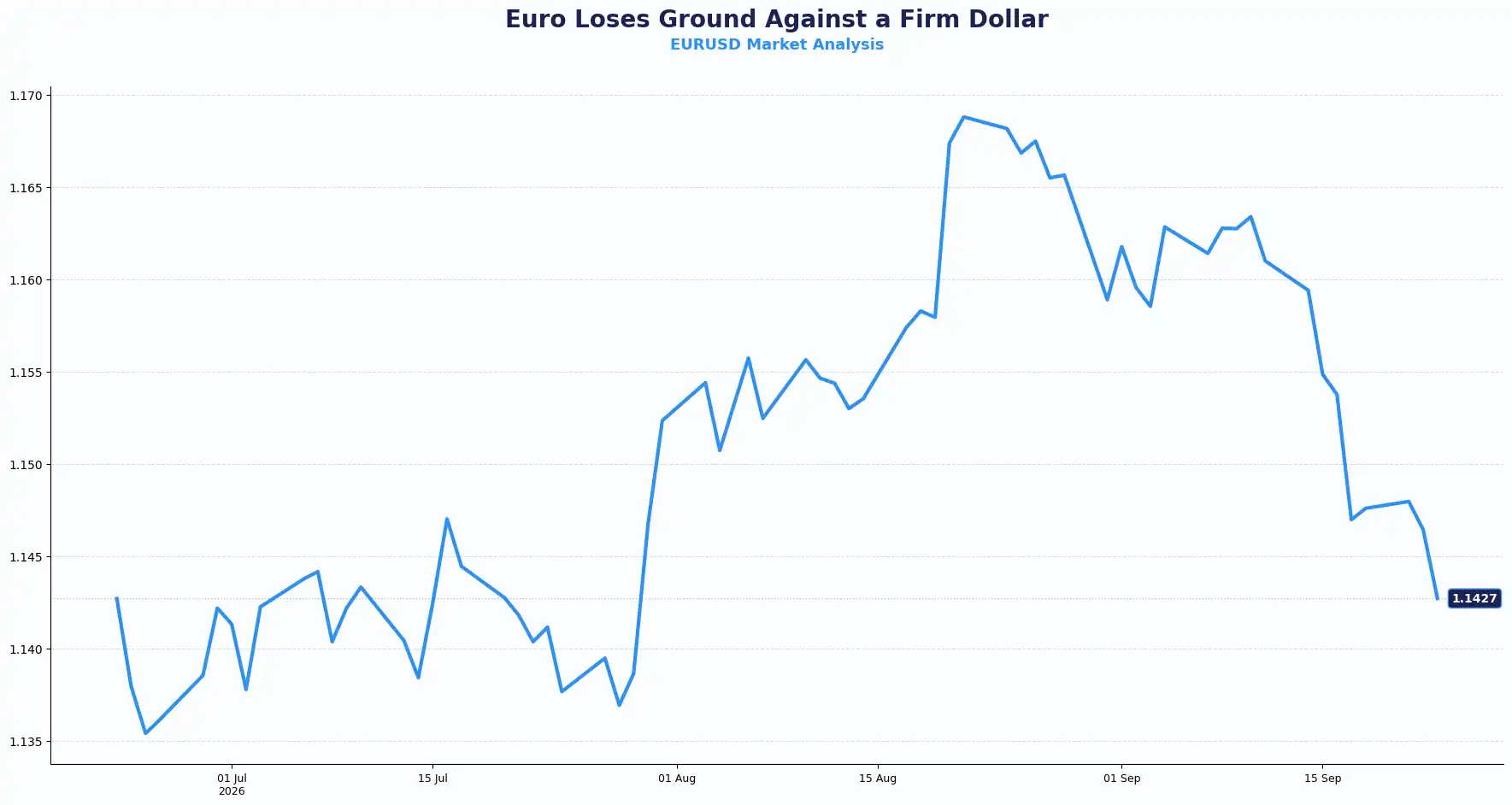
Key technical reference levels for EUR/USD: resistance sits near 1.1500, followed by 1.1550, while support sits around 1.1400, followed by 1.1350.
USD: Fed Signals Keep Dollar Near Seven-Week Highs
DXY: 100.70
The Dollar Index (DXY) is trading around 100.70, close to its highest level in seven weeks. Expectations for another Fed rate increase have coincided with continued dollar strength, with interest-rate markets continuing to indicate a possibility of further tightening before the end of the year.
Fresh comments from Fed officials have kept inflation at the centre of the rate debate. Richmond Fed President Tom Barkin said the US economy may be strengthening and that inflation pressures are no longer limited to energy and tariffs. Boston Fed President Susan Collins also supported the latest rate increase and said inflation risks remain elevated. Their comments indicate that both officials remain focused on the risk of persistent price pressures even as oil prices move lower.
At the same time, US Treasury yields have eased alongside falling oil prices, providing some balance to the dollar’s recent advance. Attention now turns to today’s preliminary US PMI readings, which will offer a fresh view of business activity and could influence expectations for the Fed’s next move.
Other Currencies: Australian Dollar Slips as Business Activity Cools
AUD/USD: 0.7110 | USD/JPY: 157.70 | NZD/USD: 0.5710
AUD/USD is trading around 0.7110, extending its decline for a third session after preliminary Australian business-activity data weakened in September. The Manufacturing PMI fell to 49.3 from 52.0, moving below the 50 level that separates expansion from contraction, while the Services PMI eased to 51.4 from 53.2. The softer readings have coincided with further weakness in the Australian dollar ahead of the Reserve Bank of Australia’s (RBA) policy decision next week.
USD/JPY is trading near 157.70, with the yen weakening further against the US dollar. Expectations for additional Fed tightening have coincided with relative dollar strength, while markets assess how quickly the Bank of Japan (BoJ) may raise rates again following its latest increase.
NZD/USD has slipped towards 0.5710 alongside broader US-dollar strength. There has been little fresh domestic data from New Zealand overnight, which may leave the currency more sensitive to broader moves in the dollar and global rate expectations.
Current Rate Table
| Pair | Rate | Trend |
|---|---|---|
| GBP/USD | 1.3312 | Bearish short-term |
| EUR/GBP | 0.8581 | Mildly bullish EUR |
| EUR/USD | 1.1427 | Bearish short-term |
| USD/JPY | 157.70 | Mildly bullish USD |
| AUD/USD | 0.7110 | Neutral to bearish |
| NZD/USD | 0.5710 | Bearish short-term |
| USD/CAD | 1.4070 | Mildly bullish USD |
Market Lookahead
Wednesday, Sep 23
- Germany & Eurozone HCOB Composite & Services PMI (Sep)
- S&P Global Composite & Services PMI (Sep)
- S&P Global Services PMI (Sep)
Thursday, Sep 24
- Germany Ifo Business Climate (Sep)
- US Initial Jobless Claims
Friday, Sep 25
- US Durable Goods Orders (Aug)
Stay Ahead in the Currency Game
Whether you're a daily FX trader or handle international transactions regularly, our 'Currency Pulse' newsletter delivers the news you need to make more informed decisions. Receive concise updates and in-depth insights directly in your LinkedIn feed.
Subscribe to 'Currency Pulse' now and never miss a beat in the currency markets!
Ready to act on today’s insights? Get a free quote or give us a call on: +44 (0)20 7740 0000 to connect with a dedicated portfolio manager for tailored support.
Important Disclaimer: This blog is for informational purposes only and should not be considered financial advice. Currency Solutions does not take into account the investment objectives, financial situation, or specific needs of individual readers. We do not endorse or recommend any specific financial strategies, products, or services mentioned in this content. Forward contracts can help businesses manage foreign exchange exposure by providing greater certainty over future exchange rates, although they may also mean that businesses do not benefit from favourable exchange-rate movements. Businesses should consider their individual circumstances and speak with their dealer to understand how forward contracts may support their specific foreign exchange requirements. All information is provided “as is” without any representations or warranties, express or implied, regarding its accuracy, completeness, or timeliness.