October 2026 Market Outlook for GBP, EUR and USD
9 min read
Share


Key Takeaways
-
GBP: Cable has lost its $1.33 handle despite a hawkish pivot from the BoE, which has laid the groundwork for a November hike. The 28 October Budget is the key domestic event risk.
-
EUR: The ECB hiked to 2.50% in September, with further tightening more likely in December than October. Energy prices and low gas storage remain the key headwinds.
-
USD: A unanimous Fed hike and strong data have revived the ‘US exceptionalism’ theme. A second hike is likely by year-end, and could come as soon as October.
GBP
Sterling ended September with its worst monthly performance against the greenback in almost a year, with cable having slipped around 2% over the last few weeks. Spot has surrendered its $1.33 handle, trading at its lowest level since early summer.
Meanwhile, in the crosses, the quid has had a considerably quieter time of things, with GBP/EUR essentially trading flat for the second month running and continuing to gyrate in an ever-tighter range around the €1.16 figure.
Interestingly, the pound struggled as the summer came to an end, despite a notably hawkish pivot from the Bank of England, with policymakers having now laid the foundations for a 25bp Bank Rate increase as soon as the next meeting in November. While Bank Rate was held at 3.75% last time out, policymakers’ patience is clearly wearing thin, with Governor Bailey and his colleagues explicitly flagging that policy will likely need to tighten if energy prices remain elevated for a prolonged period, as is proving to be the case.
Of most importance is that the majority of MPC members no longer see the emergence of second-round effects as a prerequisite for a tighter policy stance. Instead, with conflict in the Middle East having now dragged on for over seven months, and with other major central banks having already begun to tighten policy, the ‘Old Lady’ is unlikely to be able to sit on her hands for much longer.
Higher energy prices – not only crude oil, but also distillates and natural gas – will continue to put upward pressure on inflation through year-end. Headline CPI rose to just above 3% YoY in August and is likely to climb marginally above 4% YoY at the start of next year. Underlying inflation metrics, however, have proved stable in recent months, likely reflecting a dour demand backdrop in which businesses feel unable to pass higher input costs on to customers.
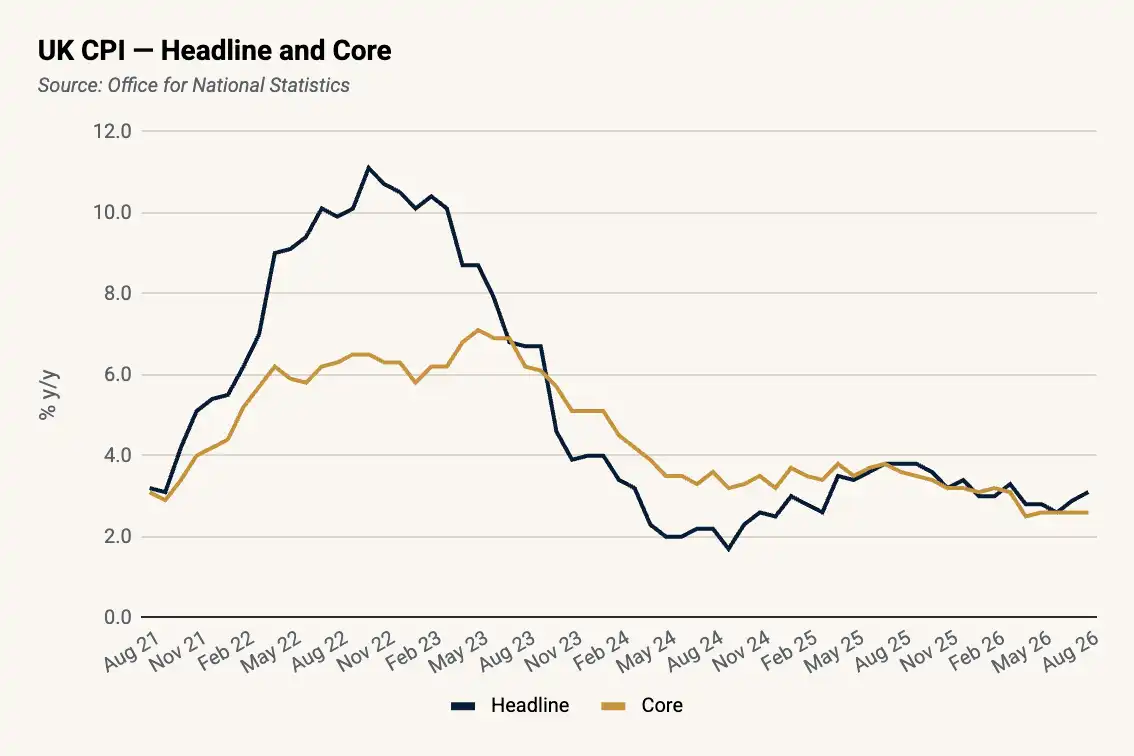
The fragile demand backdrop is also reflected in the latest labour market data. While headline unemployment held steady at 4.9% in the three months to July, private sector earnings growth continues to run at target-consistent levels, further reducing the risk of second-round inflationary effects from the energy price shock. Furthermore, PAYE payrolls fell for the third consecutive month in August, while vacancies dropped to a five-year low – a sign that businesses continue to batten down the hatches.
Looking ahead, October’s main event will be the Budget on the 28th. Chancellor Healey is likely to need to fill a ‘black hole’ of around £20bn in order to rebuild headroom against the fiscal rules to the level at which it stood in early March. While the gilt market is desperate to see the Government display a degree of spending restraint, the gap is likely to be plugged by a smorgasbord of tax hikes. With the main levers of income tax, National Insurance and VAT having been ruled out, HM Treasury will need to tinker with a host of smaller revenue-raising measures.
Once the Budget is announced, market participants will focus on two key factors: firstly, whether the Chancellor’s plans hold up to scrutiny and are credible enough to rebuild the fiscal buffer; and secondly, the extent to which further growth headwinds may materialise as a result of the tax burden almost certainly rising even further.
EUR
The common currency lost ground in September for the first time in three months, with the EUR chalking up its worst month against the greenback since the Middle East conflict began in March, as spot slid to its lowest level since the tail end of July.
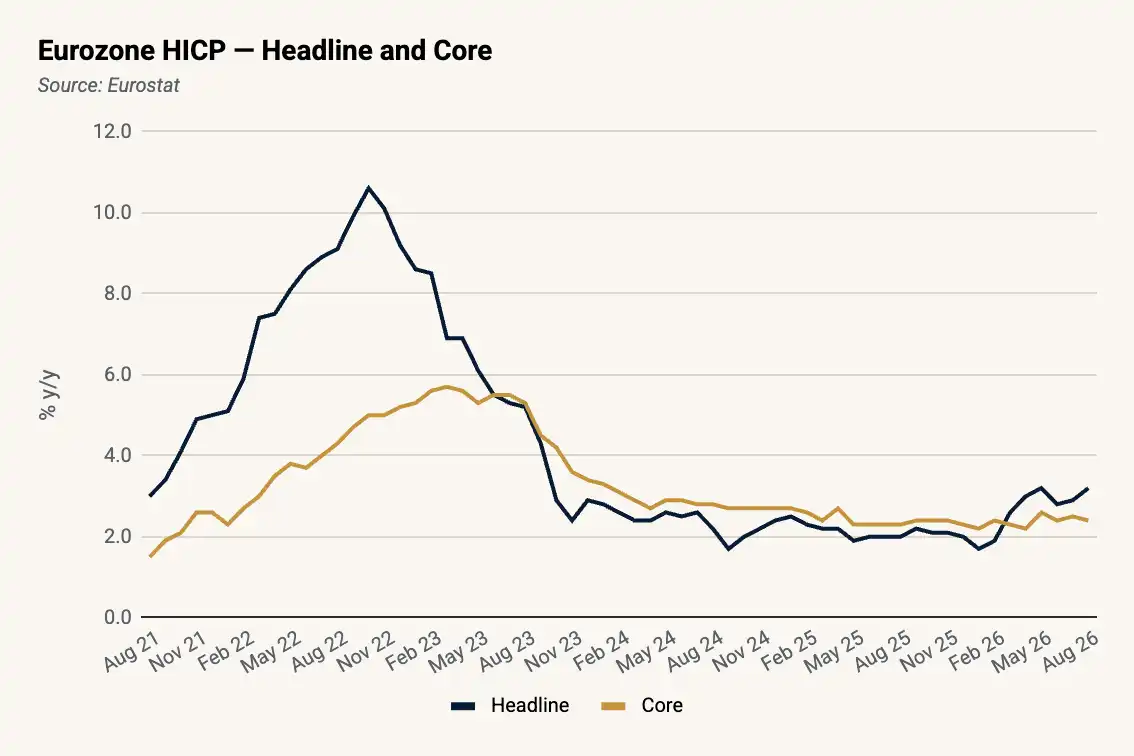
As expected, the ECB delivered a 25bp hike at the September meeting, raising the deposit rate to 2.50%, the top end of the range of estimates for the neutral rate. The hike was accompanied by a fairly hawkish set of updated staff macroeconomic projections, which showed headline inflation remaining above the 2% target through to the end of 2028. Importantly, this inflation profile was conditioned on somewhat outdated energy price assumptions, tilting the risks to the forecast firmly to the upside and, in turn, leaving the prospect of further ECB tightening on the table.
Any further tightening, though, is most likely to come at the December meeting, with October probably more of a ‘placeholder’. In fact, it has been notable in recent weeks that, despite headline inflation being on track to top 3.5% YoY by the end of the third quarter, both President Lagarde and Vice President Vujčić have sought to push back against the idea that energy prices and interest rates must move in lockstep with one another.
Lastly on the ECB, it is not only the policy debate that will likely heat up in the coming months, but the personnel side of things too. Executive Board member Isabel Schnabel has already announced that she will be leaving in early January, while speculation persists that President Lagarde will also depart before the scheduled end of her term next October. Chief Economist Philip Lane is also due to leave next year. It seems likely that, before the end of 2026, European leaders will have agreed a ‘package’ of three candidates for those roles, with Klaas Knot and Pablo Hernández de Cos the frontrunners to succeed Lagarde.
Elsewhere, geopolitical events continue to pose a significant headwind to activity in the eurozone, particularly with natural gas storage some way off target levels as winter approaches, and as chatter of a potential US diesel export ban continues to grow. Market participants will also closely monitor the extent to which the 50bp of ECB tightening already delivered may be denting demand, even if activity is holding up well so far, with the composite PMI rising to a 41-month high in September.
USD
The dollar enjoyed a solid September, gaining ground against most G10 peers, with the Dollar Index (DXY) rising to its best levels since July and notching its first monthly gain in three months.
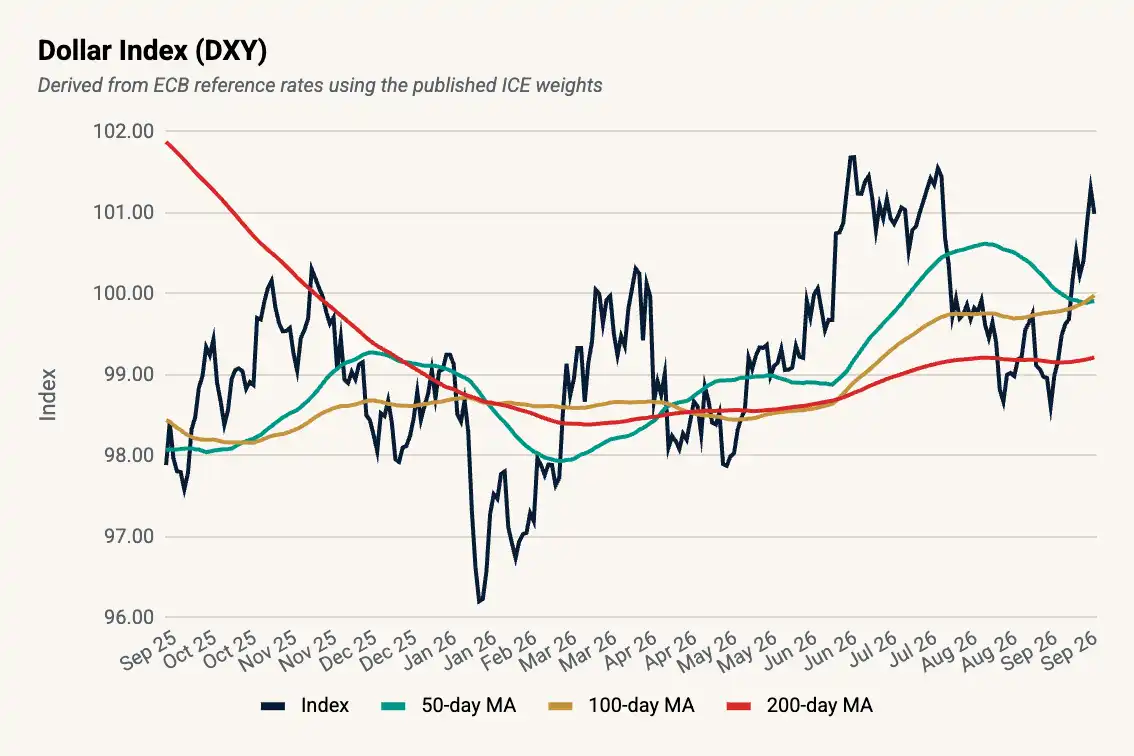
These gains came as the market appeared to buy back into the ‘US exceptionalism’ theme, buoyed not only by the Fed’s increasingly hawkish stance, but also by a strong run of economic data, including a composite PMI pointing to the strongest pace of growth in over a decade, excluding the post-pandemic rebound.
On the monetary front, the FOMC delivered a 25bp hike at the September meeting, with policymakers unanimous in their view that a tighter stance was required. The hike was a decidedly hawkish one, not only in terms of the vote split, but also given the accompanying Summary of Economic Projections (SEP), in which the median ‘dot’ pointed to another hike by year-end, as policymakers revised up their inflation forecasts while simultaneously revising down their unemployment projections. December seems the most likely timing for a second hike at this stage, though a further surge in energy prices, or a surprisingly hot CPI print, could tip the balance in favour of moving in October, just a week before the midterms.
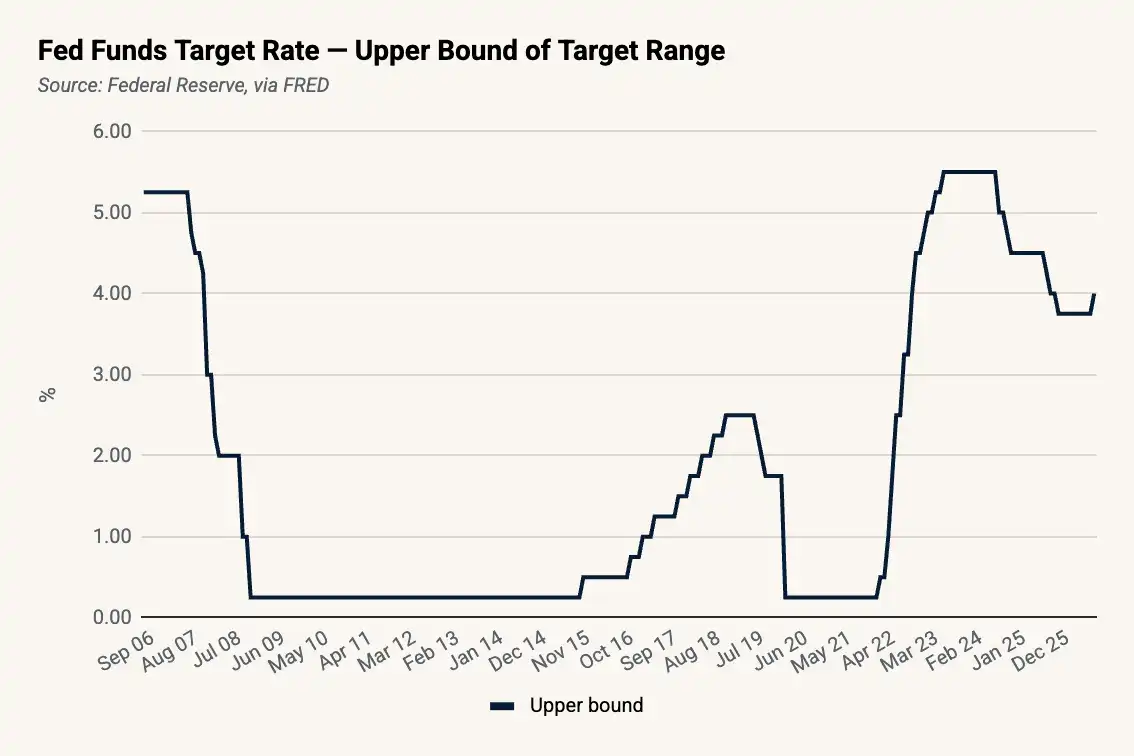
For the time being, policymakers’ focus will likely remain firmly on the inflation side of the dual mandate, amid signs of demand remaining fairly robust across the economy and the labour market exhibiting a remarkable degree of stability overall. Headline nonfarm payrolls rebounded by a surprisingly strong 162k in August, while unemployment held steady at 4.1%, suggesting a jobs backdrop that, while not overheating, could withstand a marginally tighter policy stance.
As for the inflation side of things, the three main drivers of price pressures remain higher energy prices, the pass-through of ever-changing tariffs, and the ongoing AI build-out. Quite clearly, the first two of those factors will not be affected at all by the level of the fed funds rate, while the third seems almost entirely insensitive to rates. This raises the question of whether the FOMC will have to actively slow other areas of the economy in order to sustainably return inflation to target.
Away from monetary policy, the fiscal backdrop remains tricky, particularly with Treasury yields having printed a series of post-GFC highs across the curve. Though this has been driven in large part by energy prices, a lack of obvious signs of fiscal restraint from Treasury Secretary Bessent hasn’t helped matters, while increased long-end buybacks have been a mere drop in the ocean overall, even if the signal they send is a strong one.
Key Dates
GBP
- 1 - Manufacturing PMI (Sep F)
- 5 - Services PMI (Sep F)
- 15 - GDP (Aug)
- 20 - Labour Market Report (Aug)
- 21 - CPI (Sep), PSNB (Sep)
- 23 - Retail Sales (Sep), ‘Flash’ PMIs (Oct)
- 28 - Chancellor Healey delivers the Budget
EUR
- 1 - Manufacturing PMI (Sep F)
- 2 - ‘Flash’ CPI (Sep), Unemployment (Aug)
- 5 - Services PMI (Sep F), PPI (Aug)
- 6 - Retail Sales (Aug)
- 8 - ECB Accounts (Sep)
- 15 - Industrial Production (Aug)
- 16 - CPI (Sep F)
- 23 - ‘Flash’ PMIs (Oct)
- 29 - ECB Decision
- 30 - GDP (Q3 - 1st Est.)
USD
- 1 - ISM Manufacturing (Sep)
- 2 - Labour Market Report (Sep)
- 5 - ISM Services (Sep)
- 7 - FOMC Minutes (Sep)
- 9 - UMich Consumer Sentiment (Oct)
- 14 - CPI (Sep)
- 15 - PPI (Sep), Retail Sales (Sep)
- 28 - FOMC Decision
- 29 - GDP (Q3 - 1st Est.)
- 30 - PCE (Sep)
Data: Bloomberg
Important Information:
This content is a marketing communication produced by Currency Solutions Limited for information purposes only. It does not constitute investment advice, a personal recommendation, or an offer or solicitation to buy or sell any financial instrument, and it has not been prepared in accordance with legal requirements designed to promote the independence of investment research. The views expressed are those of the author as at the date of publication and are subject to change without notice. Forecasts and past performance are not reliable indicators of future results. Currency Solutions Limited is authorised and regulated by the Financial Conduct Authority.
Click here for an instant quote or contact us for a free foreign exchange health check, guaranteed to save you money.
Important Disclaimer: This blog is for informational purposes only and should not be considered financial advice. Currency Solutions does not take into account the investment objectives, financial situation, or specific needs of individual readers. We do not endorse or recommend any specific financial strategies, products, or services mentioned in this content. Forward contracts can help businesses manage foreign exchange exposure by providing greater certainty over future exchange rates, although they may also mean that businesses do not benefit from favourable exchange-rate movements. Businesses should consider their individual circumstances and speak with their dealer to understand how forward contracts may support their specific foreign exchange requirements. All information is provided “as is” without any representations or warranties, express or implied, regarding its accuracy, completeness, or timeliness.