Sterling Gains While BoE's Bailey Says Wider Inflation Effects Remain Limited So Far
7 min read
Share


Sterling strengthened against the US dollar on Thursday and climbed towards 1.3300 in early Friday trading, coinciding with a weaker dollar and declining US Treasury yields. Bank of England (BoE) Governor Andrew Bailey said signs of higher energy costs spreading into broader UK inflation remained limited so far. However, he cautioned that it was too early to draw firm conclusions about the strength of these secondary inflation effects.
Bailey also noted that businesses were focusing on controlling costs, while describing the UK economy as more resilient than previously expected. A survey of 63 economists found that 54 anticipated a quarter-percentage-point BoE interest-rate increase to 4.0% in November, although expectations for subsequent increases remained less certain.
Meanwhile, the euro recovered against the weaker dollar despite Eurostat reporting a 0.5% decline in eurozone industrial production in August. In the US, producer prices increased 1.3% in September, while retail sales rose 0.8%, with higher fuel costs contributing to both figures. The dollar nevertheless remained under pressure amid declining Treasury yields and concerns surrounding AI-related investment financing, which may have influenced market sentiment.
Federal Reserve (Fed) Chair Kevin Warsh said he would not prejudge upcoming interest-rate decisions. Friday's eurozone inflation figures and US industrial-production data could provide further direction for monetary-policy expectations and major currency pairs.
GBP: Sterling Strengthens as BoE Assesses Wider Inflation Risks
GBP/USD: 1.3318 | EUR/GBP: 0.8440
Sterling strengthened against the US dollar during Thursday's session and extended its recovery into early Friday trading, with GBP/USD approaching 1.3300. The advance coincided with a weaker dollar and falling US Treasury yields, despite stronger-than-expected US producer inflation figures. Expectations of a possible BoE interest-rate increase in November may also have provided some support for sterling, although broader movements in the dollar remained an important influence on GBP/USD.
BoE Governor Andrew Bailey said the wider effects of higher energy prices on UK inflation appeared relatively limited so far, but cautioned that it was too early to draw firm conclusions. Speaking at an international financial gathering in Bangkok, Bailey highlighted how businesses were increasingly focusing on reducing costs rather than passing higher expenses directly to consumers. He also described the UK economy as more resilient than previously anticipated, while acknowledging that inflation remained above the BoE's 2% target.
Separately, BoE Deputy Governor Sarah Breeden said businesses' efforts to absorb higher energy costs could help contain inflation. She also highlighted slower wage growth as a factor that might reduce the risk of persistent price pressures. Meanwhile, a newly published survey of 63 economists found that 54 expected the BoE to increase Bank Rate by 25 basis points to 4.0% in November. However, economists remained divided over whether further increases would be necessary during 2027.
Against the euro, sterling remained relatively firm, with EUR/GBP trading around 0.8440 after declining below 0.8450 during Thursday's session. The contrasting expectations surrounding future BoE and European Central Bank (ECB) policy remained relevant to the pair, although both currencies had strengthened against the US dollar. Attention now turns to the UK's September inflation figures, scheduled for 21 October, which could influence expectations for the BoE's next interest-rate decision.
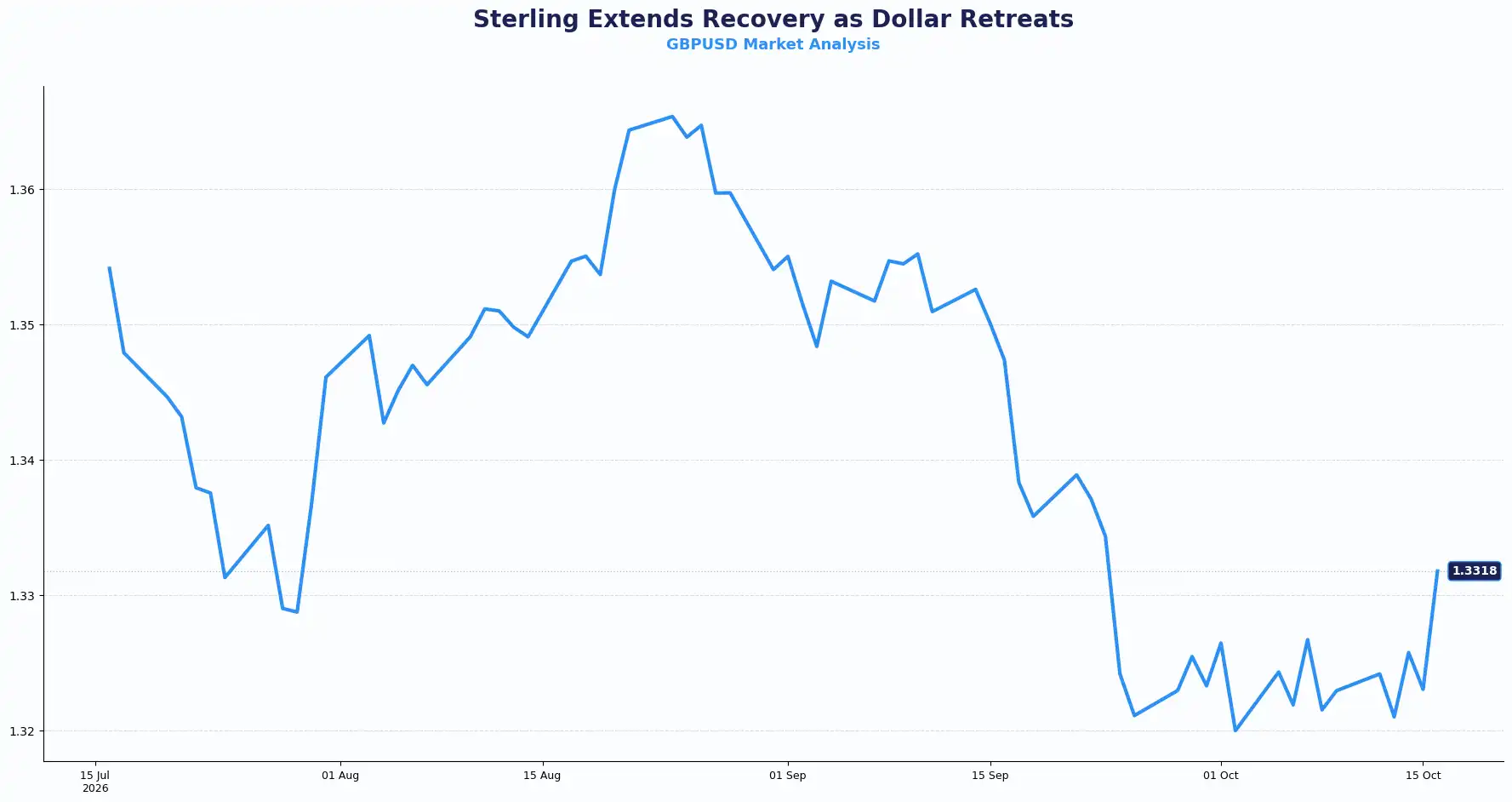
Key technical reference levels for GBP/USD: Resistance sits near 1.3340, followed by 1.3390, while support sits around 1.3250, followed by 1.3160.
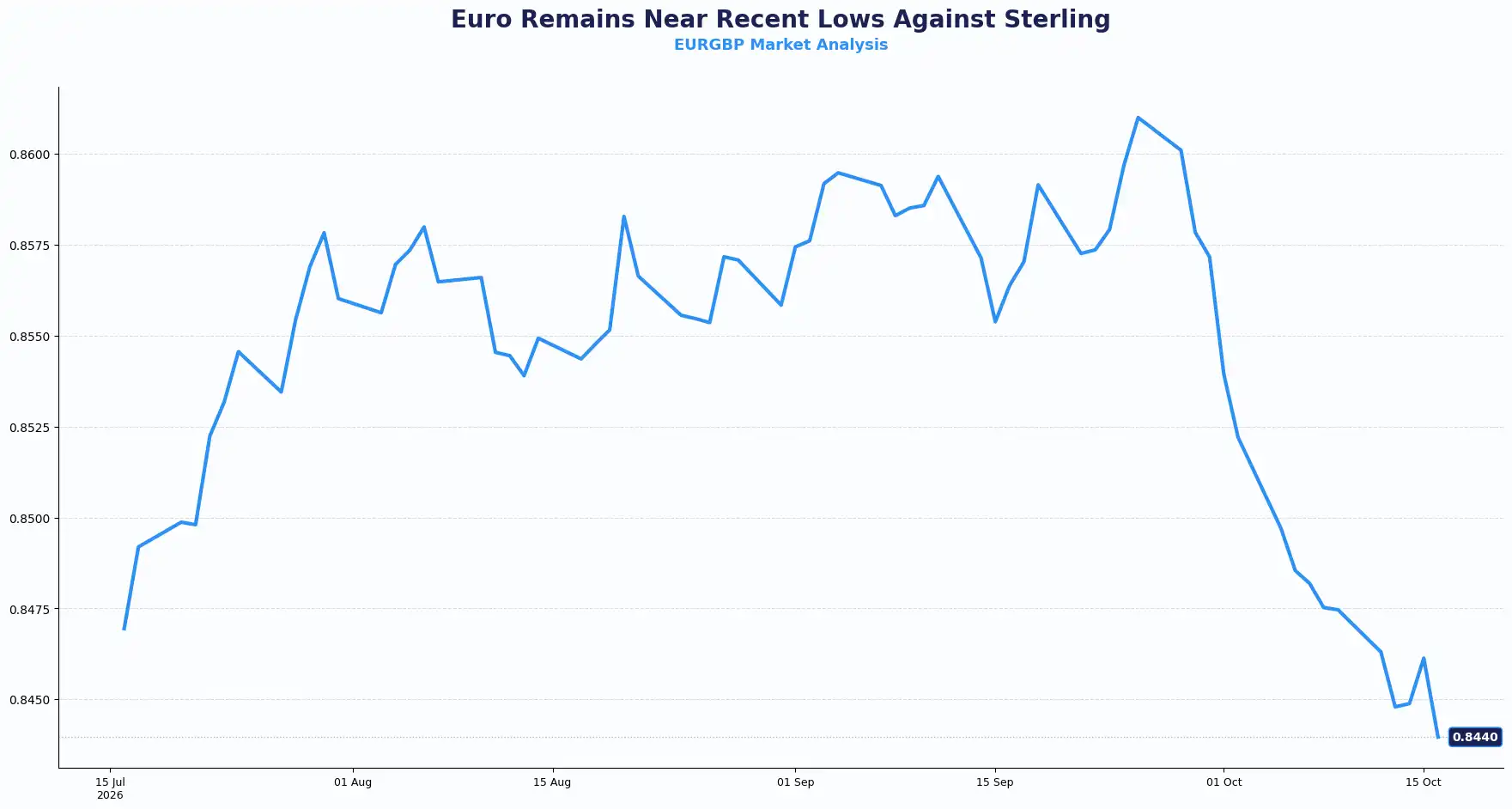
Key technical reference levels for EUR/GBP: Resistance sits near 0.8485, followed by 0.8500, while support sits around 0.8434, followed by 0.8400.
EUR: Euro Recovers Despite Weaker Industrial Output
EUR/USD: 1.1244
The euro strengthened against the US dollar during Thursday's session, with EUR/USD reaching approximately 1.1244 before easing towards 1.1226 in early Friday trading. The recovery coincided with declining US Treasury yields and renewed dollar weakness, despite stronger-than-expected US producer inflation figures. However, weaker eurozone economic data and uncertainty over future ECB interest-rate decisions continued to influence the currency's outlook.
According to Eurostat, eurozone industrial production declined 0.5% month-on-month in August, compared with market expectations for no change. July's figures were also revised down to a 0.3% contraction from an initially reported 0.1% decline. On an annual basis, industrial output fell 1.1%, suggesting continued weakness across parts of the eurozone economy.
The breakdown revealed uneven performance across industrial sectors. Production of non-durable consumer goods declined 2.7% month-on-month, while intermediate-goods output fell 0.8%. However, capital-goods production increased 0.4%, providing some evidence of resilience within specific industries. The figures may have added to concerns about economic momentum, although EUR/USD showed limited immediate reaction to the release.
Against sterling, the euro also retreated, with EUR/GBP falling below 0.8460 after approaching 0.8480 earlier on Thursday. The movement coincided with stronger UK economic figures and continued uncertainty surrounding relative BoE and ECB interest-rate expectations.
Attention now turns to Friday's final eurozone Harmonised Index of Consumer Prices (HICP) figures for September. The release could provide further evidence of underlying inflation pressures and influence expectations for future ECB monetary-policy decisions.
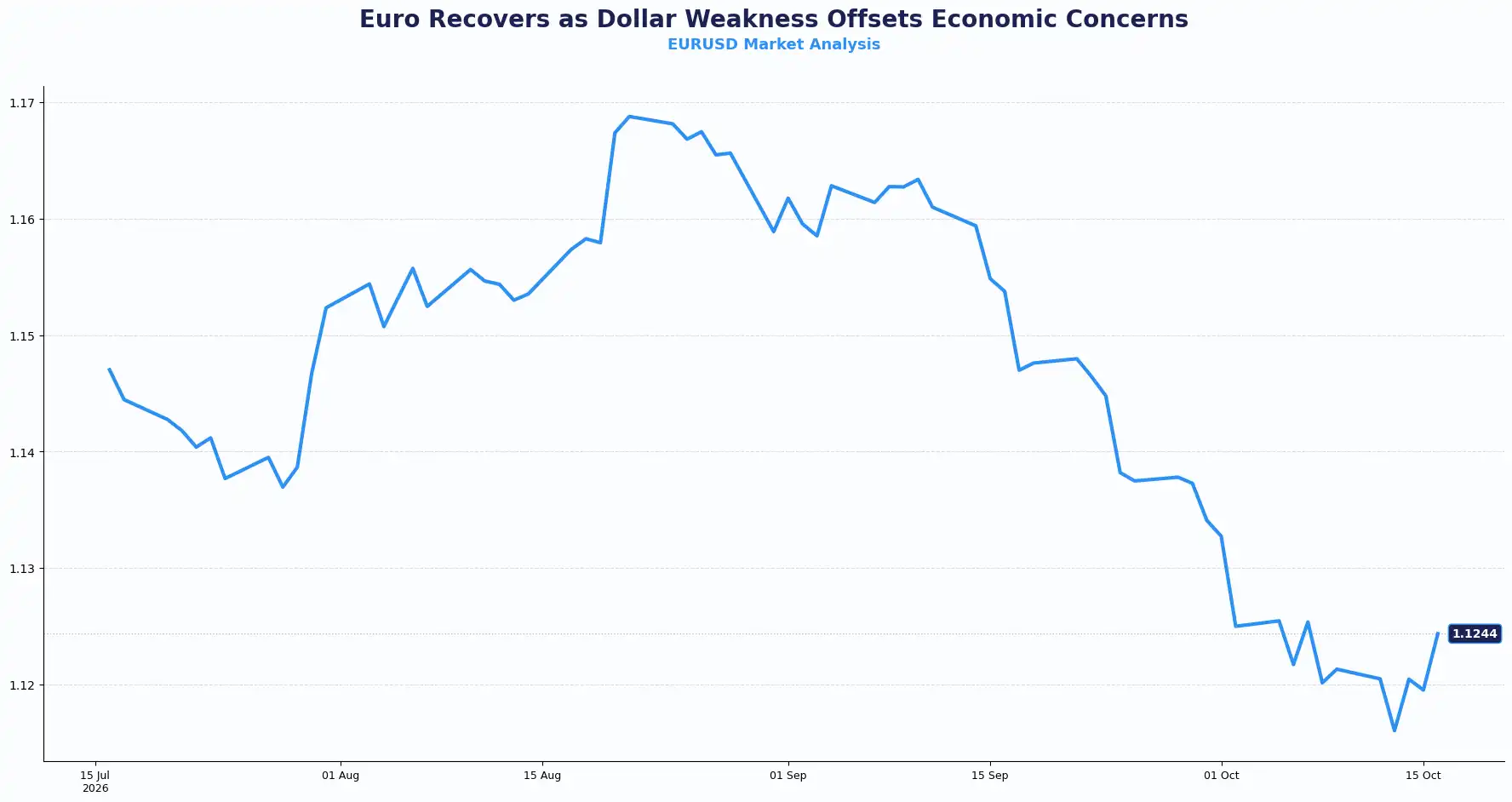
Key technical reference levels for EUR/USD: Resistance sits near 1.1254, followed by 1.1264, while support sits around 1.1200, followed by 1.1114.
USD: Dollar Weakens Despite Stronger US Producer Inflation
DXY: 101.83
The US dollar extended its decline during Thursday's session and remained under pressure in early Friday trading, with the US Dollar Index (DXY) falling towards 101.83, its lowest level in approximately ten days. The weakness coincided with a sharp decline in US Treasury yields and renewed concerns about debt-financed artificial intelligence investment. Increased demand for US government bonds contributed to lower yields, potentially reducing some of the interest-rate support for the dollar despite stronger US economic figures.
According to the Bureau of Labor Statistics, the US Producer Price Index (PPI) increased 1.3% month-on-month in September, exceeding economists' expectations of 0.5% and marking the largest monthly increase since March 2022. Annual producer inflation accelerated to 6.3% from 5.6% in August, with energy prices contributing significantly to the rise. Separately, the US Census Bureau reported that retail sales increased 0.8% in September, above forecasts of 0.3%. However, sales excluding automobiles, gasoline, building materials and food services increased just 0.1%, suggesting more moderate underlying consumer spending.
Federal Reserve (Fed) Chair Kevin Warsh reaffirmed the central bank's commitment to price stability during Friday's remarks but declined to indicate whether additional interest-rate increases would be required. He highlighted the resilience of the US economy and broadening investment activity while emphasising that future policy decisions would depend on economic developments.
Despite elevated inflation, interest-rate markets assigned approximately a 72% probability to unchanged rates at the Fed's October meeting, according to CME FedWatch pricing. The dollar's near-term direction could remain sensitive to Treasury-yield movements, financial-market sentiment and upcoming US economic releases, including Friday's industrial-production figures.
Other Currencies: Yen Strengthens While US Treasury Official Comments on Japan's Policy Outlook
AUD/USD: 0.6945 | NZD/USD: 0.5650 | USD/JPY: 157.89 | GBP/JPY: 209.80
The Japanese yen strengthened modestly against the US dollar, with USD/JPY trading near 157.89 during early Friday trading. The pair had briefly declined towards 157.50 on Thursday before recovering some ground. The movement coincided with falling US Treasury yields and changing Federal Reserve (Fed) interest-rate expectations, while fresh comments from US and Japanese officials highlighted continued attention to exchange-rate stability.
US Treasury Undersecretary for International Affairs Erin Browne said Japan was no longer facing the deflationary conditions experienced over previous decades and that its currency and monetary policy should adjust accordingly. Browne also emphasised cooperation between US and Japanese authorities to maintain stable financial markets, warning that sharp, disorderly currency movements could create wider financial disruptions. Separately, Japanese Finance Minister Satsuki Katayama urged close monitoring of exchange-rate volatility during G20 discussions, reinforcing concerns about excessive currency fluctuations.
Meanwhile, the New Zealand dollar strengthened against the weaker US dollar, with NZD/USD approaching 0.5650. According to the monthly manufacturing survey published by BusinessNZ and the Bank of New Zealand (BNZ), New Zealand's manufacturing activity improved to 56.5 in September from 53.3 in August, with the survey indicating a fifteenth consecutive month of expansion. The stronger reading suggested improving industrial activity, although the immediate currency reaction was not clearly established.
Upcoming US economic releases and further central-bank communications could influence these currencies through changes in interest-rate expectations and broader market sentiment.
Current Rate Table
| Pair | Rate | Trend |
|---|---|---|
| GBP/USD | 1.3318 | Mildly bullish GBP |
| EUR/GBP | 0.8440 | Bearish EUR |
| EUR/USD | 1.1244 | Mildly bullish EUR |
| USD/JPY | 157.89 | Consolidation |
| AUD/USD | 0.6945 | Ranging |
| NZD/USD | 0.5650 | Mildly bullish NZD |
| USD/CAD | 1.4175 | Bearish USD short-term |
Market Lookahead
Friday, 16 October
- Eurozone HICP & Core HICP (September, Final)
- US Industrial Production & Capacity Utilisation (September)
Monday, 19 October
- CAD Consumer Price Index & BoC Core CPI (September)
- Bank of Canada Business Outlook Survey
- CNY GDP (Q3)
Stay Ahead in the Currency Game
Whether you're a daily FX trader or handle international transactions regularly, our 'Currency Pulse' newsletter delivers the news you need to make more informed decisions. Receive concise updates and in-depth insights directly in your LinkedIn feed.
Subscribe to 'Currency Pulse' now and never miss a beat in the currency markets!
Ready to act on today’s insights? Get a free quote or give us a call on: +44 (0)20 7740 0000 to connect with a dedicated portfolio manager for tailored support.
Important Disclaimer: This blog is for informational purposes only and should not be considered financial advice. Currency Solutions does not take into account the investment objectives, financial situation, or specific needs of individual readers. We do not endorse or recommend any specific financial strategies, products, or services mentioned in this content. Forward contracts can help businesses manage foreign exchange exposure by providing greater certainty over future exchange rates, although they may also mean that businesses do not benefit from favourable exchange-rate movements. Businesses should consider their individual circumstances and speak with their dealer to understand how forward contracts may support their specific foreign exchange requirements. All information is provided “as is” without any representations or warranties, express or implied, regarding its accuracy, completeness, or timeliness.