Dollar Rises as PCE Surprise Revives Fed Hike Bets Ahead of Jackson Hole
8 min read
Share


The dollar climbed to an eight-day high after July PCE came in above forecast, keeping Fed rate hike bets alive into year-end. With Jackson Hole now open and Warsh's keynote due Friday, every G10 pair appears to be in a holding pattern.
The ECB's Schnabel doubled down on hawkish rhetoric, pushing September hike expectations to near-certainty, keeping the euro firm above 1.1650. Germany's GfK confidence beat and upward GDP revision added weight to that case.
Elsewhere, Australia's hotter-than-expected CPI sent the Aussie outperforming. The Bank of Korea delivered a second consecutive hike to 3.00%; and the BoJ held its taper course steady after Himino's balanced remarks. Reports of a US-Iran ceasefire deal eased some Strait of Hormuz risk premium.
Sterling tracks weekly lows with no UK data to anchor it, still holding ground around near 1.3600. Fed Chair Warsh speaks Friday at Jackson Hole. Until then, the dollar holds its breath and so does the rest of G10.
GBP: Sterling Caught Flat-Footed Below 1.3600
GBP/USD: 1.3589 | EUR/GBP: 0.8575
The pound sat below 1.3600 on Thursday morning, nursing a 0.4% weekly decline against the dollar. A quiet UK data calendar left sterling with nothing to push back against a broadly firmer greenback. GBP/USD trades around 1.3587, with the pair firmly capped below the 1.3660–1.3665 supply zone.
US inflation has given the dollar more room to press the Pound. July headline PCE inflation rose 3.7% YoY, a touch above the 3.6% forecast. Core PCE held at 3.3% annually, precisely where markets expected. Monthly headline and core PCE both rose 0.2%, ahead of the 0.1% forecast. The data kept Fed rate hike expectations alive for later this year, giving the dollar a floor it has held since Wednesday.
The broader narrative is one of policy divergence. The Bank of England (BoE) faces a UK economy that has offered little fresh data this week, while the Fed continues to draw attention with each inflation print. If the Fed holds to the current bank rate, keeping policy unchanged at September's meeting, which is broadly the base case, it could weigh further on Sterling. CME FedWatch currently prices a 64% chance of the Fed holding rates in September, with a full 25-basis-point (bps) hike priced in by December.
On the downside, GBP/USD has prior consolidation pockets around the mid-1.3400s and the low-1.3300s acting as structural reference points. The near-term picture stays tilted to the downside until the Jackson Hole Symposium on Friday delivers fresh direction from Fed Chair Kevin Warsh.
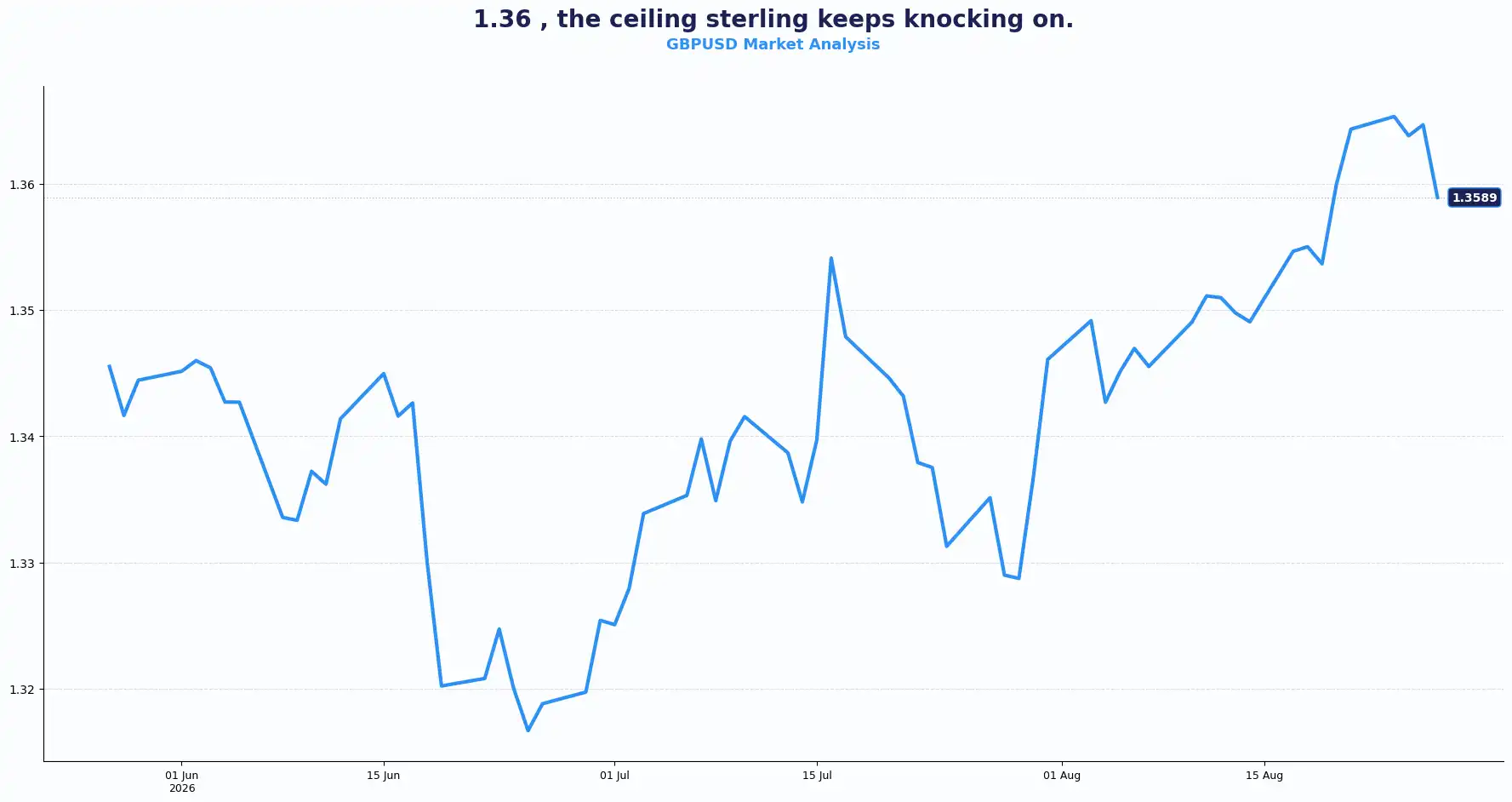
Key technical levels for the GBP/USD pair: Resistance sits at 1.3660, 1.3665, 1.3700, 1.3750, and Support sits at 1.3440, 1.3300
EUR: Euro Holds Its Ground Above 1.1650
EUR/USD: 1.1659 | EUR/GBP: 0.8575
The euro extended its run against the dollar on Thursday, trading around 1.1655 in early European hours. ECB member Isabel Schnabel reinforced the hawkish tone on Wednesday, pointing to upside inflation risks tied to both geopolitical pressures and a more resilient eurozone economy than forecast.
Against sterling, the euro extended its gains to 0.8576. The pair hit an intraday high near 0.8580 during the Asian session before fading back at the European open. If the policy divergence between the ECB's more aggressive path and the BoE's continues, it could push EUR/GBP towards 0.8700 in the coming months.
Schnabel's comments carry real weight with rate pricing. The ECB Watch tool puts the probability of a deposit rate hike to 2.50% at September's meeting at close to 96%. The ECB already tightened its policy in June, and with inflation risks skewed to the upside, another move looks likely.
German data continues to outperform. GfK Consumer Confidence for September improved to -26.6 from -29.4 in August, against a market expectation of further deterioration to -29.6. The key drivers were a jump in income expectations and a modest uptick in the economic outlook sub-index. Earlier in the week, Germany's second-quarter GDP got revised upward to 0.3% quarter-on-quarter, and the IFO Business Climate Index hit its highest reading in 12 months. German Bund yields edged higher on Thursday, though the broader trend remains sensitive to upcoming data.
That gives the euro a policy advantage against Sterling in EUR/GBP and supports EUR/USD when US inflation does not surprise to the upside.
For now, the EUR/USD stays capped below 1.1700. The pair faces near-term resistance at that level. The dollar's recovery, roughly half of the losses triggered after Treasury Secretary Scott Bessent's bond market measures last week, keeps the euro's upside limited for now. Friday's Warsh speech is the near-term swing factor.
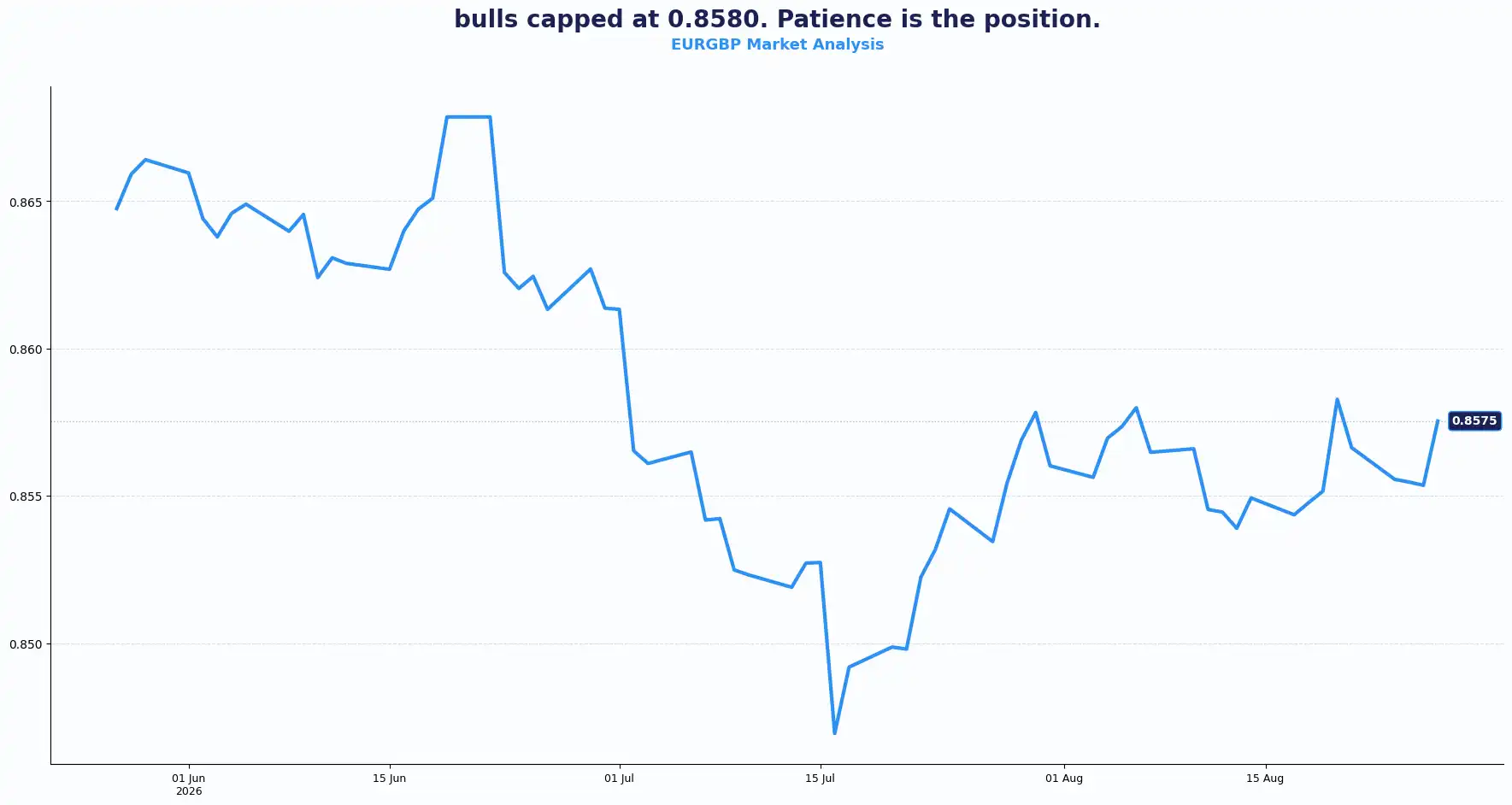
Key technical levels for the EUR/GBP pair: Resistance sits at 0.8580, 0.8700, and Support sits at 0.8560, 0.8490
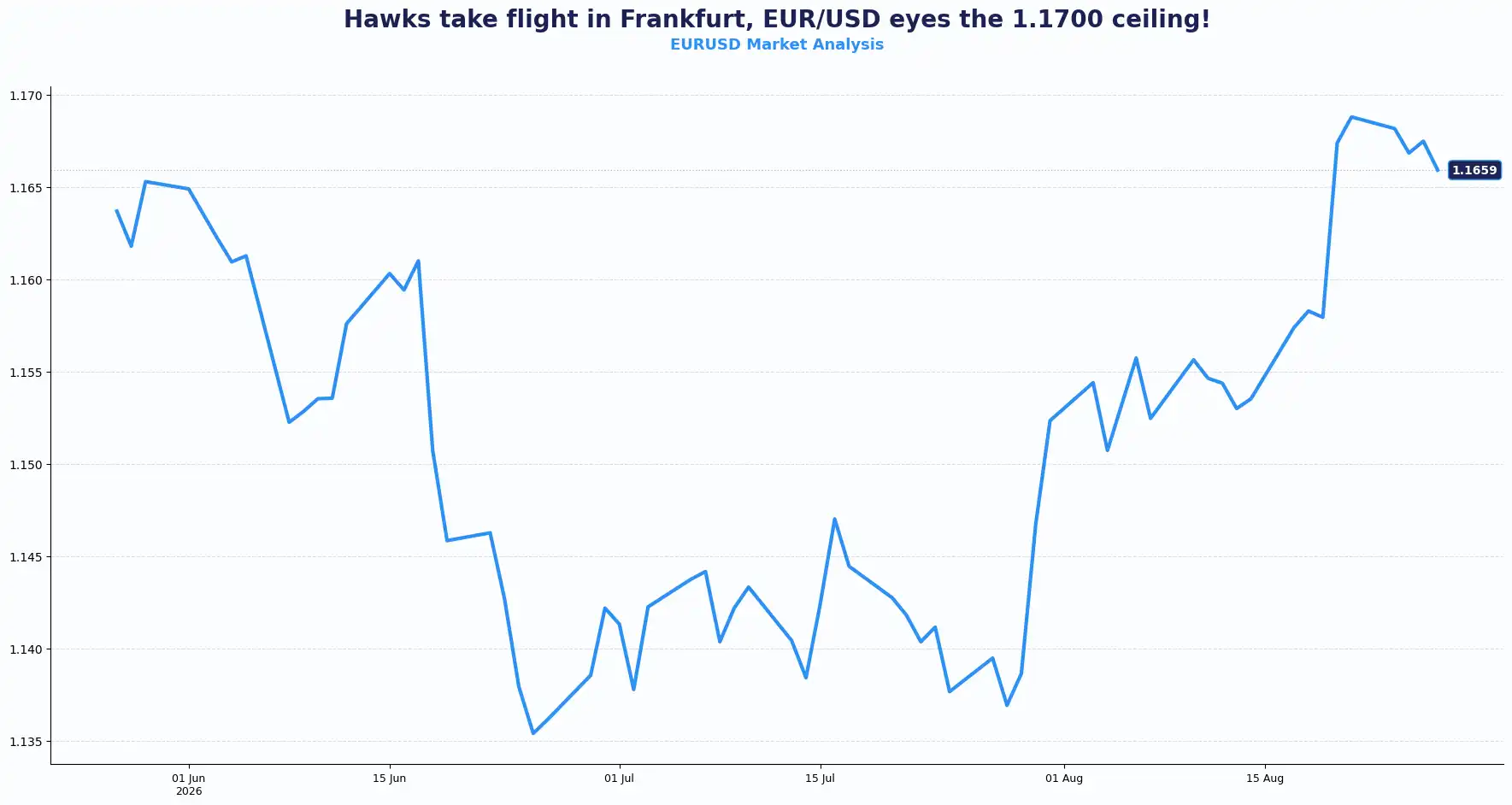
Key technical levels for the EUR/USD pair: Resistance sits at 1.1700, 1.1750, 1.1805, and Support sits at 1.1600, 1.1550
USD: Dollar Steadies at 99, Warsh in the Chair Friday
DXY: 99.16
The Dollar Index (DXY) held near 99.16 on Thursday, recording its largest single-day gain in nearly four weeks on Wednesday after PCE data provided a modest upside surprise. The index recouped roughly half of its prior losses from the week. Rate swap pricing now puts a 43% probability on a Fed hike next month, with a full 25-basis-point move priced in by December.
Fed Chair Kevin Warsh faces a nuanced communications task at Jackson Hole. The challenge lies in balancing institutional independence and the price-stability mandate while offering enough clarity on the policy path to satisfy the markets watching every word. Warsh has historically been reluctant to rely on forward guidance, which makes Friday's speech particularly difficult to read in advance. Any signal that the Fed sees rates staying on hold risks quickly softening the dollar.
US Treasury yields bounced from recent lows during Thursday's session after briefly sitting under pressure from the Treasury's buyback programme. The broader yield picture stays constructive for the dollar. Gold and silver pulled back but hold a bullish medium-term structure. Brent and WTI crude both bounced from recent lows.
Reports of a new US-Iran ceasefire deal, expected to be announced within days, along with a temporary Oman-brokered maritime route through the Strait of Hormuz, eased some geopolitical risk premium in energy pricing, though the strait remains partially restricted until the US fulfils interim peace commitments signed in June.
DXY faces resistance around 99.40. A move through that level would strengthen the recovery structure. The 99.00 area provides the first near-term reference point on a pullback.
Other currencies: Antipodeans, Asia and Beyond
AUD/USD: 0.7182 | NZD/USD: 0.5947 | USD/JPY: 159.35 | GBP/JPY: 216.51 | USD/KRW: ~1,381 | USD/IDR: ~17,800
Australian Dollar
AUD/USD trades around 0.7185 after Australia's July inflation data strengthened expectations for another Reserve Bank of Australia (RBA) rate increase. Headline CPI rose 1.0% MoM in July. Annual inflation eased to 3.5% from 3.8% but came in above the 3.3% forecast. Fuel and clothing contributed to the monthly rise.
AUD/USD has moved above its 20-day EMA near 0.7100. That keeps the short-term structure constructive. The pair now approaches 0.7275 as the next upside reference. The hotter inflation print gives the Australian dollar a domestic policy catalyst even as the US dollar benefits from sticky PCE inflation.
Japanese Yen
In Japan, BoJ Deputy Governor Ryozo Himino said policymakers need to consider timely rate increases as underlying inflation approaches 2%. He also highlighted the yen's influence on domestic price pressure. USD/JPY trades around 159.35. The pair sits close to the 160 area while BoJ tightening expectations create downside risk below 159.
South Korean Won
The won strengthened against the dollar after the Bank of Korea delivered a back-to-back interest rate hike, pushing the policy rate to 3.0%. It marked a second consecutive hike as policymakers responded to inflationary pressures and resilient growth.
The move supports the Korean won by widening the domestic policy response to inflation. The dollar still has support from US rate expectations, so USD/KRW will depend on the relative pace of policy adjustment.
Indonesian Rupiah
USD/IDR extended its advance for a third consecutive day to trade around 17,800 during Asian hours. Ongoing protests in Jakarta weighed on sentiment, adding to risk concerns. El Niño-related food price risks add to the pressure. The market’s attention now turns to Indonesian inflation and trade data.
Across the major currencies, the same theme seems to keep surfacing. Inflation is forcing central banks to balance price stability against growth. The euro has gained support from renewed expectations of ECB tightening. Sterling lacks a fresh domestic catalyst this week. The dollar has regained ground after sticky PCE inflation.
The next move might depend less on a single data point and more on how central bank officials frame the policy path. Jackson Hole now sits at the centre of that story.
Current Rate Table
| Pair | Rate | Trend |
|---|---|---|
| GBP/USD | 1.3589 | Bearish short-term |
| EUR/USD | 1.1659 | Slightly bearish / range-bound |
| EUR/GBP | 0.8575 | Bullish near-term |
| AUD/USD | 0.7182 | Bullish near-term |
| NZD/USD | 0.5947 | Neutral to slightly bearish |
| USD/JPY | 159.35 | Bullish bias |
| GBP/JPY | 216.51 | Neutral to mildly bullish |
| USD/IDR | ~17,800 | Bullish USD / bearish IDR |
| USD/KRW | ~1,381 | Bearish USD / bullish KRW |
Market lookahead:
Thurs, Aug 27
- US Goods Trade Balance (Jul)
Fri, Aug 28
- Eurozone’s Consumer Confidence (Aug)
- Fed Chair Warsh Speech
Stay Ahead in the Currency Game
Whether you're a daily FX trader or handle international transactions regularly, our 'Currency Pulse' newsletter delivers the news you need to make more informed decisions. Receive concise updates and in-depth insights directly in your LinkedIn feed.
Subscribe to 'Currency Pulse' now and never miss a beat in the currency markets!
Ready to act on today’s insights? Get a free quote or give us a call on: +44 (0)20 7740 0000 to connect with a dedicated portfolio manager for tailored support.
Important Disclaimer: This blog is for informational purposes only and should not be considered financial advice. Currency Solutions does not take into account the investment objectives, financial situation, or specific needs of individual readers. We do not endorse or recommend any specific financial strategies, products, or services mentioned in this content. Forward contracts can help businesses manage foreign exchange exposure by providing greater certainty over future exchange rates, although they may also mean that businesses do not benefit from favourable exchange-rate movements. Businesses should consider their individual circumstances and speak with their dealer to understand how forward contracts may support their specific foreign exchange requirements. All information is provided “as is” without any representations or warranties, express or implied, regarding its accuracy, completeness, or timeliness.