All Eyes on Wyoming: Jackson Hole Holds the FX Dial
9 min read
Share


Sterling holds near 1.36, the euro eyes another ECB hike, and the dollar awaits Warsh. Jackson Hole is likely to set the tone for September rate decisions across G10.
The dollar index sits at 99.18, drifting lower through August with US inflation sitting at 3.7%, nearly twice the Fed's target and growing pressure inside the Fed itself to raise rates again. Nobody knows what Fed Chair Kevin Warsh is going to do next. Warsh has offered no guidance since taking the chair in May, and that communications vacuum has kept positioning light and currency traders in a holding pattern heading into his speech in Wyoming today; the single event G10 FX is pricing around this week.
What he says could impact the direction for the dollar and everything priced against it. If he signals rates are going higher, the pound and euro both soften against the dollar. If he sidesteps the rate question entirely, the dollar's recent slide is likely to continue. The pound is already quiet with little UK data to move it independently. The euro at 1.1645 has the European Central Bank's (ECB) own September rate hike keeping it better supported.
GBP: Sterling Steady as BoE Bets Soften and Warsh Looms
GBP/USD: 1.3586 | EUR/GBP: 0.8570
Sterling trades near 1.3590 against the dollar after a recent pullback. GBP/USD closed little changed around 1.3595 after dipping to 1.3571. The pair now trades inside a tight range as softer UK rate expectations limit sterling upside.
UK rate pricing has shifted towards a slower path of tightening. Current pricing points to about 24 basis points of BoE tightening by December and around 36 basis points by February 2027. Less than 4 basis points are priced in for the September meeting. That implies only about a 15% probability of a September hike.
The BoE held the Bank Rate at 3.75% in July with a 6-3 vote. Three policymakers backed a 25bp increase. The bank also noted that energy prices could push inflation higher later this year.
Lower Brent prices have eased some of that inflation pressure. The UK data calendar also offers little immediate guidance ahead of the next round of PMI data. That leaves sterling more exposed to shifts in US rate expectations. For GBP/USD, the technical picture still favours a defined range. The pair sits above its 100-day moving average.
Fed Chair Kevin Warsh delivers his first keynote address at the Jackson Hole Symposium in Wyoming this afternoon, his first since taking the reins from Jerome Powell in May 2026. Any signal toward tighter US policy would support the dollar and weigh on cable. If Warsh opts for broad structural themes rather than rate guidance, analysts note the market could read that as relatively dovish, keeping the pound's current range broadly intact into next week.
Sterling has lost some of its rate advantage but has not suffered a decisive technical break. The next move depends more on the US rate outlook than on a busy UK data calendar.
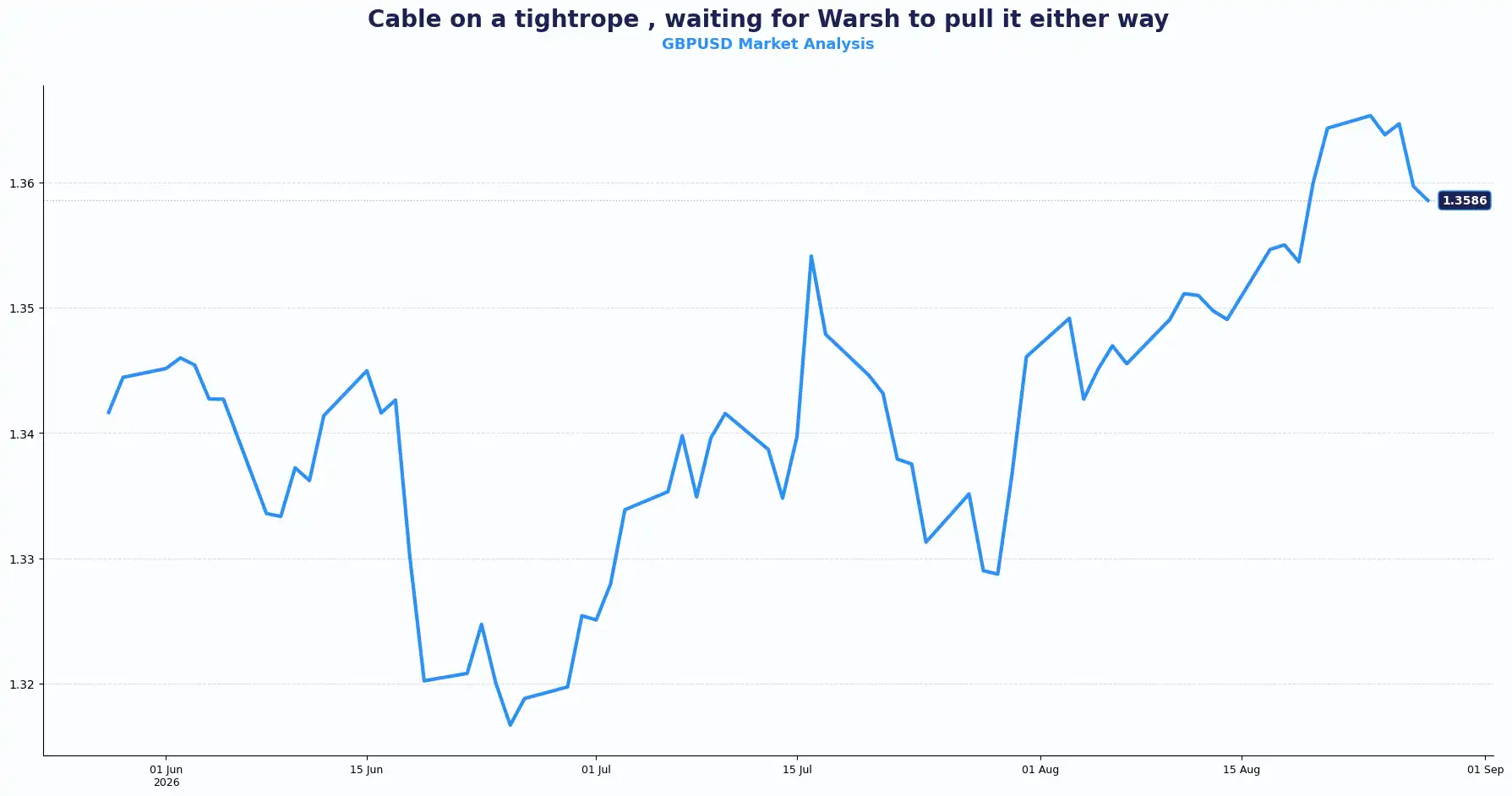
Key technical levels for the GBP/USD pair: Resistance sits at 1.3620 - 1.3655 and Support sits at 1.3550 - 1.3570
EUR: Hawkish ECB Tone Drives Relative Support
EUR/USD: 1.1647 | EUR/GBP: 0.8570
EUR/USD trades around 1.1647 after pulling back from the 1.1700 area and is on track for a 0.3% weekly decline after rallying roughly 2.5% over the previous four weeks. The pair eased again this morning as the dollar found cautious support and traders positioned ahead of Warsh's speech. The euro has lost some short-term momentum but retains a stronger policy backdrop than sterling.
The backdrop for the euro is structurally supportive, even if near-term momentum has faded. The ECB raised its deposit rate from 2% to 2.25% at its June meeting, its first hike in nearly three years, and held rates unchanged in July. The ECB's July meeting account showed policymakers saw another rate increase as likely unless inflation improved materially. Officials now see a possible move from 2.25% to 2.50% at the September meeting.
ECB Executive Board member Isabel Schnabel reinforced that trajectory this week, citing the ongoing Middle East conflict and a resilient eurozone economy as twin upside risks to inflation. She argued that waiting for clear second-round effects before acting would mean acting too late. Eurozone business activity data released today showed growth at its fastest pace this year, adding to the case for continued tightening.
That policy gap supports the euro against the dollar over the medium term. The short-term picture looks less clean. EUR/USD has slipped below 1.1660 and now tests the 1.1640 area.
August inflation data add another layer. Current forecasts point to eurozone inflation around 3.3% in August. Energy prices account for much of the expected rise. Core inflation could offer a cleaner signal on underlying pressure.
That distinction matters for EUR/USD. A higher headline figure driven by energy may support the ECB's caution without changing the longer-term policy path. A broader rise in core inflation would carry more weight.
German–US yield spreads have compressed slightly in recent sessions, which clipped some near-term support for the euro. The broader policy divergence story is one of ECB tightening while the Fed signals uncertainty, and continues to underpin medium-term EUR strength in the analytical consensus. Short-term direction depends heavily on what Warsh says this afternoon. A hawkish Fed signal could boost the dollar and pressure EUR/USD toward 1.1580 support; vague, high-altitude remarks from Warsh are likely to leave the euro's base case intact.
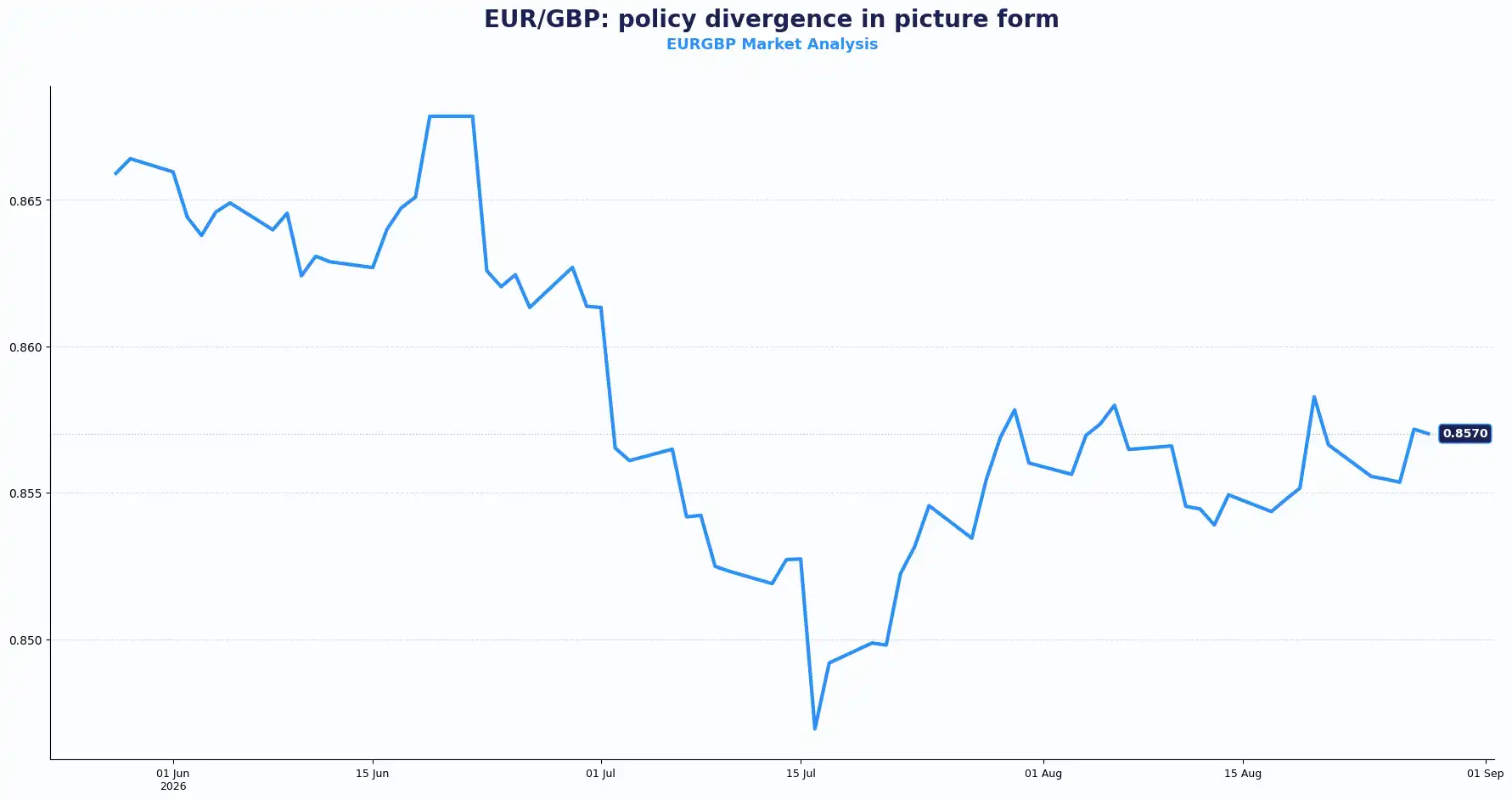
Key technical levels for the EUR/GBP pair: Resistance sits at 0.8620, 0.8700, and Support sits at 0.8540
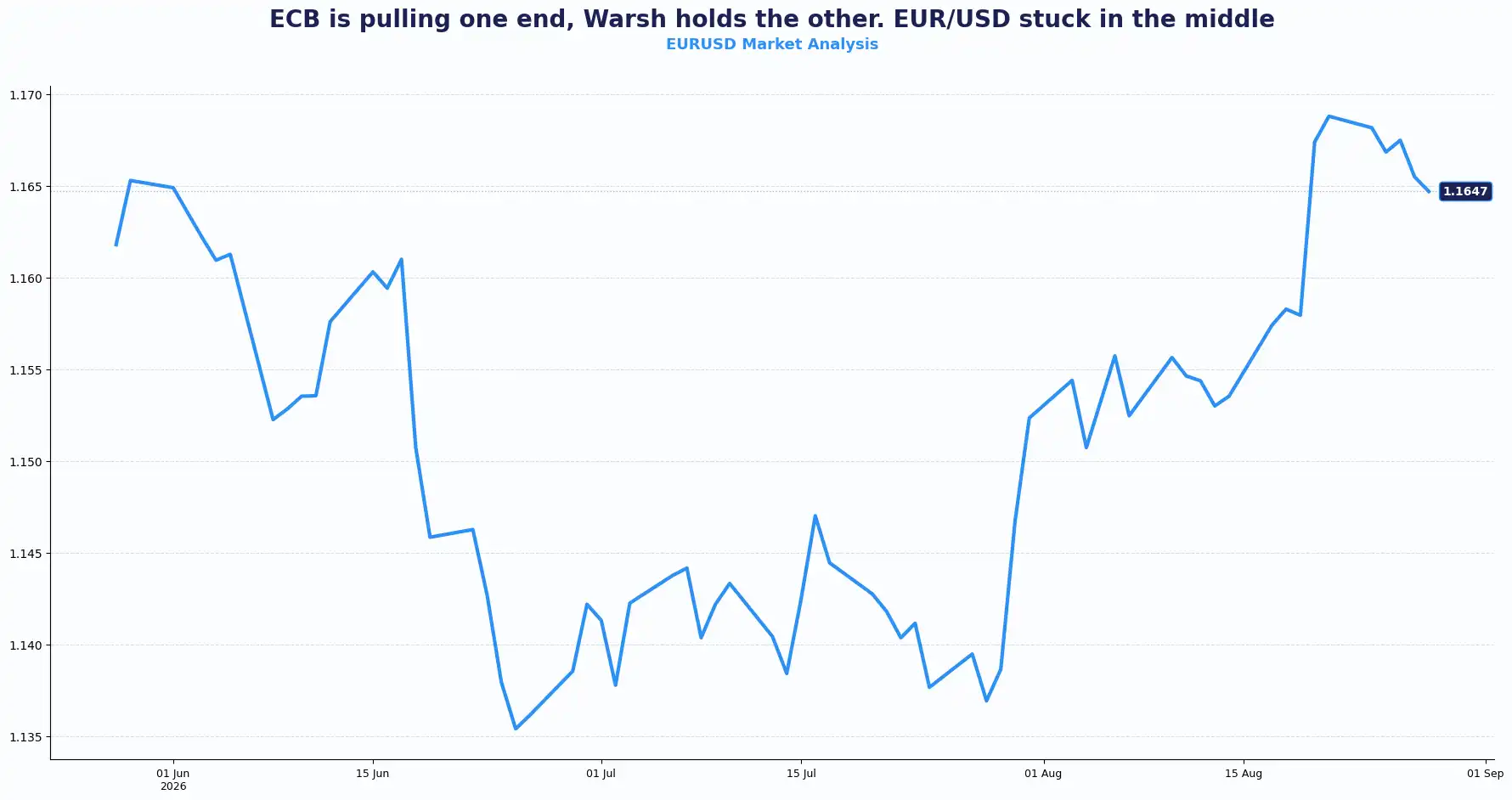
Key technical levels for the EUR/USD pair: Resistance sits at 1.1670–1.1720, and Support sits at 1.1580-1.1610
USD: Dollar Steady at 99 as Warsh Prepares to Take the Stage
DXY: 99.18
The dollar index (DXY) sits near 99.20, holding above the 99.00 handle after modest losses yesterday. It has recovered some ground on cautious positioning ahead of Warsh's afternoon address, with analysis suggesting the current recovery is corrective within a broader downtrend.
US inflation provides the dollar with clear fundamental support. July PCE inflation rose 3.7% year-on-year. Core PCE held at 3.3%. The figures sit well above the Fed's 2% target. Those figures reinforced market pricing for at least one further rate hike before year-end. The CME FedWatch tool currently shows a 74% probability of a December move, while September is broadly expected to be a hold; markets price a roughly 65% chance of no change at the 17 September meeting.
At the July meeting, three officials dissented in favour of an immediate 25 basis point hike. Since then, Fed officials Jeffrey Schmidt and Beth Hammack have both struck a hawkish tone publicly. Boston Fed President Susan Collins offered a slightly softer note, emphasising that current policy is already restrictive and should deliver gradual disinflation. She also characterised the recent rise in bond yields as consistent with the path to price stability, which tempered some immediate dollar upside.
Warsh himself has opted for a less-is-more communications style since taking over in May. After the July meeting, he offered no forward guidance on rates and instead flagged interest in using Jackson Hole to address big structural questions around productivity, demographics, and the global economy amid supply shocks. Analysis suggests one-week implied volatility is running below recent averages, suggesting positioning may be light ahead of his remarks. A hawkish rate signal would likely support the dollar and shake broader FX. If Warsh sticks to the structural script, markets might read that as softening urgency around near-term tightening.
DXY faces resistance around 99.25. A sustained move above it would put 99.48 and 99.68 in focus. Support sits around 99.12 and 98.99. The 98.56 area marks the recent low.
Separately, US Treasury Secretary Scott Bessent announced last week that the department will at least double the size of its buyback operations on off-the-run debt when the next round begins on 9 September. At the current scale, it represents a modest portion of total US debt outstanding, but the move has fuelled discussion about coordination between fiscal and monetary authorities, an uncomfortable backdrop for Warsh's first major speech.
The dollar therefore faces two opposing forces. Sticky inflation supports tighter Fed expectations. Fiscal concerns can weigh on longer-term dollar sentiment. Jackson Hole could sharpen that divide.
The DXY range to watch: the near-term focus is on a retest of the mid-99 area, with the broader technical structure still pointing to the downtrend as dominant.
Other Currencies: Policy Signals Drive the Periphery
AUD/USD: 0.7196 | NZD/USD: 0.5949 | USD/JPY: 159.62 | GBP/JPY: 216.83
USD/JPY trades near 159.30 to 159.50. The pair faces resistance around 160.00 while support sits near 159.00 and 158.50.
The yen has found support from stronger Tokyo inflation. Headline Tokyo CPI rose 1.9% year-on-year in August. The core CPI excluding fresh food rose to 1.8% from 1.7%. Inflation excluding fresh food and energy reached 2.0%. The data strengthens the case for another BoJ hike. Deputy Governor Ryozo Himino also adopted a hawkish tone and highlighted greater attention to upside inflation risks.
The Australian dollar trades in a range just below 0.7200. Stronger inflation has increased expectations of further RBA tightening. That keeps AUD among the higher-yielding major currencies.
The New Zealand dollar trades near 0.5960. A hawkish RBNZ outlook has supported the kiwi while traders also await the Fed's next signal.
Geopolitics adds another variable. Iran is preparing conditions for reopening the Strait of Hormuz after mediators pushed for renewed dialogue. Media reports note that Tehran wants an end to the regional conflict as one of its conditions.
Oil prices therefore continue to feed directly into FX expectations. Influencing energy costs and, by extension, inflation, central bank policies, and the impact on respective currencies.
The wider FX picture now turns on one question: which central bank can justify tighter policy without damaging growth? Sterling has lost some rate support. The euro has gained from a firmer ECB outlook. The dollar has inflation on its side but faces fiscal questions. The yen has gained a fresh inflation argument. The Aussie and kiwi retain support from higher domestic rate expectations. Currently, policy divergence is more likely to impact currency pairs than any single headline.
Current Rate Table
| Pair | Rate | Trend |
|---|---|---|
| GBP/USD | 1.3586 | Sideways/mild bearish |
| EUR/USD | 1.1647 | Sideways/mild bearish |
| EUR/GBP | 0.8570 | Neutral |
| USD/CAD | 1.3856 | Neutral |
| AUD/USD | 0.7196 | Bullish bias |
| NZD/USD | 0.5949 | Mildly bullish |
| USD/JPY | 159.62 | Bearish JPY bias |
| GBP/JPY | 216.83 | Neutral |
Market lookahead:
Fri, Aug 28
- Fed Chair Warsh Speech
Mon, Aug 31
- Germany’s Consumer Price Index (CPI) & HICP (Aug)
Tue, Sep 1
- Germany’s Retail Sales (Jul)
- Eurozone Consumer Price Index (CPI) & HICP (Aug)
- Eurozone Unemployment Rate
Stay Ahead in the Currency Game
Whether you're a daily FX trader or handle international transactions regularly, our 'Currency Pulse' newsletter delivers the news you need to make more informed decisions. Receive concise updates and in-depth insights directly in your LinkedIn feed.
Subscribe to 'Currency Pulse' now and never miss a beat in the currency markets!
Ready to act on today’s insights? Get a free quote or give us a call on: +44 (0)20 7740 0000 to connect with a dedicated portfolio manager for tailored support.
Important Disclaimer: This blog is for informational purposes only and should not be considered financial advice. Currency Solutions does not take into account the investment objectives, financial situation, or specific needs of individual readers. We do not endorse or recommend any specific financial strategies, products, or services mentioned in this content. Forward contracts can help businesses manage foreign exchange exposure by providing greater certainty over future exchange rates, although they may also mean that businesses do not benefit from favourable exchange-rate movements. Businesses should consider their individual circumstances and speak with their dealer to understand how forward contracts may support their specific foreign exchange requirements. All information is provided “as is” without any representations or warranties, express or implied, regarding its accuracy, completeness, or timeliness.