Dollar Rebounds as ISM Beats and Iran Talks Stall
9 min read
Share


The dollar clawed back ground on Tuesday after US Manufacturing PMI came in at 55.6 beating forecasts and lifting Treasury yields. Conflicting signals on US-Iran talks added to safe-haven demand for the dollar, with Trump claiming negotiations are underway but Tehran denying it.
Sterling bore the brunt of the dollar's recovery, slipping to 1.3425. Governor Bailey's post-meeting press conference last week continues to weigh on the pound. His explicit pushback against rate hike expectations offset the MPC's 6-3 hawkish vote split. The pound is the weakest European major on the session.
The euro held above $1.1500, supported by firmer Eurozone inflation data and ECB rate hike pricing that extends into 2026. Elsewhere, the Australian dollar led G10 losses and the Swiss franc softened after July CPI hit a four-month low. Markets await Global Composite and Services PMI and Friday's US jobs report.
GBP: Sterling Falters as Safe-Haven Flows Bid Dollar
GBP/USD: 1.3436 | EUR/GBP: 0.8568
GBP/USD fell to 1.3425 in the Asian session, giving back the post-BoE advance and settling as the weakest performer among the European majors. The dollar's broad recovery is driving the move, but sterling is not fighting back. Cable dropped 0.4% from recent multi-week highs and settled near 1.3430 during the early European session.
Renewed tension between Washington and Tehran prompted currency traders to step away from risk assets. Safe-haven demand pushed funds straight into the dollar. S&P Global composite and services PMI figures for July arrive tomorrow, keeping short-term volatility high.
July's UK Manufacturing PMI was revised lower compared to June, pointing to a softening in factory output. S&P Global's services and composite PMI figures arrive Wednesday and could set the tone for sterling heading into the week's second half. Stronger US ISM manufacturing data added extra weight against cable.
Last week's BoE vote split of 6-3 to hold at 3.75%, with three members backing a hike, initially read as hawkish. Governor Bailey stepped firmly on that interpretation at the press conference. "Please do not leave this room thinking that the Bank of England is edging towards a hike," he told journalists, adding that nothing in the MPC's communication supported that reading. That message landed. Net short positioning on sterling bounced higher ahead of the meeting and held there after it.
The structural picture for the cable is under pressure. A downward-sloping trend line near 1.3470 acts as the key short-term barrier. A clean break above that level is needed to shift the near-term bias. Without it, 1.3420 and below stay in focus.
EUR/GBP ticked higher on Tuesday but is capped just below 0.8575, the base of a short-term ascending channel. A confirmed close above 0.8575 would expose the end-of-July high at 0.8585, with resistance from late June just above 0.8600 beyond that.
The BoE's ambiguous signalling a vote split that suggests some hawkishness, a governor that explicitly denies it is weighing on sterling sentiment. Until policy communication sharpens, sterling is unlikely to find sustained directional support from the rate story alone.
For GBP/USD, the balance still favours the dollar while geopolitical headlines and US economic releases dominate sentiment. For EUR/GBP, the picture looks more balanced. Sterling lacks a strong domestic catalyst while the euro continues to draw support from expectations that the European Central Bank may keep policy tighter for longer. Those opposing forces could continue to influence both pairs as investors digest this week's data calendar.
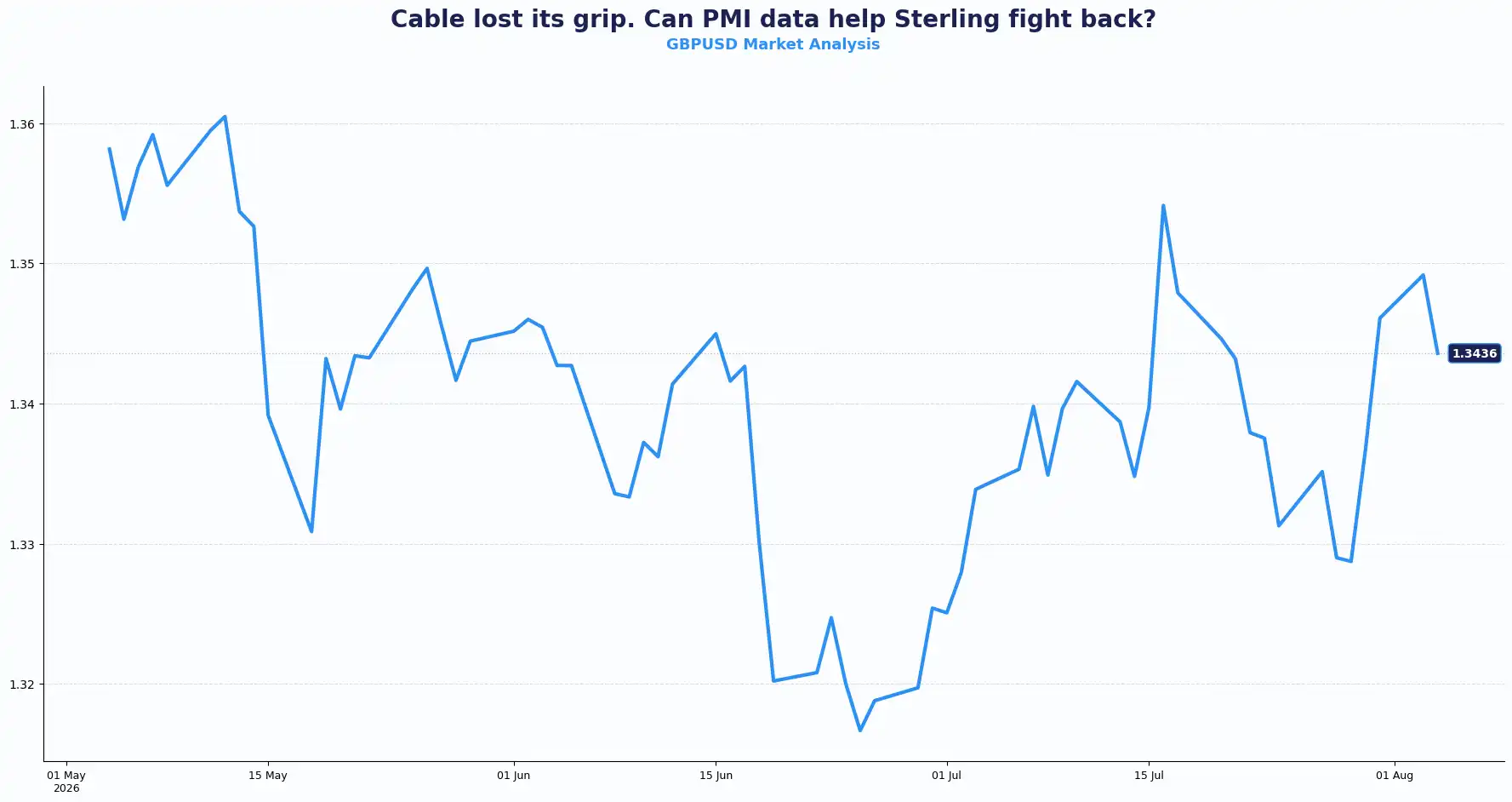
Key Technical levels for the GBP/USD pair: Resistance sits at 1.3470, 1.3500 and Support sits at 1.3420, 1.3400
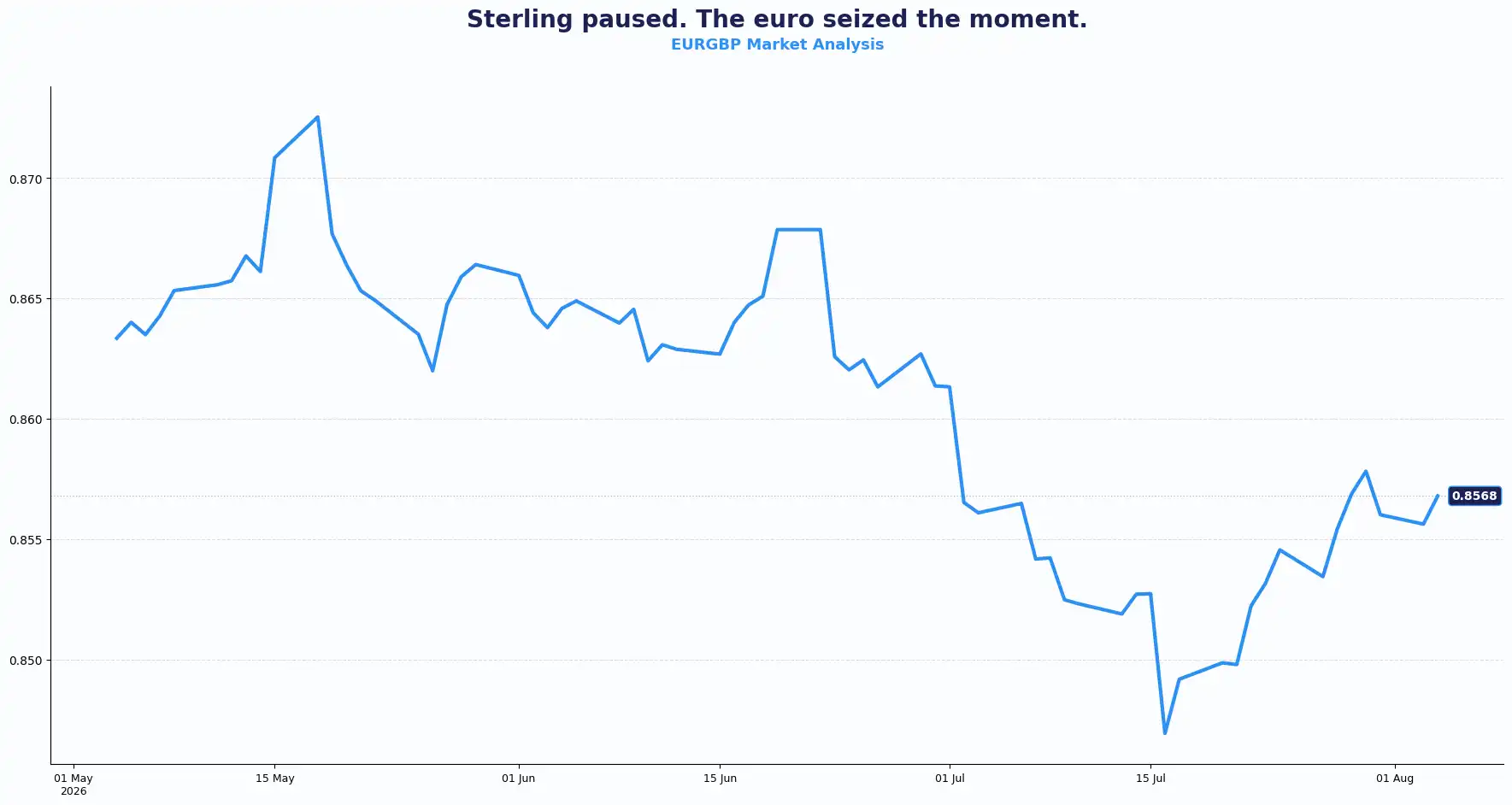
Key Technical levels for the EUR/GBP pair: Resistance sits at 0.8575, 0.8585, 0.8600 and Support sits at 0.8550, 0.8525
EUR: Euro Holds the Line at 1.15 as ECB Bets Stay Firm
EUR/USD: 1.1515
The euro holds around 1.1509 against the Greenback after surrendering early gains. US Treasury yields lifted off recent lows following strong ISM data, boosting the dollar and capping euro upside. The pair is holding above the 1.1500 handle for now.
The euro's underlying support is rooted in inflation data. Eurozone headline CPI rose to 2.9% YoY in July from 2.8% in June, in line with forecasts but pointing in the wrong direction for the ECB's price target. Core inflation accelerated to 2.5% YoY, topping expectations. ECB policymakers face persistent price pressures. Money markets now fully price in two ECB hikes, with the first expected by October and the second by April.
Oil price dynamics are adding a secondary layer to euro sentiment. Crude fell sharply on Monday as hopes of renewed US-Iran dialogue lifted risk appetite broadly. Lower energy costs have reduced inflation pressure across the eurozone, a factor that has tempered some of the more aggressive ECB rate hike pricing at the margin. A September move is still widely anticipated.
German yields pulled back sharply, but technical support is limiting further downside and the broader uptrend is intact. The EUR/USD pair may encounter renewed downside pressure towards 1.1400 if the dollar extends its current recovery. On the upside, the pair needs a clear hold above 1.1500 to maintain the constructive structure that has been building since late July.
Wednesday brings the Eurozone HCOB Composite and Services PMI alongside the Producer Price Index (PPI) for June. Friday follows with German and French trade balance figures and industrial production data. These data releases could offer a broader view of economic momentum across the bloc and help shape expectations for the ECB's next move.
For EUR/USD, attention extends beyond European data. US employment figures later this week could influence expectations for the Federal Reserve's (Fed) policy path and affect interest rate differentials between the two economies. As long as both central banks continue to balance inflation risks against slowing growth, incoming economic data will likely carry greater influence over price action than policy guidance alone.
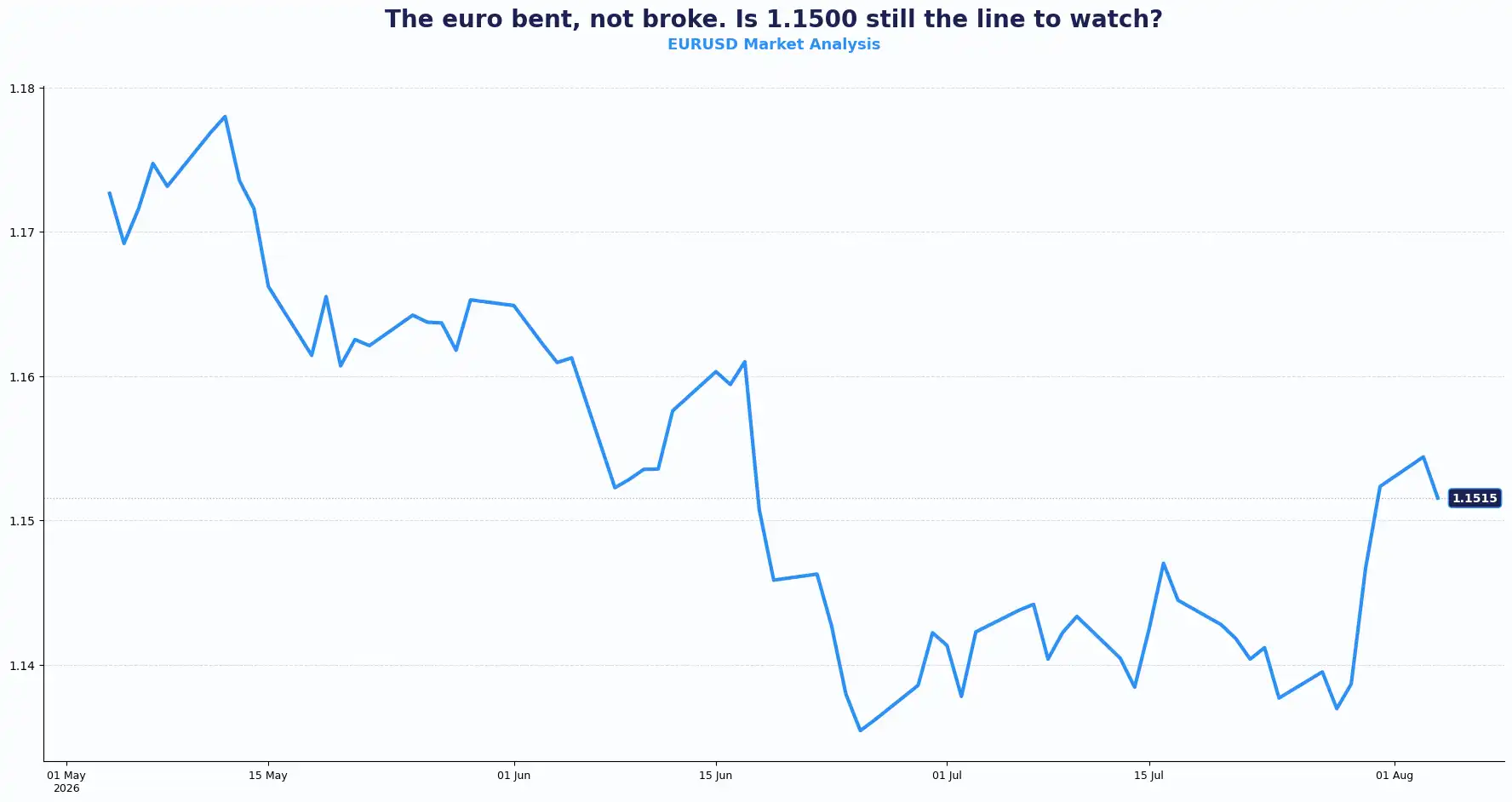
Key Technical levels for the EUR/USD pair: Resistance sits at 1.1550, 1.1600 and Support sits at 1.1500, 1.1400
USD: Dollar Finds Footing on Iran War Uncertainty and ISM Data Beat
DXY: 100.00
The dollar started the week on firmer footing after recovering from recent losses. The US Dollar Index (DXY) climbed back toward 100.00 on Tuesday after posting a fresh two-week low at 99.42 on Monday, as stronger economic data and geopolitical uncertainty encouraged investors to reduce risk exposure.
The biggest surprise came from the latest ISM Manufacturing PMI, which rose to 55.6 in July from 53.3 and comfortably beat expectations of 54.0. The stronger reading reinforced confidence that the US economy continues to outperform many of its developed peers. That lifted Treasury yields and gave the dollar fresh support against most major currencies.
Geopolitical headlines added another layer of support. President Donald Trump said discussions with Iran are under way, while Tehran denied direct negotiations. The conflicting messages kept uncertainty elevated and encouraged demand for traditional safe-haven assets, including the dollar.
Attention now shifts from policy signals to economic data. The Fed held rates steady in July. Fed Governor Williams stated that policy is well positioned and that inflation is expected to ease in the second half of the year. Meanwhile, Fed Chair Kevin Warsh is reported to be considering reducing regular FOMC meetings from eight to six per year. A structural shift that would represent the most significant change to Fed scheduling since the 1980s and place greater emphasis on incoming data, meaning each economic release now carries greater weight for interest rate expectations.
Rate expectations have already adjusted. CME FedWatch data now indicates around a 65% probability of a September rate increase, lower than expectations immediately after the July Federal Reserve meeting. That leaves the dollar increasingly sensitive to fresh economic evidence rather than central bank rhetoric alone.
Friday's jobs data is the next critical test. Economists forecast Nonfarm Payrolls (NFP) to increase by 83,000 in July, with the unemployment rate tipping up to 4.3%. A material beat on payrolls would put September firmly back on the table. A miss could complicate the case considerably.
JOLTS job openings and the goods trade balance for June are due later today. Tomorrow brings S&P Global's services and composite PMI alongside ISM services PMI. Traders will be parsing each reading for clues on the Fed's direction, given the explicit shift away from forward guidance under the current chair.
The dollar index can push towards 100.50 on continued uncertainty. German and US Treasury yields are stabilising after recent sharp moves, limiting disorderly extension in either direction.
For GBP/USD and EUR/USD, the focus now shifts towards whether incoming US data continues to justify dollar strength. If the labour market and services sector show further resilience, the dollar could extend its recovery. Softer releases would likely challenge that narrative and narrow interest rate expectations once again.
Yen, Aussie, Kiwi and the Commodity Complex
USD/JPY: 157.58 | AUD/USD: 0.7020 | NZD/USD: 0.5866 | GBP/JPY: 211.58
The yen held gains after coordinated US-Japan action to support the currency, though the possibility of further intervention is keeping markets alert. USD/JPY recovered to 157.58 after earlier dollar weakness.
The Aussie dollar is leading losses among the majors, sliding approximately 0.5% to near 0.6990 before recovering to 0.7020. Strong job ads data and resurgent inflation had supported the case for a hawkish Reserve Bank of Australia (RBA), but the firmer dollar and softer commodity prices are exerting pressure in the near term. AUD/USD could attempt a near-term rebound before the broader correction resumes.
The Kiwi dollar softened below 0.5900 against the backdrop of US-Iran uncertainty and the better ISM data, with NZD/USD trading near 0.5866. The Swiss franc weakened after July CPI dropped to 0.4%, a four-month low, signalling minimal energy cost pass-through to consumer prices. The Swiss National Bank's (SNB) monetary policy is priced by the markets to stay unchanged through the year-end.
Oil is trading with a mild positive bias just below $79.00 per barrel. WTI fell sharply on Monday on hopes of US-Iran dialogue but has since partially recovered as the geopolitical picture stays unresolved. Continued uncertainty over the Strait of Hormuz is keeping supply risk narratives active in the background.
Current Rate Table
| Pair | Rate | Trend |
|---|---|---|
| GBP/USD | 1.3436 | Bearish near-term |
| EUR/USD | 1.1515 | Neutral, holding above 1.1500 |
| EUR/GBP | 0.8568 | Mild upside bias |
| USD/JPY | 157.58 | Dollar recovery, intervention risk |
| AUD/USD | 0.7020 | Bearish near-term |
| NZD/USD | 0.5866 | Bearish |
| GBP/JPY | 211.58 | Weak GBP weighing |
Market lookahead:
Tues, Aug 04
- USD - Goods Trade Balance
- USD - JOLTS Job Openings (Jun)
Wed, Aug 05
- Composite PMI releases USD, GBP, EUR (Global)
- Eurozone Producer Price Index (PPI)
Thurs, Aug 06
- Germany Factory Orders (Jun)
- Eurozone Retail Sales
- US Initial Jobless Claims
Fri, Aug 07
- Germany’s Imports, Exports, Trade Balance (Jun)
- US Average Hourly Earnings (Jul)
- US NonFarm Payrolls (Jul)
- US Unemployment rate (Jul)
Stay Ahead in the Currency Game
Whether you're a daily FX trader or handle international transactions regularly, our 'Currency Pulse' newsletter delivers the news you need to make more informed decisions. Receive concise updates and in-depth insights directly in your LinkedIn feed.
Subscribe to 'Currency Pulse' now and never miss a beat in the currency markets!
Ready to act on today’s insights? Get a free quote or give us a call on: +44 (0)20 7740 0000 to connect with a dedicated portfolio manager for tailored support.
Important Disclaimer: This blog is for informational purposes only and should not be considered financial advice. Currency Solutions does not take into account the investment objectives, financial situation, or specific needs of individual readers. We do not endorse or recommend any specific financial strategies, products, or services mentioned in this content. Forward contracts can help businesses manage foreign exchange exposure by providing greater certainty over future exchange rates, although they may also mean that businesses do not benefit from favourable exchange-rate movements. Businesses should consider their individual circumstances and speak with their dealer to understand how forward contracts may support their specific foreign exchange requirements. All information is provided “as is” without any representations or warranties, express or implied, regarding its accuracy, completeness, or timeliness.