Dollar Holds Below 100 as Fed Hike Case Weakens; Mideast Stalemate Caps the Slide
9 min read
Share


The dollar index (DXY) sits at 99.82 as back-to-back soft CPI and PPI prints pull September Fed hike probability to 34.8%. Sterling presses 1.3500, caught between a softer dollar and Thursday's mixed UK data. UK GDP growth slowed in Q2 and industrial production contracted.
BoE's Pill insists growth still supports higher rates, but strategists note the October budget can act as a medium-term weight on the pound. The euro holds above 1.1535, still consolidating in range. Euro is drawing support from ECB September hike expectations while Hormuz tensions keep a lid on gains. Iran confirms no reopening talks are underway, embedding the geopolitical risk premium across all three pairs and putting a floor under the dollar's slide. US Retail Sales arrives today.
GBP: Cable Presses 1.3500 as Dollar Softens, Mixed UK Data Keeps the Ceiling
GBP/USD: 1.3522 | EUR/GBP: 0.8543
GBP/USD is testing 1.3500 after gaining traction around 1.3495 in early European trading as softer US inflation data weighs on the dollar.
US CPI data on Wednesday came in without surprise, and Thursday's PPI figures added to that picture. US producer prices were flat in July. The result fell short of expectations. Neither reading gives the Federal Reserve (Fed) an obvious mandate to tighten further. That shift has weakened the dollar and given the GBP/USD pair room to push higher.
What limits the pound's advance is the data it dragged into Friday. Thursday showed the UK economy grew 0.4% quarter-on-quarter in Q2 2026, slowing from the 0.6% pace of Q1. The figure landed in line with forecasts, no disappointment, but no acceleration either. Industrial production contracted in June, with manufacturing output falling noticeably. That softened the pound's footing just as the dollar started to slip. The services sector provided much of the support.
Bank of England (BoE) Chief Economist Huw Pill also pointed to stronger UK activity as a factor in the BoE's policy debate. Stronger-than-expected overall growth, he argued, supports the case for keeping borrowing costs elevated to bring inflation back to target. Pill's framing implies the BoE views its work as unfinished, even as the pace of expansion slows. His broader policy view continues to focus on inflation risks from energy prices and geopolitical disruption.
That creates a sharper GBP/USD story. US inflation is cooling. UK activity is holding up. The interest-rate gap could therefore move less in the dollar's favour if US data continues to soften.
Fiscal risk acts as a medium-term weight on sterling. With the UK budget on 28 October approaching, the pound could come under pressure as questions about fiscal headroom gain focus. That risk sits in the background for now.
The overarching ceiling on Cable's rally comes from geopolitics, not through economics. Iran's Islamic Revolutionary Guard Corps (IRGC), through senior official Hossein Taeb, asserted on Thursday that the Strait of Hormuz is under Iran's control and management, directly contesting Washington's claim of dominance over the waterway. That exchange keeps the geopolitical risk premium embedded in the dollar. The dollar's downside from fading hike bets "could still be thrown off course if oil prices spike higher again."
Higher crude prices could feed back into inflation expectations. OPEC has also cut its 2026 global oil demand growth forecast to 580,000 barrels per day from 780,000. The lower demand outlook offsets some of the supply concerns stemming from disruptions to key shipping routes.
The GBP/USD pair is testing 1.3500 while softer US inflation weighs on the dollar; UK growth data adds support as Hormuz risk limits the extent of dollar weakness.
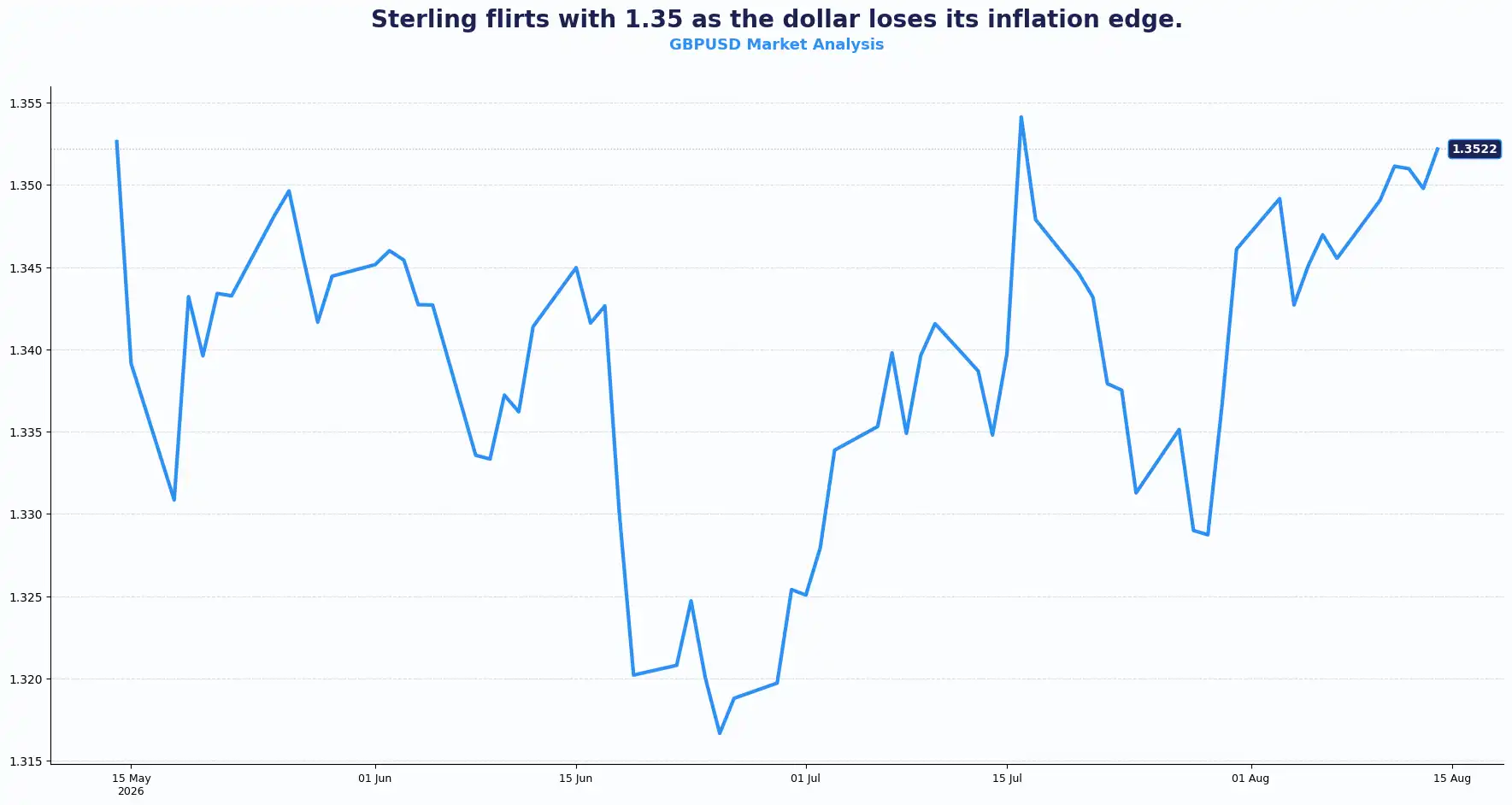
Key Technical levels for the GBP/USD pair: Resistance sits at 1.3546, 1.3600 and Support sits at 1.3450, 1.3400.
EUR: Bound by Range as ECB Hike Bets Offset Geopolitical Drag
EUR/GBP: 0.8543 | EUR/USD: 1.1557
The euro nudged higher towards $1.1542 in the early European session, building on Thursday's recovery from the $1.1500 area, where the pair touched its one-week low. The EUR/USD pair is trading within a two-week range and has yet to find a catalyst to break it convincingly in either direction. The pair is now testing 1.1550 again.
The euro has gained from the same dollar weakness supporting sterling. Softer US CPI and PPI data have reduced pressure for additional Fed tightening. US Treasury yields have also moved lower. That combination has reduced support for the dollar and allowed EUR/USD to recover.
EUR/GBP is holding near 0.8549, practically unchanged for the session, but has struggled to find acceptance above 0.8550 since then. On a weekly basis, the euro is modestly lower against sterling around 0.2%, but the cross is locked in a tug-of-war.
Thursday's UK data handed the euro a brief leg up. Industrial production contracted, and the pace of GDP growth slowed, adding weight to the argument that the BoE's rate path is constrained. Market consensus currently leans toward the BoE keeping rates on hold through year-end. The October UK budget leaves sterling exposed to renewed fiscal uncertainty as autumn progresses.
For the EUR/GBP pair, ECB expectations provide a floor, with a September hike as the prevailing assumption, which keeps the euro from losing ground substantially against a pound that is itself losing momentum. The cross lacks a near-term directional catalyst. Fiscal news flow and the ECB meeting calendar are where traders' focus would be for next directional cues.
For the EUR/USD pair, Eurozone inflation remains a policy consideration while growth signals lack the strength seen in parts of the US economy. On the ECB side, the market is increasingly settled on the view that the ECB will deliver one final 25-basis-point rate hike at its September meeting, with inflation still running above the 2% target. That expectation gives the euro independent support.
Against that, geopolitics cuts the other way. The US-Iran confrontation and risks around the Strait of Hormuz and the Red Sea continue to support defensive demand for the dollar. Oil supply disruption also creates an inflation risk for Europe. That could pressure growth while complicating ECB policy expectations. That level of event risk tends to restore demand for the dollar as a defensive currency and caps how far EUR/USD can stretch.
German wholesale prices offered a small data point on the day: July brought a 0.2% monthly rise following June's 0.7% contraction, though this fell short of the 0.4% increase forecast. Year-on-year, wholesale prices accelerated to 5.3% from 4.9%. The euro's response was limited.
EUR/USD therefore has a cleaner technical story than a fundamental one. The pair has recovered from 1.1500 but needs acceptance above 1.1550 to show stronger upside momentum.
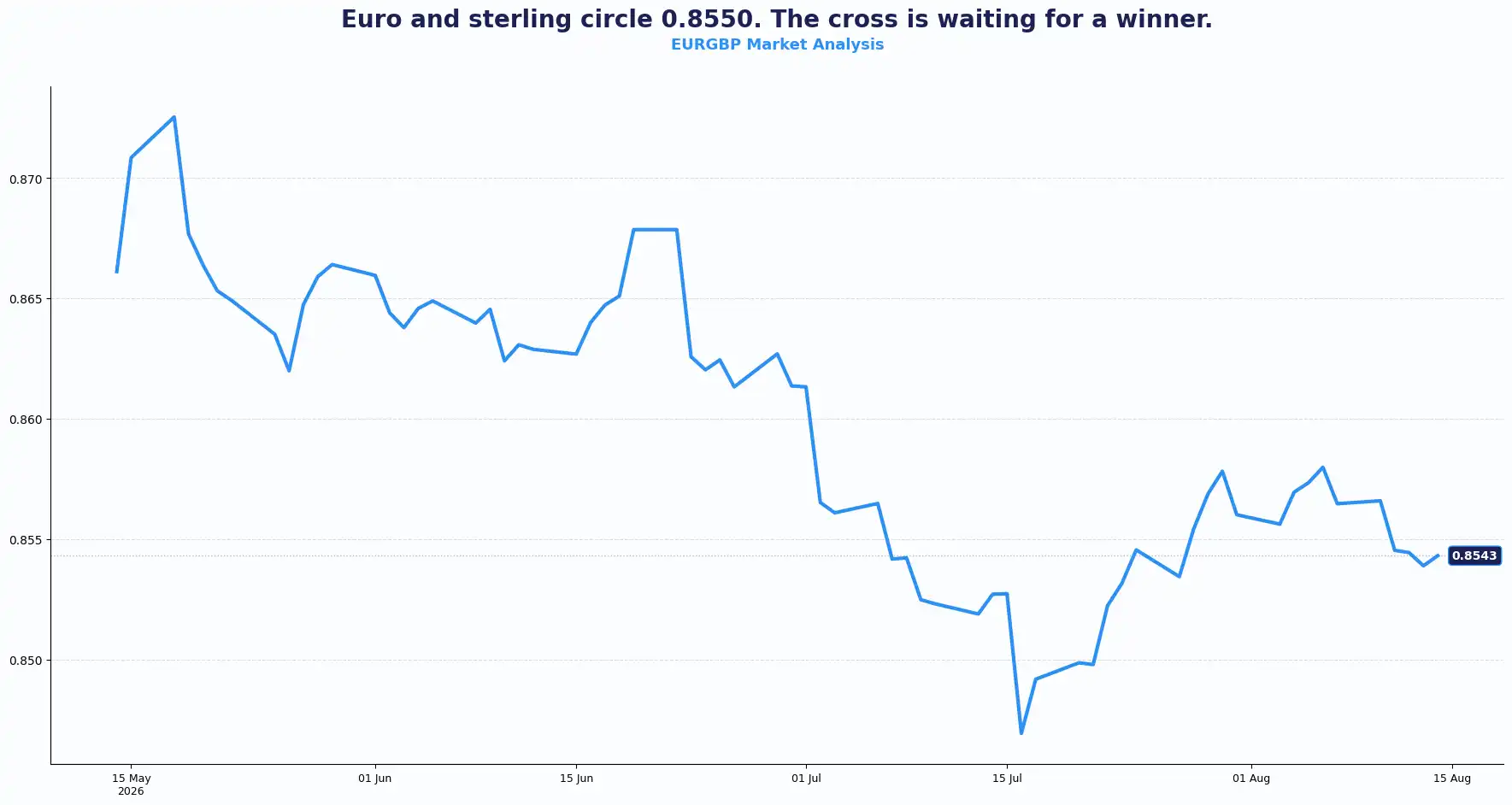
Key Technical levels for the EUR/GBP pair: Resistance sits at 0.8560, 0.8600 and Support sits at 0.8500
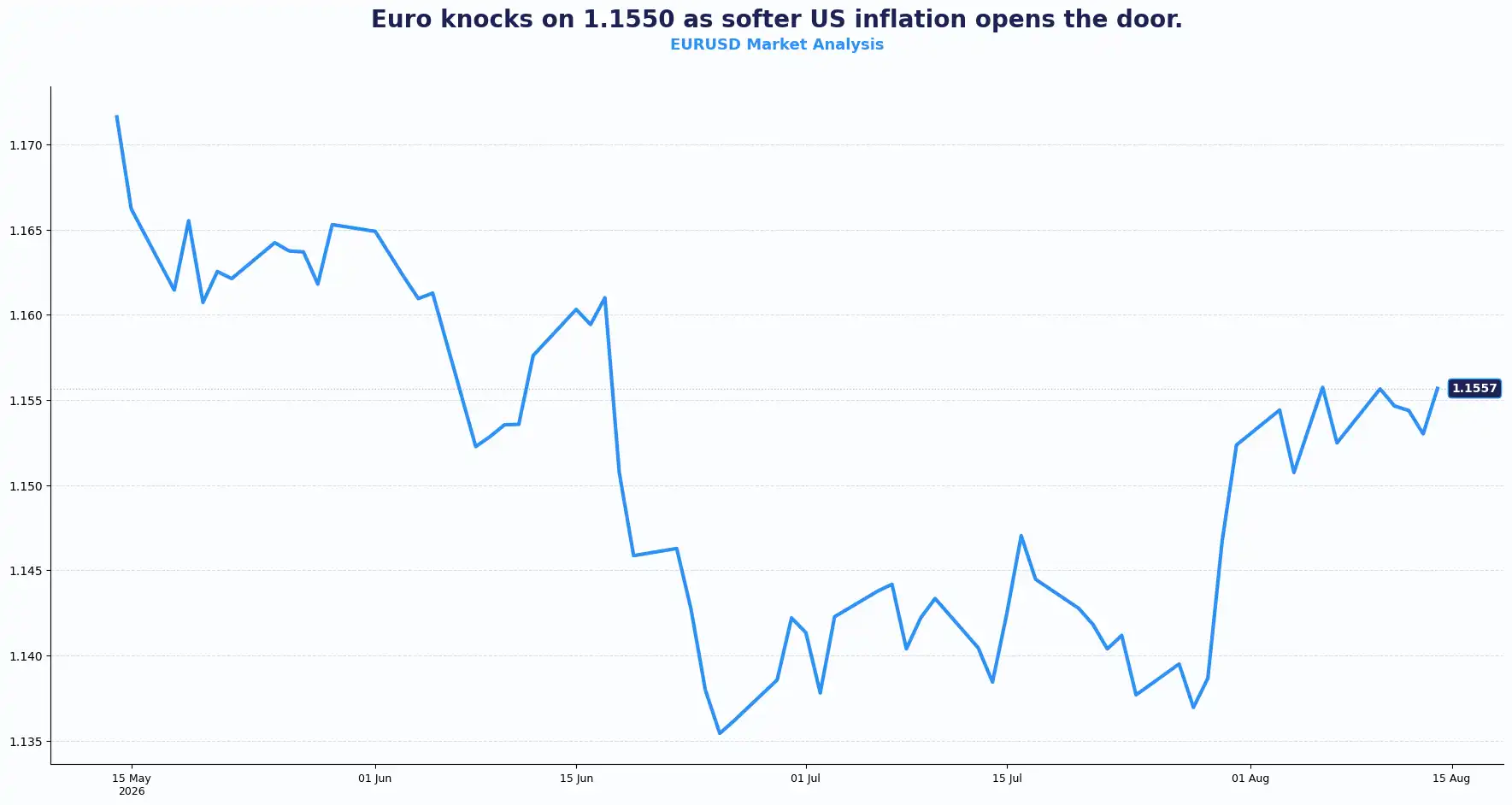
Key Technical levels for the EUR/USD pair: Resistance sits at 1.1550, 1.1565 and Support sits at 1.1500
USD: The Dollar Under The Weight of Falling Hike Bets
DXY: 99.73 | USD/CHF: 0.8140 | USD/JPY: 159.19
The US Dollar Index (DXY) declined to 99.73, holding steady below 100 as markets processed cooling producer and consumer price indicators.
Initial Jobless Claims rose to 209,000 for the last week, exceeding forecasts of 204,000 and providing further evidence of a cooling labour market.
Flat wholesale prices for July, against a forecast of 0.2% growth, reduced the Fed's argument for another move in September to a minority view. The CME FedWatch Tool puts the probability of a September hike at 34.8%.
Fed Governor Tom Barkin said that further monetary tightening is still an open question. His framing acknowledged that inflation may already be on a downward path toward target, without committing to a particular course.
Despite this, the dollar is not in free-fall. Geopolitical risk continues to function as a stabiliser.
The dollar still carries its traditional defensive role during geopolitical stress. Hormuz disruption keeps that role relevant. A renewed oil spike could also revive inflation concerns and alter expectations for Fed policy.
That makes the dollar story less about one-way weakness and more about competing forces. Softer US data pulls it lower. Geopolitical risk pulls it back towards defensive demand.
USD/CHF reflects part of that tension. The pair is around 0.8140 after a four-day rise. Softer US inflation has reduced some of the dollar's yield support. Swiss inflation also remains low, with June CPI inflation at 0.5% year-on-year.
The Japanese yen has also strengthened against the dollar. Softer US inflation reduces some of the yield advantage supporting the dollar, while expectations for further Bank of Japan (BoJ) normalisation keep the yen in focus.
US Retail Sales for July prints today. An upside beat could complicate the soft-landing narrative and prompt a reassessment of Fed expectations. A miss could reinforce the current trend.
Other currencies:
AUD/USD: 0.7068 | NZD/USD: 0.5869 | USD/JPY: 159.19 | GBP/JPY: 214.93
AUD/USD is around 0.7068. The Australian dollar is supported by the softer US inflation backdrop. The Reserve Bank of Australia's policy outlook still carries a risk of tightening if inflation pressures return.
NZD/USD is near 0.5869 after recovering from a two-week low. The fading US rate-hike narrative has reduced some of the dollar's support. Geopolitical risk still limits the upside.
USD/JPY near 159.19 reflects the same US rate story from another angle. Expectations for a possible Bank of Japan hike in September or October keep the yen sensitive to the US-Japan yield gap.
GBP/JPY at 214.93 also carries a cross-current. Sterling has support from stronger UK activity, while yen strength can emerge if expectations for BoJ normalisation build.
The common thread across these pairs is policy divergence. Softer US inflation has weakened one pillar of dollar support. Domestic inflation and growth data could decide how much room other currencies have to extend those moves.
The immediate FX picture, therefore, comprises three layers. Sterling and the euro have gained as the dollar loses some rate support. US inflation has changed the policy conversation. Geopolitical risk still has the potential to reverse that move, driven by oil and safe-haven demand.
Current Rate Table
| Pair | Rate | Trend |
|---|---|---|
| GBP/USD | 1.3522 | Mild bid |
| EUR/USD | 1.1557 | Mild bid |
| EUR/GBP | 0.8543 | Flat |
| AUD/USD | 0.7068 | Soft |
| NZD/USD | 0.5869 | Recovering |
| USD/JPY | 159.19 | Softening |
| GBP/JPY | 214.93 | Mixed |
| USD/CHF | 0.8140 | Softer |
Market lookahead:
Fri, Aug 14
- Eurozone Trade Balance (Jun)
- Eurozone GDP Q2
- US Retail Sales (Jul)
Stay Ahead in the Currency Game
Whether you're a daily FX trader or handle international transactions regularly, our 'Currency Pulse' newsletter delivers the news you need to make more informed decisions. Receive concise updates and in-depth insights directly in your LinkedIn feed.
Subscribe to 'Currency Pulse' now and never miss a beat in the currency markets!
Ready to act on today’s insights? Get a free quote or give us a call on: +44 (0)20 7740 0000 to connect with a dedicated portfolio manager for tailored support.
Important Disclaimer: This blog is for informational purposes only and should not be considered financial advice. Currency Solutions does not take into account the investment objectives, financial situation, or specific needs of individual readers. We do not endorse or recommend any specific financial strategies, products, or services mentioned in this content. Forward contracts can help businesses manage foreign exchange exposure by providing greater certainty over future exchange rates, although they may also mean that businesses do not benefit from favourable exchange-rate movements. Businesses should consider their individual circumstances and speak with their dealer to understand how forward contracts may support their specific foreign exchange requirements. All information is provided “as is” without any representations or warranties, express or implied, regarding its accuracy, completeness, or timeliness.