Pound Flat, Dollar Under Pressure as Hormuz Talks Advance
10 min read
Share


Sterling consolidating approaching the key trendline resistance at 1.3470 against the dollar, as a cautious BoE and an empty UK calendar keep the GBP/USD pair range-bound. The dollar is under pressure for a second session this week. JOLTS job openings missed forecasts, factory orders fell 0.3%, and Hormuz diplomacy is cooling safe-haven demand.
The US, Iran and Oman are closing in on a 60-day interim agreement, with a Wednesday announcement targeted. No final deal is confirmed. WTI slipped below $74.00 on reopening optimism. The euro continues to hold above $1.1500, edging towards 1.1550, anchored by firm ECB September hike pricing. Figures for US data ADP employment and ISM services PMI publish today. Friday's payrolls cues us on the dollar's next move.
GBP: Gilts Drag Sterling as Rate Hikes Fade
GBP/USD: 1.3468 | EUR/GBP: 0.8567
Sterling holds near 1.3455 against the dollar during Wednesday's European session, eyeing the 1.3470 level. The pound is down roughly 0.1% on the day. The dollar picked up momentum off a rebound in 10-year US Treasury yields, yields that had dipped toward 4.61% on Tuesday after energy prices eased and inflation fears cooled. The yield recovery handed the dollar a fresh bid and pulled sterling back from the prior day's modest gains.
Nothing about this move is domestically driven. The Bank of England's (BoE) meeting last week reinforced the view that policymakers see no urgency to tighten further. Rate hike expectations for 2026 got pared back sharply. Several BoE members indicated rate cuts could return to the table if Middle East tensions continue to ease, a signal that pushed sterling onto the back foot against peers pricing firmer policy.
The irony? The domestic data backdrop has been about as constructive as a pound bull could wish for. July flash services PMI's are due later and are forecast at 51.8, back above the expansion line after two months of contraction. Manufacturing PMI hit a 22-month-high. The UK composite is seen at 52.1. None of it appears to be shifting the pair significantly.
The BoE's own framework explains this disconnect. The Committee's stated upside risk to inflation is the energy shock, and that shock is priced in the Persian Gulf, not in Britain. Governor Bailey flagged that headline inflation has already fallen faster than expected to 2.6%. So the same Hormuz headline that lifted global risk appetite on Tuesday is also the force most likely to dismantle the BoE's hawkish minority before September. The next BoE decision is 17 September. Six weeks away. Every catalyst this week is from the American side.
The UK docket is effectively near empty this week. What is driving sterling this week is the dollar leg, and the dollar leg answers to Friday's US payrolls. A downside surprise in non-farm payrolls (NFP) could ease the dollar, giving the GBP/USD pair scope to test back toward 1.3470. A strong print tips the balance the other way. The downward-sloping trend line near 1.3470 is the pair's immediate technical ceiling.
On the EUR/GBP cross, the euro holds near 0.8570, having bounced from support near 0.8540. Services PMI data from both the eurozone and the UK later today is the near-term swing factor for the cross. Lower oil prices and the positive risk tone have given the euro a mild relative advantage against sterling this week, in addition to UK Gilts, which underperformed European sovereign bonds, capping pound upside potential.
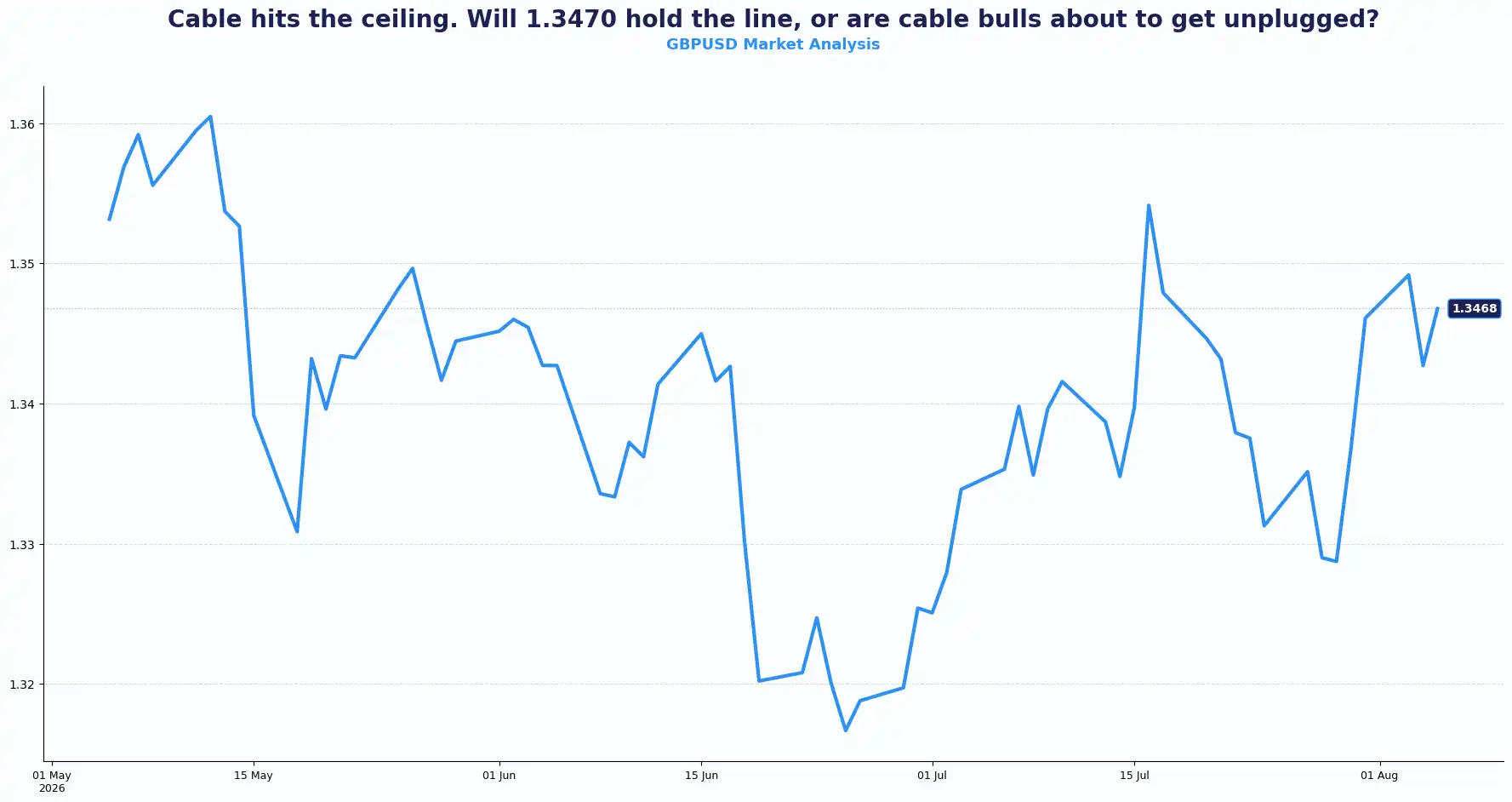
Key Technical levels for the GBP/USD pair: Resistance sits at 1.3470, 1.3530 and Support sits at 1.3390, 1.3340
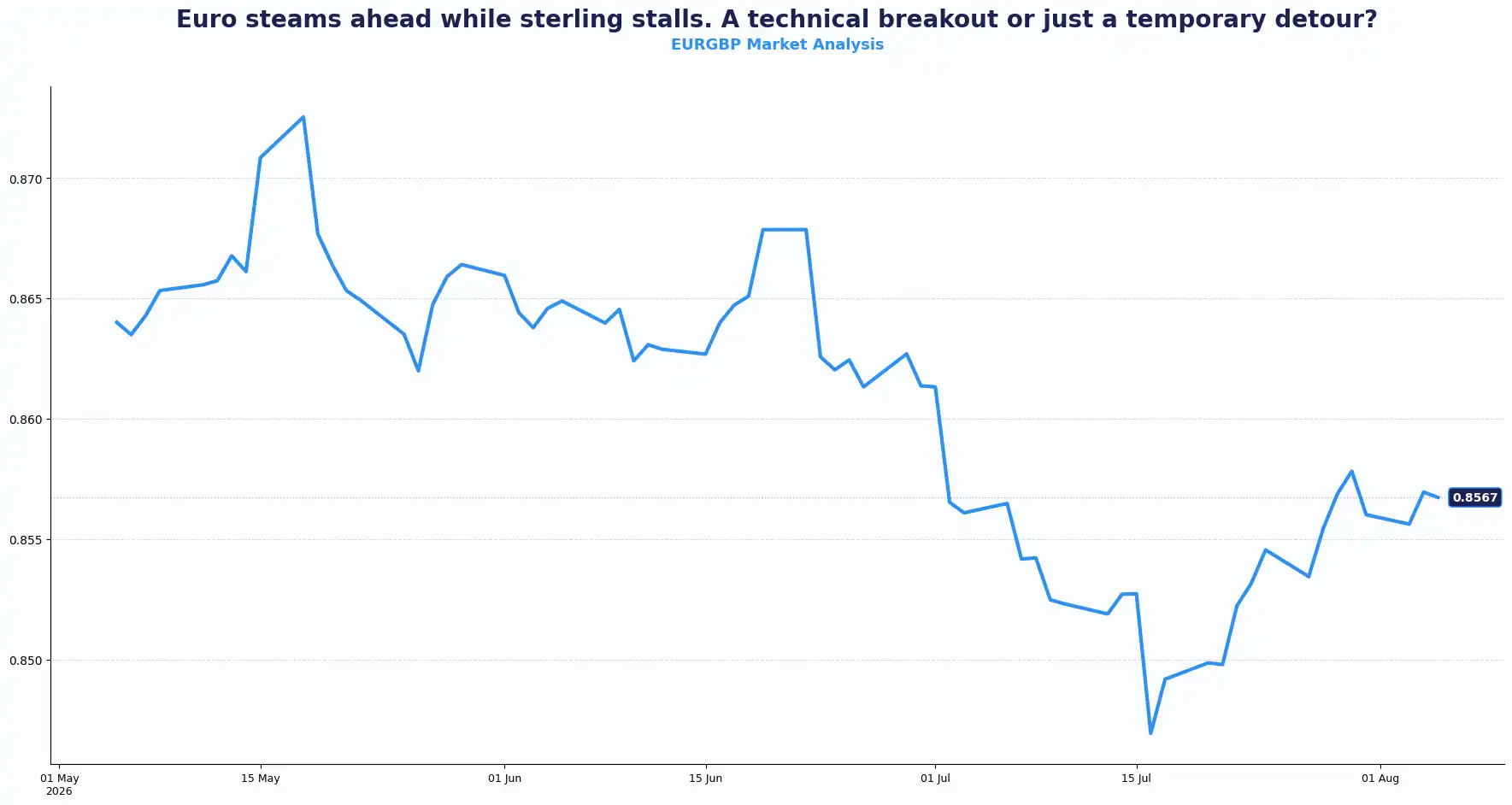
Key Technical levels for the EUR/GBP pair: Resistance sits at 0.8600, 0.8630 and Support sits at 0.8540, 0.8510
EUR: Hawkish ECB Bets Underpin European Currency Strength
EUR/USD: 1.1542 | EUR/GBP: 0.8567
The EUR/USD trades around the mid ~1.1500’s, holding above the 1.15 handle through Wednesday's European session.
The pair reversed Monday's dip and has consolidated above 1.1500 after reclaiming the level on Tuesday. The euro is trading quietly; no major eurozone data has landed this session, but the underlying bid is structural. Buyers retained control, but the pair paused ahead of fresh Eurozone and US data.
The latest move reflects policy expectations more than economic surprises. Investors continue to price in another 25 basis point European Central Bank (ECB) rate hike in September, giving the euro a steady foundation even as trading turns cautious. That expectation has changed little over recent sessions and continues to separate the ECB's outlook from other major central banks.
ECB Governing Council member Martin Kocher reaffirmed last week that the central bank is data-dependent but committed to bringing inflation back to 2% on a sustainable basis. He flagged the pace at which geopolitical developments can shift energy prices and the inflation picture. That acknowledgement of ongoing upside inflation risk keeps the ECB's stance leaning hawkish even where language is cautious. The pledge to decide in autumn based on incoming data is conditional, but the direction of the conditionality points toward further restraint rather than easing.
That policy setup gives the euro a firmer floor than the pound. Where the BoE is signalling hesitation, the ECB is signalling intent. Divergence of that kind tends to work through to the EUR/GBP cross over time.
The euro also caught a tailwind from lower oil prices and a positive risk mood earlier this week. But the market's appetite to rebuild euro longs toward last year's highs is still limited. Uncertainty about how elevated energy prices, if they return, will feed through to eurozone growth and inflation is keeping market positioning measured.
Eurostat publishes Eurozone Producer Prices (PPI) for June later today. The consensus is a 0.3% monthly contraction after the 0.2% rise in May, with the annual rate easing to 4.6% from 5.9% previously. A softer-than-expected print could temper ECB hike bets at the margin, putting mild pressure on the EUR/USD pair. A firmer print cements the September move and gives the euro more support going into Friday's US payrolls.
The US ADP Employment Change for July also publishes today. This is the week's critical pre-payrolls read. The Fed has stepped back from providing forward guidance, which means incoming data now does the heavy lifting on rate expectations. A soft ADP print could ease the dollar's rebound and give the EUR/USD room to push toward 1.1550 and above.
For now, the euro sits between supportive ECB expectations and an uncertain global backdrop. The central bank still leans towards further tightening if inflation demands it, while investors continue to weigh incoming data against shifting US policy expectations. Until either side delivers a decisive surprise, EUR/USD is likely to stay anchored around the 1.15 area, with both central banks sharing the spotlight over the coming sessions.
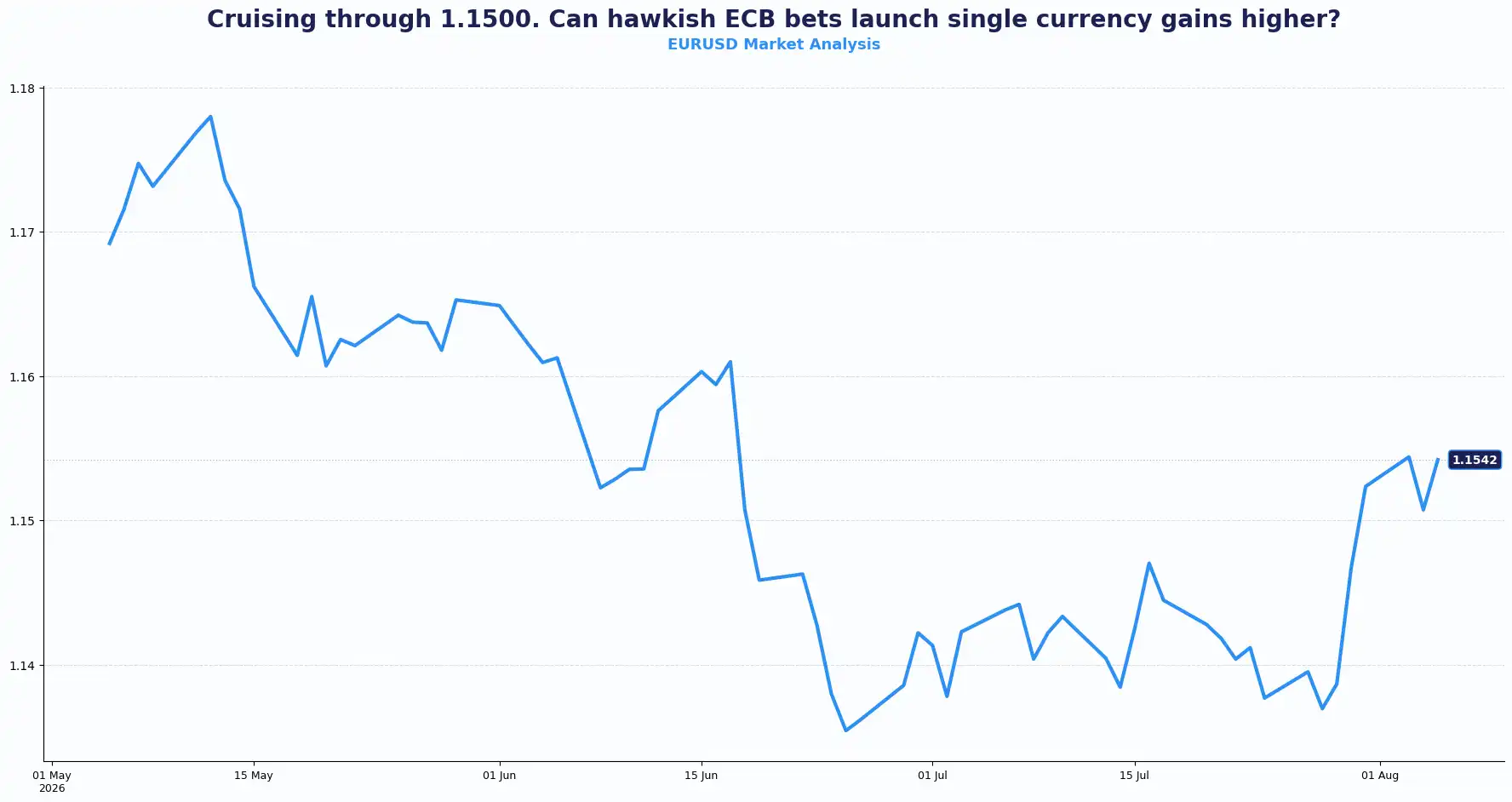
Key Technical levels for the EUR/USD pair: Resistance sits at 1.1550, 1.1600 and Support sits at 1.1500, 1.1460
USD: Dollar Awaits Jobs Data as Yields Rebuild Support
DXY: 99.83
The dollar steadied after a mixed start to the week as Treasury yields recovered and traders looked ahead to another round of US labour data. The US Dollar Index (DXY) traded near 99.83, holding above recent lows even as geopolitical tensions eased and demand for traditional safe havens faded.
The rebound in Treasury yields gave the dollar fresh support. Falling energy prices had eased inflation concerns earlier in the week and pushed yields lower, but that move proved short-lived. As yields recovered, the dollar found buyers again despite improving risk sentiment.
Tuesday's US data leaned soft; JOLTS job openings came in at 7.36 million against a 7.4 million consensus, and factory orders fell 0.3% versus expectations of a 0.2% gain. Those figures pointed to slower momentum across parts of the economy, but they did not fundamentally alter expectations for Federal Reserve (Fed) policy.
The Hormuz situation is still fluid. Qatari officials confirmed on Tuesday that an interim proposal was drafted, with both Washington and Tehran signalling progress. US Secretary of State Marco Rubio said talks with Iran and Oman have advanced but that no final deal has been reached. However, Iran stated its negotiations with Oman are separate from US participation and that it is pursuing an "intermediate corridor" arrangement of its own design. An Iranian official added that Trump has violated commitments and that Iran is shaping its Hormuz approach independently of US demands. Progress, but not finality.
The pattern here is important. Sustained Hormuz optimism pulls oil lower. Lower oil cools inflation fears. Cooled inflation fears reduce the urgency for additional Fed hikes. That chain of logic weighs on the dollar. But any reversal in diplomatic progress and the Iranian commentary this week suggests that reversal risk is alive and could snap safe-haven demand back quickly and put a bid back under the DXY.
The structural picture for the dollar is not straightforwardly bearish. Fed's Schmid pushed back this week on the idea that current policy is tight, saying inflation is "too high" and "worrisome" and flagging AI-driven investment as a fresh inflation driver. He cautioned that recent disinflation is too tentative to confirm a trend and pointed to PCE as the preferred gauge, with energy relief possibly temporary. Those comments support the view that the Fed is not ready to declare victory over inflation.
Futures pricing captured at the end of July put at least one Fed hike at approximately 59% probability by September, with no cuts priced at any 2026 meeting. Friday's non-farm payrolls will either validate that pricing or force a reset. The dollar's next directional move hinges on that print.
Energy prices remain another key variable. WTI crude slipped below $74 as negotiations continued and US crude inventories unexpectedly rose by 2.69 million barrels. Lower oil prices could ease inflation pressure over time, but policymakers continue to warn that geopolitical developments can reverse that trend quickly.
For now, the dollar sits between softer economic data and a Fed that still signals caution on inflation. Treasury yields continue to provide support, while incoming labour data will determine whether that support strengthens or weakens over the coming sessions. As a result, the next move in the dollar is likely to depend less on headlines and more on whether the US economy continues to show resilience.
Other Currencies | Risk Mood Rules the Crosses
AUD/USD: 0.7044 | NZD/USD: 0.5870 | USD/JPY: 157.62 | GBP/JPY: 212.10
The Australian dollar is consolidating near its highest level since 17 June, trading around 0.7044. Mixed signals from the Hormuz talks revived some safe-haven dollar demand on Wednesday and are capping the pair's upside from here. China's services PMI for July came in weak, giving AUD bulls little additional support; the pair's gains this week remain more of a dollar story than an Australian one.
The New Zealand dollar has tumbled towards 0.5870 after New Zealand's unemployment rate jumped to its highest level since September 2015 in Q2. The domestic labour market deterioration is a clear NZD headwind. Any further progress on the Hormuz front and a softening dollar could limit the downside from here, but the fundamental backdrop for the kiwi has weakened materially.
USD/JPY holds at 157.62 with the yen drawing some modest support as risk aversion eases and the dollar corrects. The Swiss franc is gaining in similar fashion as the dollar softens. Both the franc and the yen tend to give back grounds quickly if safe-haven demand returns, which makes the Hormuz situation a live swing factor for these pairs too.
The week has settled into a familiar pattern. Sterling continues to track US developments more closely than domestic news. The euro draws support from expectations that the ECB will keep its anti-inflation stance intact. The dollar looks to labour market data for its next direction, while commodity and Asia-Pacific currencies respond to the balance between global risk appetite and local economic releases.
The next decisive move across the major pairs is likely to come from incoming US employment data, central bank expectations and any further developments surrounding the Strait of Hormuz. Together, those themes continue to shape currency pricing across the G10 space more than any single domestic release.
Current Rate Table
| Pair | Rate | Trend |
|---|---|---|
| GBP/USD | 1.3468 | Neutral / consolidating |
| EUR/USD | 1.1542 | Mild bullish bias |
| EUR/GBP | 0.8567 | Flat to mild EUR strength |
| AUD/USD | 0.7044 | Consolidating near highs |
| NZD/USD | 0.5870 | Bearish |
| USD/JPY | 157.62 | Dollar correcting lower |
| GBP/JPY | 212.10 | Range-bound |
Market lookahead:
Wed, Aug 05
- Composite PMI releases USD, GBP, EUR (Global)
- Eurozone Producer Price Index (PPI)
Thurs, Aug 06
- Germany Factory Orders (Jun)
- Eurozone Retail Sales
- US Initial Jobless Claims
Fri, Aug 07
- Germany’s Imports, Exports, Trade Balance (Jun)
- US Average Hourly Earnings (Jul)
- US NonFarm Payrolls (Jul)
- US Unemployment rate (Jul)
Stay Ahead in the Currency Game
Whether you're a daily FX trader or handle international transactions regularly, our 'Currency Pulse' newsletter delivers the news you need to make more informed decisions. Receive concise updates and in-depth insights directly in your LinkedIn feed.
Subscribe to 'Currency Pulse' now and never miss a beat in the currency markets!
Ready to act on today’s insights? Get a free quote or give us a call on: +44 (0)20 7740 0000 to connect with a dedicated portfolio manager for tailored support.
Important Disclaimer: This blog is for informational purposes only and should not be considered financial advice. Currency Solutions does not take into account the investment objectives, financial situation, or specific needs of individual readers. We do not endorse or recommend any specific financial strategies, products, or services mentioned in this content. Forward contracts can help businesses manage foreign exchange exposure by providing greater certainty over future exchange rates, although they may also mean that businesses do not benefit from favourable exchange-rate movements. Businesses should consider their individual circumstances and speak with their dealer to understand how forward contracts may support their specific foreign exchange requirements. All information is provided “as is” without any representations or warranties, express or implied, regarding its accuracy, completeness, or timeliness.