USD/CAD Holds Firm Amid Shifting Economic Signals
7 min read
Share


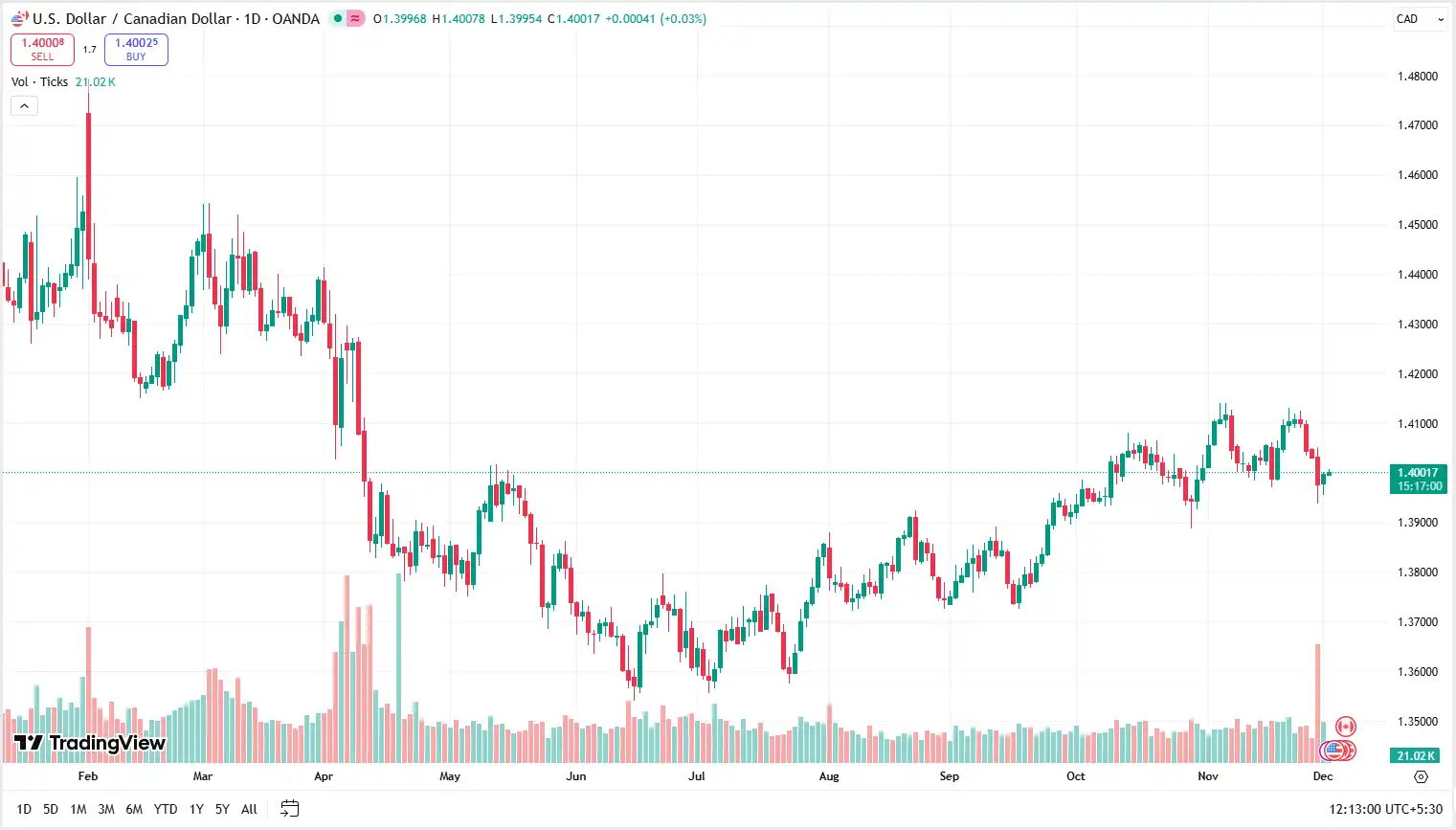
The USD/CAD pair traded around 1.4000[1] in Tuesday’s early trading, consolidating Monday’s rebound as the US dollar recovered from recent monthly lows. The price action shows the pair stabilising after a dip towards 1.3950[2], with buyers reappearing despite weak US economic data. A cautious tone in global markets has given the greenback modest short-term support, keeping the pair comfortably above the 1.4000 level.
Market reports[3] point out that the US Dollar Index has bounced back to 99.40 after briefly dipping to 99.00, as the ISM Manufacturing PMI slipped further into contraction at 48.2. This data supports expectations of another Federal Reserve (Fed)[4] rate cut in December, yet the dollar’s resilience hints that investors want clearer signals from upcoming labour and services-sector reports before pricing in more easing. Mixed signals continue to support the pair in the short term, even though medium-term pressures for the dollar remain. Weaker US labour data[5] also affects greenback sentiment, indirectly weighing on the pound by shifting rate-differential expectations.
Market commentators[6] point out that the investors now look ahead to the ADP Employment Change and ISM Services PMI, which could set the tone for the US dollar’s near-term path. Should there be further signs of weakening in labour demand or services activity, the dollar’s upside may be capped, limiting further gains for the pair[7]. However, steady readings would likely keep the pair supported above immediate technical levels, with 1.3950 remaining a key short-term floor.
Analysts[8] suggest that in Canada, the loonie is expected to stay range-bound before Friday’s labour market report. Expectations of unemployment rising to 7.0%[9] signal limited support for the Canadian dollar in the coming days and might bias the pair higher. However, medium-term risks remain if US data worsens, which could weigh on the dollar and limit the pair’s upward momentum. The USD/CAD exchange rate remains supported above 1.4000 as mixed US data and cautious market sentiment keep the pair biased slightly higher in the near term.
EUR/USD Extends Gains as Dollar Weakness Persists
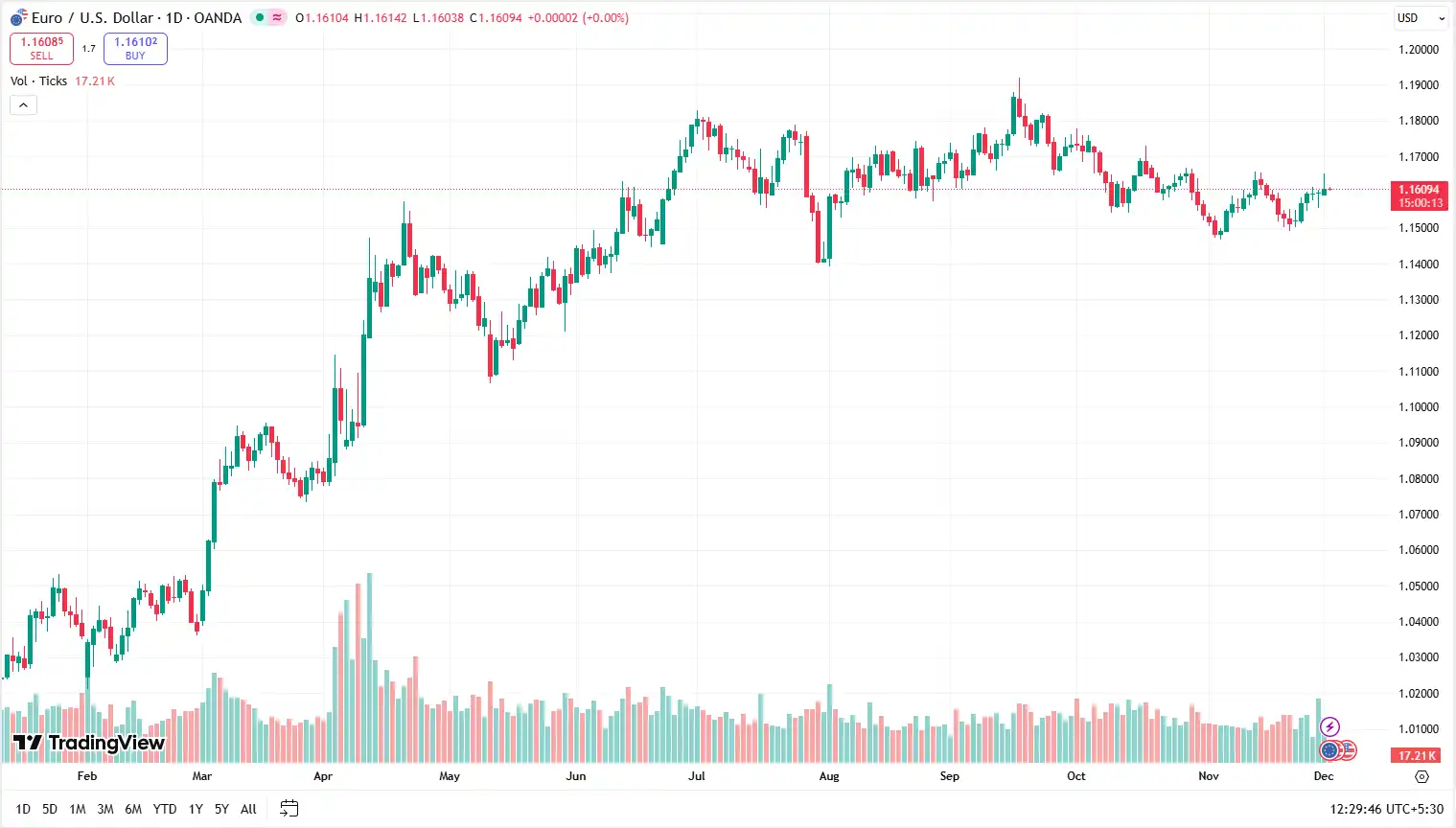
The EUR/USD pair continued its rise towards 1.1610[10] during Tuesday’s Asian session, helped by ongoing US dollar weakness after disappointing US manufacturing figures. Near-term price movement[11] shows a continued bullish trend from early in the week, with buyers taking advantage of lower US yields and changing Fed policy expectations. Initial intraday support[12] is now around 1.1560, while resistance at 1.1620 stands as the first technical barrier to further upside.
Market reports[13] indicate that the latest ISM Manufacturing PMI, which dropped to 48.2 in November, has heightened concerns over the US industrial sector's slowdown. Marking a ninth straight month of contraction, the data has strengthened market belief that the Fed[14] could cut rates later this month. Fed funds futures now show an almost 87% chance[15] of a December cut, putting significant pressure on the greenback. This reduces its short-term scope to bounce back against the euro, limiting recovery prospects for the dollar in the near future.
Market commentators[16] point out that the euro has gained further support amid rising expectations that the European Central Bank (ECB) has ended its easing cycle. Recent remarks from ECB President Christine Lagarde[17] and other policymakers show confidence in the current policy stance, offering a modest fundamental floor for the euro. This environment has helped steady the pair’s upside momentum, despite ongoing uncertainty over growth prospects in the Eurozone.
Analysts[18] indicate that market attention now shifts to the Eurozone’s HICP inflation data, with expectations of softer readings. Softer inflation may limit pair gains for now, but the outlook remains uncertain. The upcoming US labour-market updates will also shape market sentiment. Signs of US economic weakness could undermine the dollar, supporting the pair short-term. The EUR/USD exchange rate remains supported by dollar weakness and sustained euro bullish momentum.
EUR/GBP Holds Steady as Policy Uncertainty Persists
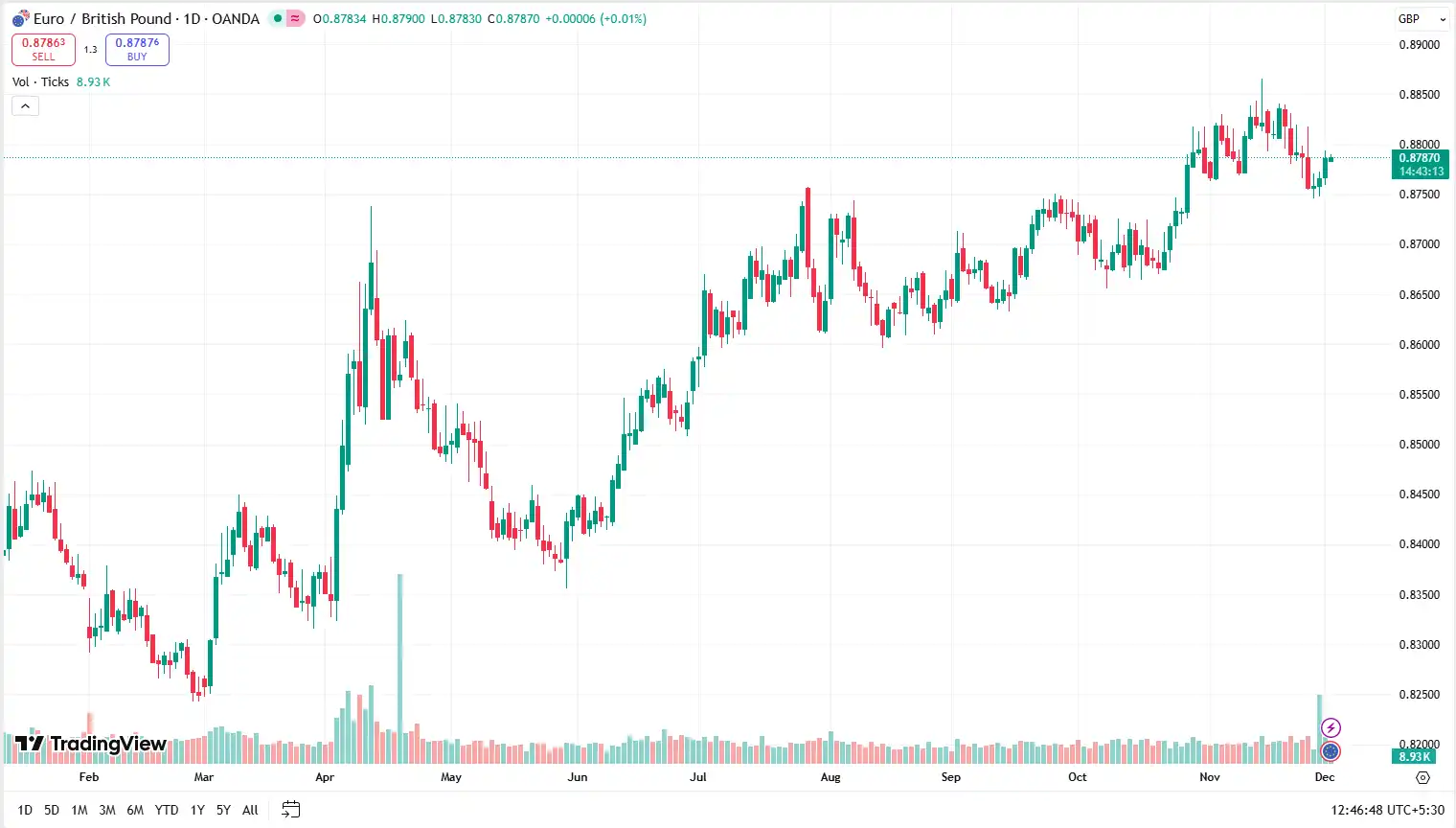
The EUR/GBP hovered near 0.8786[19] in Tuesday’s early European trading, with price action showing consolidation as markets await the Eurozone’s flash HICP inflation figures. The pair has been trading within a fairly narrow range, with buyers stepping in on dips amid persistent uncertainty over UK monetary policy[20]. Immediate support is located around 0.8750, while resistance remains at 0.8800, a level bulls have struggled to breach convincingly in recent sessions.
Market reports[21] point out that the sterling’s tone remains generally subdued as expectations grow for a December rate cut by the Bank of England (BoE). Softer UK inflation data and signs of labour market cooling add to expectations of policy easing. The November Autumn Budget’s fiscal impact, especially plans to raise taxes by £26 billion[22] by 2029–30, also weighs on sentiment. Analysts now increasingly see a cut to 3.75%, which is dampening the pound and offering a mild near-term boost for the pair.
Market observers[23] note that in the Eurozone, the pair is supported by a more cautious approach from the ECB. Statements from President Christine Lagarde and Council member Joachim Nagel[24] confirmed that rates remain at a suitable level, and the easing cycle has effectively halted. This firmer policy stance reduces downside risk for the euro ahead of important upcoming data.
Analysts[25] indicate that in the near term, the Eurozone flash HICP is expected to drive intraday volatility. Softer-than-expected inflation could challenge euro momentum. Beyond Europe, upcoming US releases, such as ISM-linked sentiment data[26] and recent weaker labour indicators, add caution to global risk sentiment. These factors may temper sterling demand in the medium term. The pair remains supported but vulnerable to shifts in inflation expectations on both sides of the Channel. The EUR/GBP exchange rate remains mildly supported as softer UK rate expectations and a steadier ECB stance keep the pair biased toward the upper end of its recent range.
NZD/USD Strengthens as Dollar Outlook Weakens
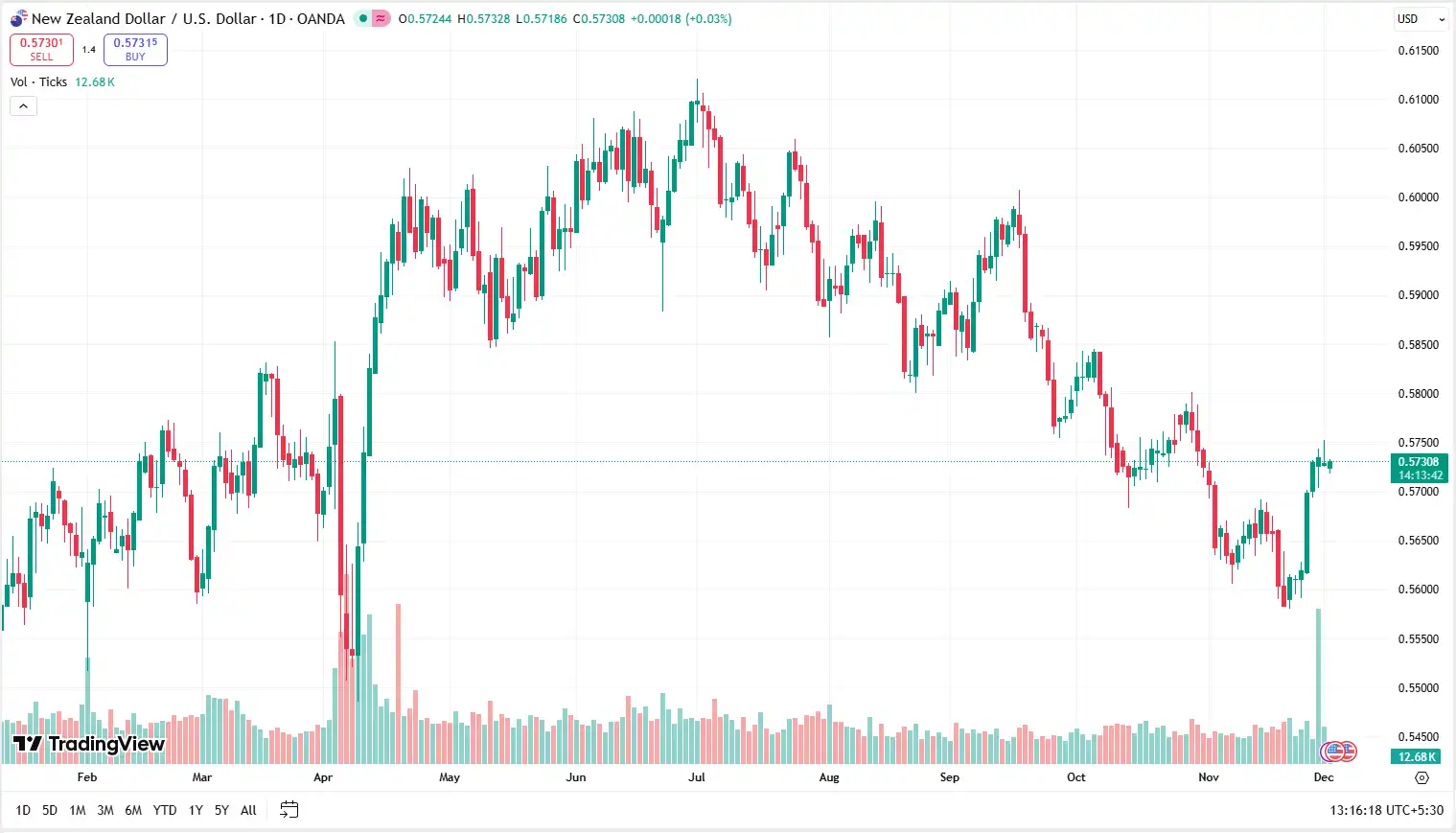
The NZD/USD pair continued its recovery, trading near 0.5730[27] during Tuesday’s early European session, as the US dollar weakened before next week’s Fed decision. Price movements show a positive short-term outlook for the kiwi, with buyers buoyed by rising expectations of a further Fed rate cut this December[28]. Markets now assign roughly an 85–88%[29] probability of a 25 bps Fed rate cut, up noticeably from earlier in the month. This shift puts continued downward pressure on the greenback, offering support to the NZD/USD pair.
Market reports show the New Zealand dollar gaining some stability after last week’s Reserve Bank of New Zealand (RBNZ)[30] decision. Policymakers delivered a widely expected 25 bps cut but indicated the easing cycle might be ending. The RBNZ’s warning that future changes depend on the inflation outlook lessens the chance of sharp further cuts[31]. This helps limit downside risks for the New Zealand dollar and offers modest balance against US dollar-driven moves.
Market commentators indicate that the medium-term outlook remains fragile. Traders now focus on China’s upcoming RatingDog Services PMI[32], expected to ease to 52.0 in November. Any downside surprise might weigh on the kiwi, due to New Zealand’s significant trade links with China. A weaker-than-expected reading could undo recent gains. It may also reignite selling pressure if broader risk sentiment worsens.
Analysts[33] highlight that in the US, attention will shift to economic releases like the services PMI and labour market data. Recent cooling signs have strengthened expectations of further Fed[34] easing, which weighs on the US dollar short-term. However, ongoing weak data may revive concerns about US economic momentum, possibly limiting risk appetite and capping the pair’s upside as global growth risks are reconsidered. The NZD/USD exchange rate is supported by a weaker US dollar and stabilising domestic conditions, though broader global risks may still cap its gains.
Stay Ahead in the Currency Game
Whether you're a daily FX trader or handle international transactions regularly, our 'Currency Pulse' newsletter delivers the news you need to make more informed decisions. Receive concise updates and in-depth insights directly in your LinkedIn feed.
Subscribe to 'Currency Pulse' now and never miss a beat in the currency markets!
Ready to act on today’s insights? Get a free quote or give us a call on: +44 (0)20 7740 0000 to connect with a dedicated portfolio manager for tailored support.
Important Disclaimer: This blog is for informational purposes only and should not be considered financial advice. Currency Solutions does not take into account the investment objectives, financial situation, or specific needs of any individual readers. We do not endorse or recommend any specific financial strategies, products, or services mentioned in this content. All information is provided “as is” without any representations or warranties, express or implied, regarding its accuracy, completeness, or timeliness.