The Dollar's War Premium, How Long Can It Hold?
7 min read
Share


Trump signals a swift end to the Middle East conflict. Global asset classes pivot on his words. Energy volatility shakes FX. Sterling holds firm, the euro steadies after a slide amidst energy pricing fears, and the dollar gives back gains as traders price war risk and inflation pressure. Asia rebounds on Trump's war comments.
GBP: Sterling's Resilience Amidst Policy Gridlock
The pound holds its ground near $1.3440 today, refusing to yield after Monday’s brief slip. While the currency shows resilience, the underlying narrative shifted overnight. Rising energy costs now dictate the Bank of England’s (BoE) hand. Inflation concerns have effectively erased expectations for a rate cut this month.
The Strait of Hormuz crisis fundamentally altered the UK rate path. Traders now price in less than a 20% chance of a rate cut in March, a staggering drop from 80% before the conflict. Further anticipating a less than 25 bps reduction for the remainder of this year. High energy prices threaten to bake inflation into the economy, forcing the BoE to maintain its restrictive stance.
If oil stays elevated, inflation expectations may edge higher. That narrows the room for near-term easing. If growth cracks, the debate swings back to cuts. For now, inflation risk leads.
Political friction adds another layer of complexity. UK Prime Minister Keir Starmer chose diplomacy over joining the initial US-Israeli strikes on Iran. Meanwhile, US President Donald Trump’s dismissal of British naval strategy introduces a chill into the Special Relationship. This geopolitical tension, paired with upcoming GDP data, suggests the pound’s current stability faces a rigorous test. Sterling trades on rate repricing and energy headlines. Volatility has picked up across G10. Periods like this often coincide with adjustments in risk management positioning.
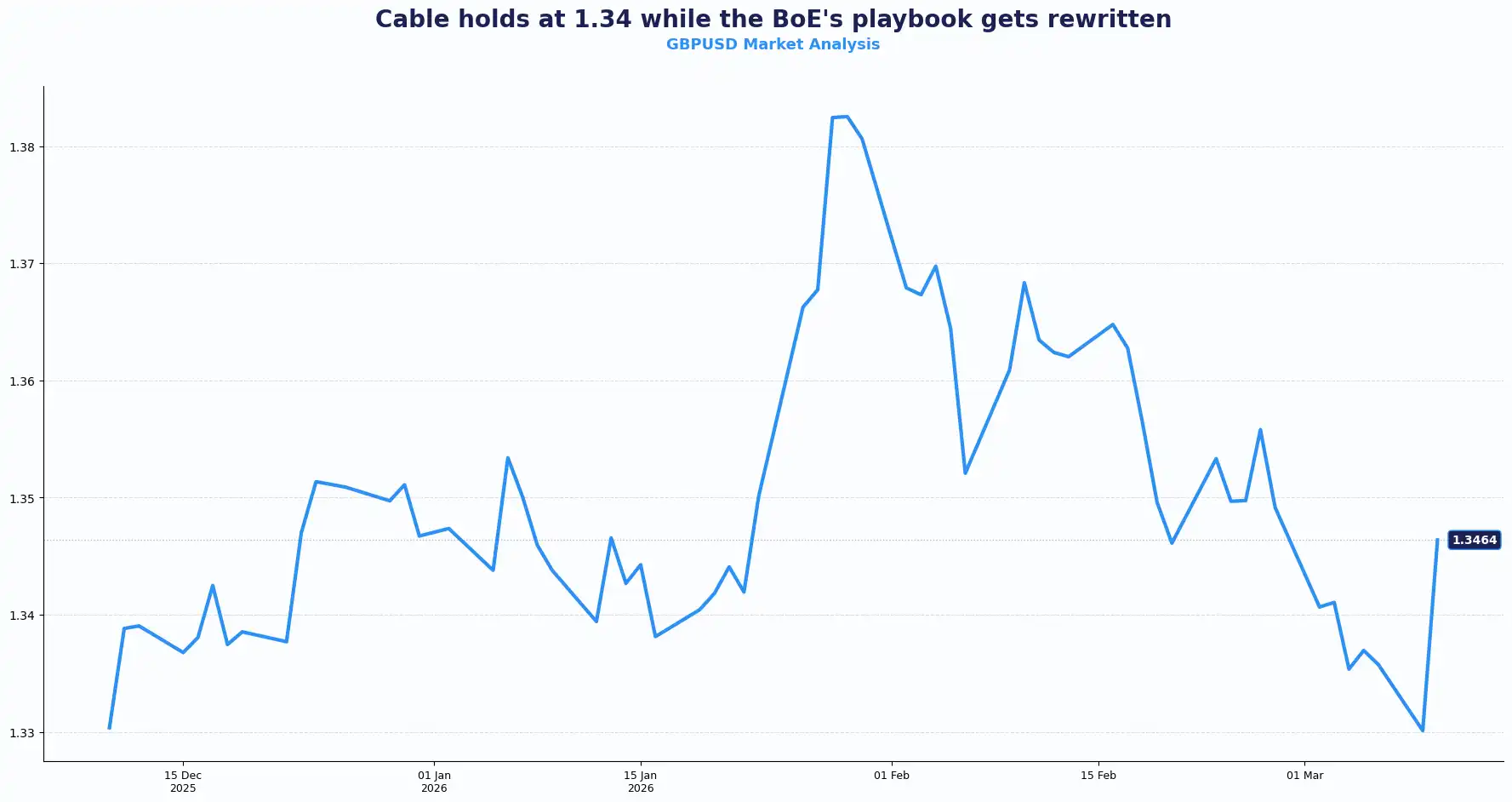
Key technical levels for GBP/USD: Resistance 1.3500, 1.3600. Support 1.3300, 1.3200. Bias constructive while above 1.3300.
The GBP/USD pair shows stability despite external pressures. Investors watch the January GDP and UK manufacturing production data on Friday, alongside the US Core PCE and preliminary Q4 GDP set to be released the same day.
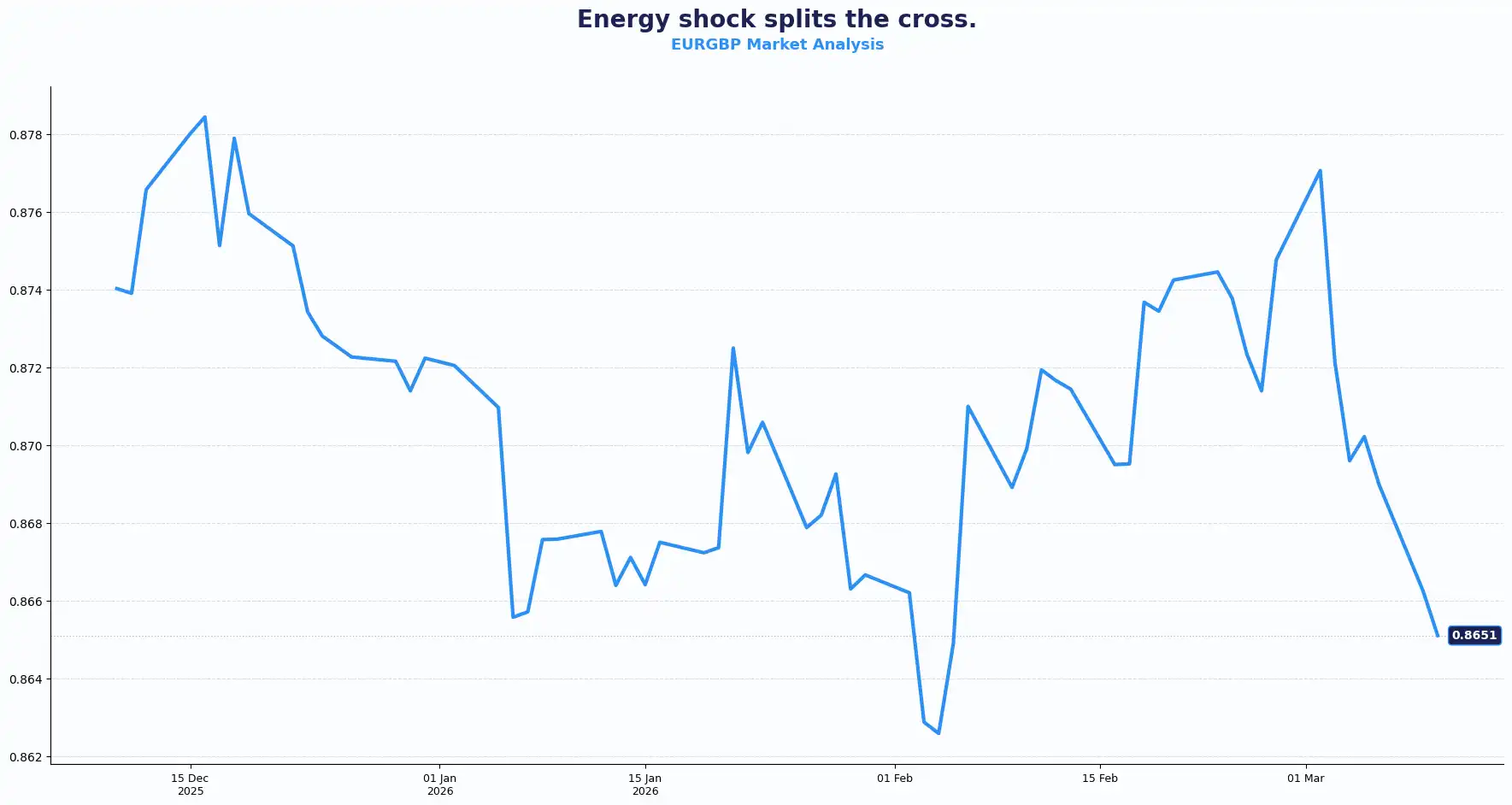
Key technical levels for EUR/GBP: Resistance 0.8720. Support 0.8580. Bias range-bound.
The EUR/GBP pair trades near 0.8650. The cross reflects diverging energy exposure and relative rate paths.
EUR: The Continent’s Energy Dilemma
EUR/USD trades at 1.1630, up 0.10% on the day, having touched a three-month low of $1.1505 earlier in the week.
The Eurozone grapples with a sudden chill in investor morale. The Sentix Investor Confidence index dropped to 3.1 in March, a direct casualty of the escalation in Iran. Attacks on energy infrastructure and shipping disruptions in the Persian Gulf weigh heavily on the European psyche.
Europe is facing a renewed energy price shock reminiscent of the year 2022. Oil and natural gas prices have climbed, forcing EU governments to revisit 2022-2023 contingency playbooks. Policymakers are contemplating mechanisms to cap prices and reduce natural gas demand. The European Central Bank (ECB) faces a classic dilemma: balance inflation risks against weaker demand.
If this energy shock persists, the ECB may find its hands tied. While recession risks usually invite rate cuts, the inflationary impulse of oil could spark a pivot toward hikes if expectations unanchor. This uncertainty has already pushed the euro toward three-month lows. Market participants are monitoring these shifts as the cost of doing business in the Eurozone becomes increasingly volatile.
Germany’s industrial production dropped 0.5% month on month in January, missing expectations for a 0.9% rise. Germany’s trade balance (s.a.) printed at €21.2B, beating forecasts and up from €17.4B. The stronger surplus suggests external demand is holding up for now, offering the euro a modest buffer against domestic softness but it does not offset the broader energy-driven risk.
Options data for the week ended 6 March shows investors adding to short euro positions and trimming short dollar positions. The euro's recovery from $1.1505 tells part of the story. Whether it holds depends on what comes next in the Middle East, not on European data.
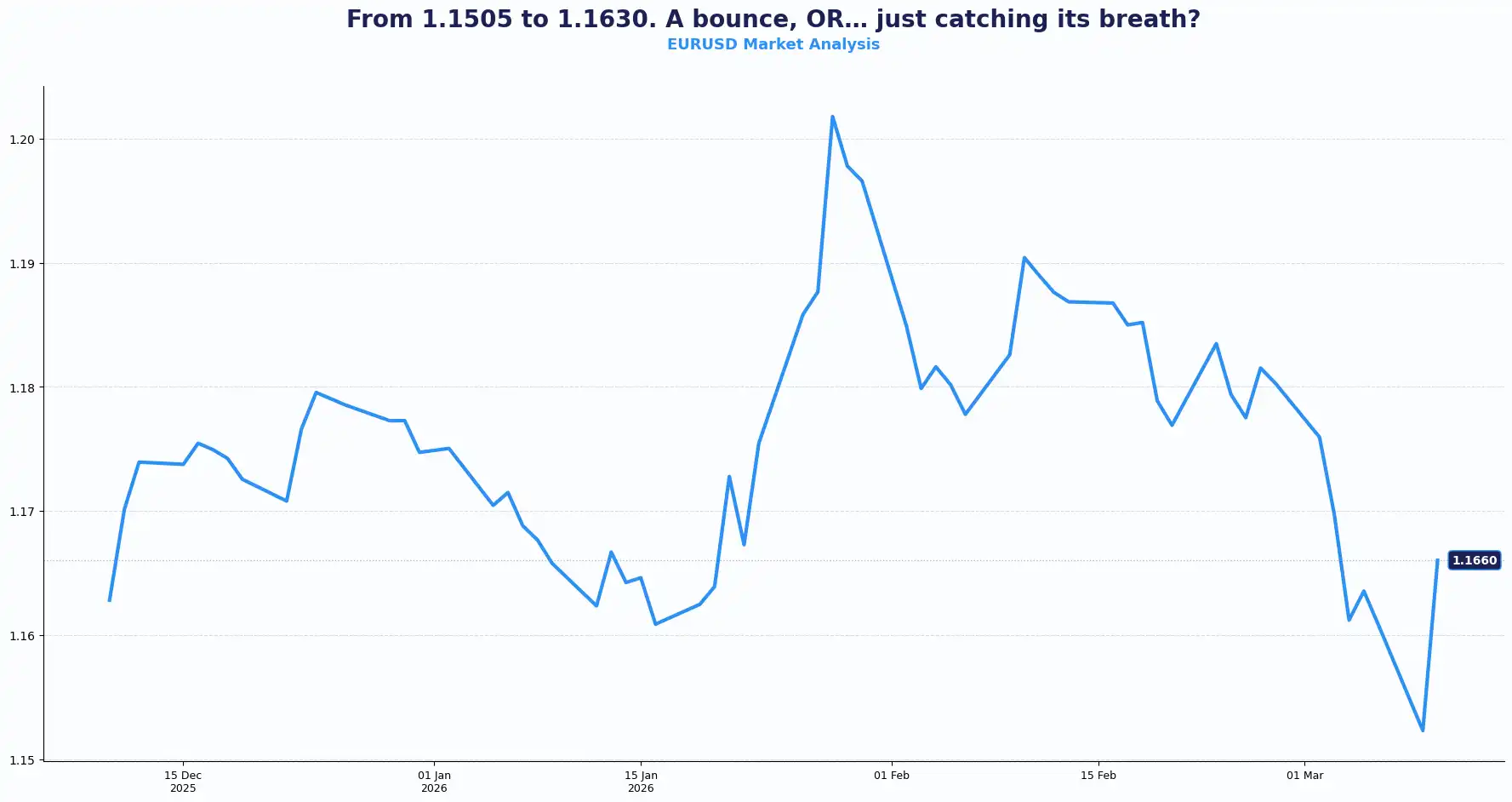
Key technical levels for EUR/USD: Resistance 1.1700, 1.1800. Support 1.1505, 1.1450. Bias cautious below 1.1700. The EUR/USD pair now trades with a heavier geopolitical premium. Dollar demand strengthens when oil risk rises and liquidity tightens.
As long as conflict risk lingers, downside pressure on the euro can reappear in sharp bursts. Energy headlines and US data will drive near-term direction.
USD: Retraces as War Rhetoric Shifts
The dollar index (DXY) sits at 98.84, pulling back 0.1% to 98.79 intraday, retracing the gains of the past week.
Trump's declaration that the Iran war could be "over soon" sent Brent Crude down from near $120 to $93 a barrel and triggered a sharp equity rally. Japan's Nikkei jumped 3.6%. South Korea's Kospi surged 6.4%, triggering a sidecar trading curb after futures rose more than 5%. The competing signals played out on Wall Street on Monday: oil spiked, stocks tumbled, then Trump spoke.
The dollar benefits from a dual engine: unmatched liquidity as a safe haven and its role as a proxy for rising oil prices. Trump’s rhetoric oscillates between declaring a "friendly takeover" of the situation and threatening to hit Iran "twenty times harder" if oil flows stop. This volatility keeps the greenback buoyed, even as Treasury bonds recover from their initial inflation scare.
Traders have pushed expectations around the timing for the first Federal Reserve (Fed) rate cut out to July. While some believe the dollar’s strength lacks a firm economic foundation, the current geopolitical vacuum makes it the only logical destination for capital. The market is currently trading on hope, but until a resolution is clear, the dollar's dominance feels structural rather than temporary.
If tensions escalate and oil prices push higher, the dollar is likely to regain ground. If de-escalation gains traction and energy prices retreat, the dollar could soften as risk assets recover. The Strait of Hormuz stays a focal point, with any disruption to oil flows could reprice inflation risk fast.
The dollar trades as both shield and pressure valve. It strengthens when fear spikes. It retreats when optimism returns. This two-way risk keeps implied volatility elevated across majors. Participants continue to reassess exposure as geopolitical headlines shift.
Global Echoes: Yen Firms and Antipodeans Slip
In Asia, the yen rose to 157.66 as oil eased from $120. Revised GDP growth of 0.3% and rising real wages let the Bank of Japan keep normalising policy, offering a rare counterweight to the dollar’s strength.
The Australian and Kiwi dollars were soft, reflecting cautious risk appetite. Gold sits at $5,133.55, holding its breath within a tight channel, while most cryptocurrencies remain directionless. Bitcoin was up 0.2% at $69,127.60, while Ether was down 0.4% at $2,018.69. Such periods of directionless trading in "risk-on" assets often precede significant breakouts once the geopolitical fog clears. The real question for the week is how long prices stay at these levels, as the duration of the shock will determine the eventual economic fallout.
Current Rate Table
| Pair | Spot | Short-term Trend Bias |
|---|---|---|
| GBP/USD | 1.3440 | Constructive above 1.3300 |
| EUR/USD | 1.1630 | Heavy below 1.1700 |
| EUR/GBP | 0.8650 | Range 0.8580–0.8720 |
| USD/JPY | 157.66 | Elevated, volatile |
| AUD/USD | 0.7060 | Soft risk tone |
| NZD/USD | 0.5912 | Under pressure |
| GBP/JPY | 211.71 | Flat |
(rates as at the time of writing)
Market Look ahead
Tue, 10 Mar
Eurozone EcoFin Meeting (all day)
Wed, 11 Mar
Germany CPI (Feb); US CPI (Feb)
Thu, 12 Mar
BoE Governor Bailey speech
Fri, 13 Mar
UK January GDP & Manufacturing Production
US Core PCE & Preliminary Q4 GDP
Stay Ahead in the Currency Game
Whether you're a daily FX trader or handle international transactions regularly, our 'Currency Pulse' newsletter delivers the news you need to make more informed decisions. Receive concise updates and in-depth insights directly in your LinkedIn feed.
Subscribe to 'Currency Pulse' now and never miss a beat in the currency markets!
Ready to act on today’s insights? Get a free quote or give us a call on: +44 (0)20 7740 0000 to connect with a dedicated portfolio manager for tailored support.
Important Disclaimer: This blog is for informational purposes only and should not be considered financial advice. Currency Solutions does not take into account the investment objectives, financial situation, or specific needs of any individual readers. We do not endorse or recommend any specific financial strategies, products, or services mentioned in this content. All information is provided “as is” without any representations or warranties, express or implied, regarding its accuracy, completeness, or timeliness.