Oil Shock and Politics Rattle G10 FX
7 min read
Share


The pound retreats as political shocks and rate-cut whispers grow, while a widening Middle East conflict turns the dollar into the world’s preferred sanctuary against surging energy costs. The euro and yen absorb energy hits as the conflict deepens. War risk surges. Oil climbs. Inflation risk pushes back to the top of every central bank brief.
GBP: Sterling Caught Between Westminster and War
Cable fell to 1.3373 on Tuesday, striking near a one-month low. The pair last traded around 1.3400, with bearish pressure holding firm. GBP/CHF sat at 1.0441, reflecting the pound's broad softness across the board.
This descent follows a seismic shock in the domestic arena. The Labour Government lost the Gorton and Denton by-election. This seat once stood as a fortress. Now, it stands as a symbol of voter discontent.
The defeat raises questions about the longevity of Keir Starmer and Chancellor Rachel Reeves. If the front bench shifts toward populist spending to win back voters, the fiscal books will suffer. Politics would normally dominate the pound’s narrative. This week, geopolitics overrides it. Rising oil prices shift attention straight back to inflation.
The Bank of England (BoE) now sits in a narrow corridor. Governor Andrew Bailey avoided committing to a March cut, yet rate expectations still lean towards easing later this year. MPC member Alan Taylor struck a confident tone. He said disinflation stays intact and wage growth should converge towards target-consistent levels this year. He also warned the UK could soon move beyond policy trade-off territory and risk a period of deficit demand. The next policy decision is scheduled for 19 March.
Political volatility and shifting BoE expectations drive current sterling weakness. Softening growth nudges the BoE towards cuts. Sticky services inflation and energy risk pull the other way. Sterling currently trades in that gap.
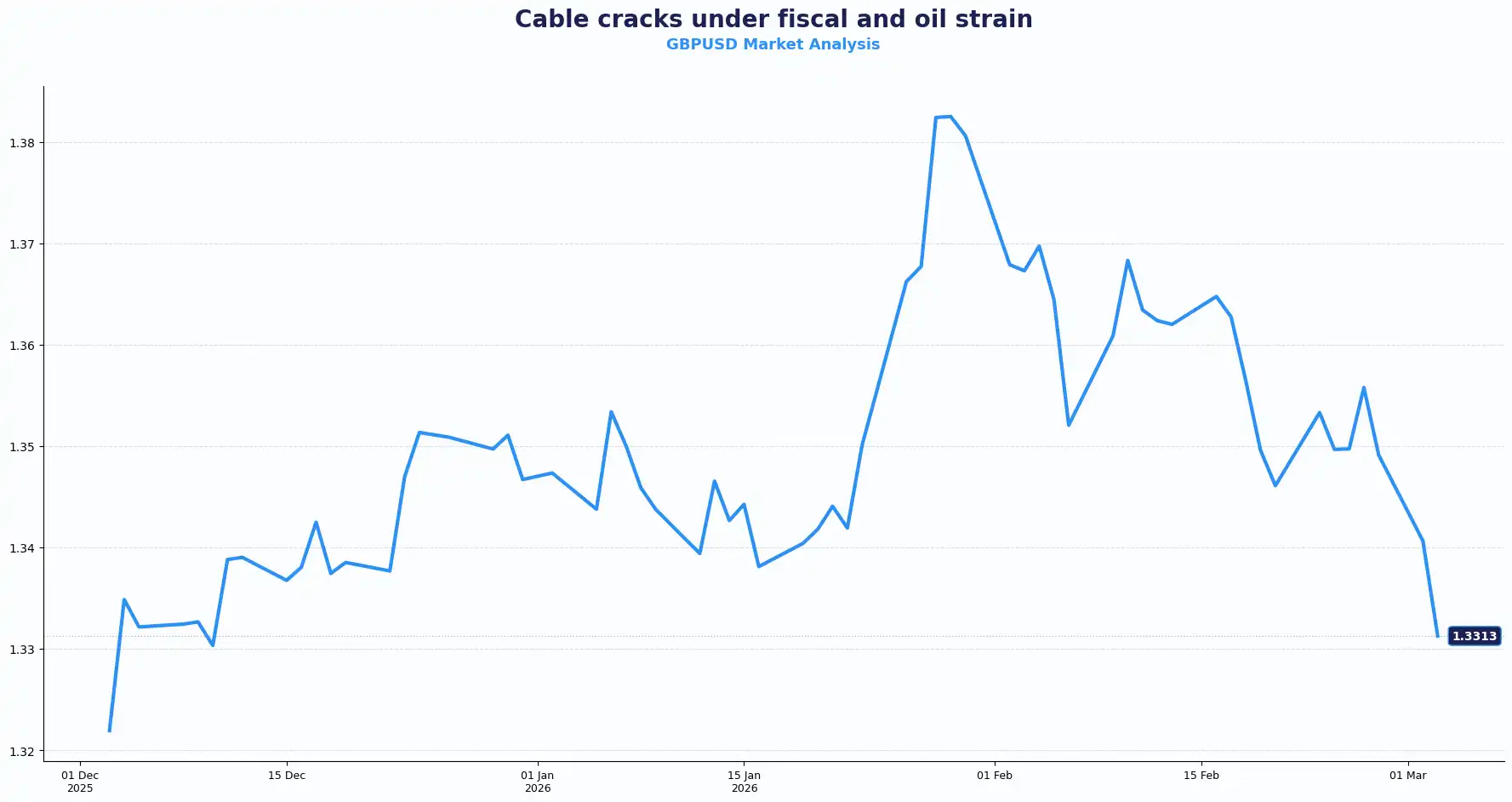
Key technical levels for GBP/USD: Resistance sits at 1.3450, 1.3520 and Support at 1.3370, 1.3300.
Volatility reflects political risk layered on top of policy uncertainty. Price action shows how quickly sentiment can shift when fiscal credibility comes into question.
This week's domestic data slate: house prices, consumer credit, mortgage approvals, the Halifax House Price Index, and PMI readings, will sharpen the picture on UK demand. Investors are watching for any signal that could shift the timeline for the rate cut in either direction.
EUR: Euro Fragile Amid Energy Hunger and Strategic Dilemmas
The euro trades with a nervous flicker at $1.1670. It struggles to hold ground following a 1.1% slide in the previous session. EUR/GBP pushed higher to 0.8727, up 0.08% in today’s early Asian session. Political noise in the UK gave the cross a direct lift.
Investors perceive the Eurozone as a fragile vessel in the current geopolitical storm. Energy prices climb as the Middle East conflict widens. This creates a direct hit for a bloc that relies heavily on energy imports. The euro languishes because the cost of doing business in Europe just surged.
A currency strategist at National Australia Bank said it plainly, “Europe and Japan stand out among the major economies for their significant need to import energy, and history tells you those currencies struggle to perform in this environment.”
Chancellor Friedrich Merz has aligned Germany firmly with the United States and Israel. He declared support for the strikes on Iran. This hardline stance signals a departure from traditional diplomacy. While Merz seeks to end the "mullah regime," the economic cost to Germany is high.
Brent Crude climbed for a third consecutive day to $80.35, complicating the European Central Bank’s (ECB) work and acting as headwind for the euro. The market had leaned towards steady policy into mid-2026. ECB’s Martin Kocher signalled that the central bank must stay ready to move rates "quickly in either direction" if fresh economic threats emerge. This pivot away from a pre-determined path reflects a growing concern over stagflationary pressures.
Energy prices have not reached the levels seen at the start of the Russia-Ukraine conflict in 2022, but the duration and scale of any supply disruption will define the trajectory of the EUR pairs in the sessions ahead.
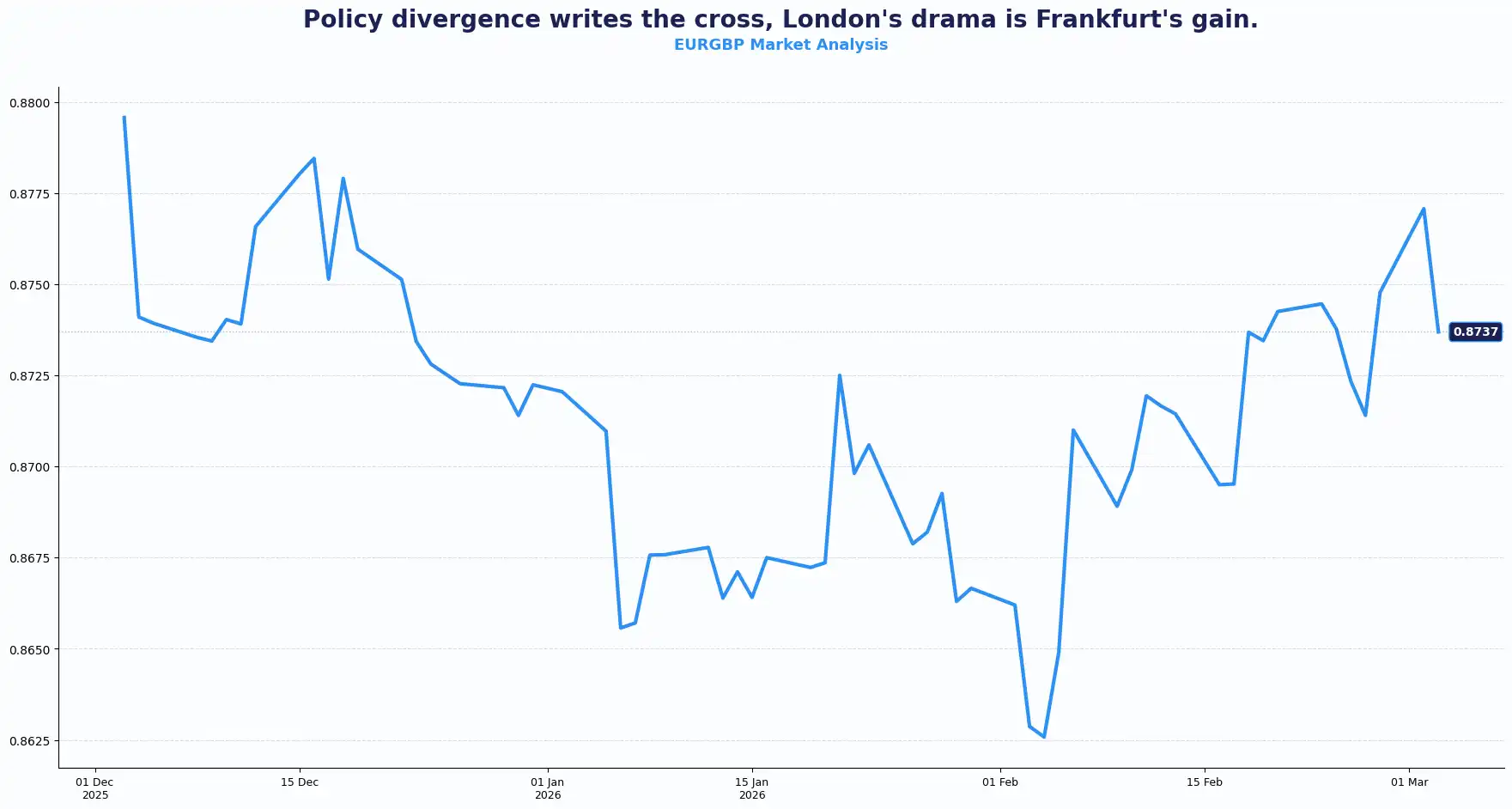
EUR/GBP acts as a direct read on policy divergence between Frankfurt and London. With BoE cut bets building and the ECB holding a cautious, two-directional tone, participants are recalibrating the gap between the two central banks.
Key technical levels for EUR/GBP: Resistance sits at 0.8750, 0.8780 and Support at 0.8700, 0.8650
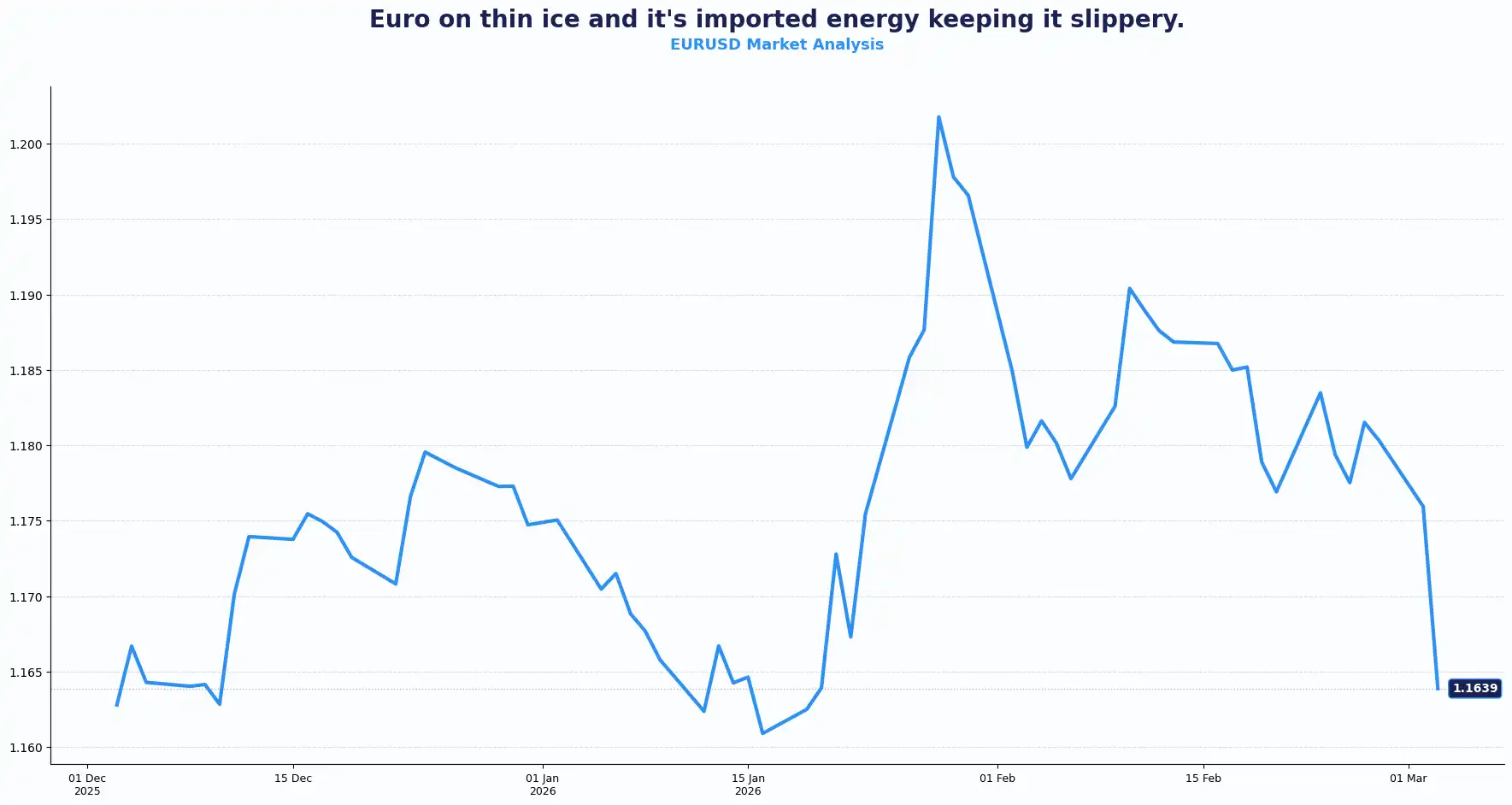
The euro trades as an energy proxy in this phase. If oil stabilises, EUR/USD may find footing. If crude extends higher, inflation repricing will dominate.
Key technical levels for EUR/USD: Resistance sits at 1.1700, 1.1750 and Support at 1.1620, 1.1550;
Investors are closely monitoring the upcoming Eurozone HICP inflation data, as any upside surprise could force a swifter ECB response despite slowing growth.
USD: The Dollar’s Ascent, A Safe-Haven Stronghold
The Dollar Index (DXY) rose to 99.05, approaching a six-week high, as the dollar absorbed safe-haven demand following the escalation of US and Israeli air strikes against Iran.
Trump declared the US will do "whatever it takes" to achieve its military objectives, deepening the equity sell-off and lifting oil further. With the death of Supreme Leader Ayatollah Ali Khamenei leaving leadership in Tehran unclear, Trump acknowledged the conflict could run for weeks. Israeli PM Netanyahu told news outlets it would not become an "endless war." Drone strikes hit the US embassy in Riyadh, causing limited damage. Disruptions hit Amazon data centres in the UAE and Bahrain, putting the safe-haven reputation of Gulf financial hubs under fresh scrutiny.
The Fed's task grew harder. ISM manufacturing data for February showed US activity expanding at a steady pace, but a gauge of factory gate prices surged to a near three-and-a-half-year high, driven by tariffs. The floor now prices a 97.5% chance that the Fed stays on hold this month. A rate cut before September looks unlikely. Traders continue to price two 25-basis-point cuts by year-end. Inflation is not a ghost; it is a guest that refuses to leave. The dollar benefits from both fear and firm interest rates.
Secretary of State Rubio confirmed the US will announce plans to address rising energy prices. Some analysts note the current risk-off tone reads as mild; insufficient to generate a firm bid on US Treasuries or push the Fed towards faster action.
A hawkish Fed against a backdrop of geopolitical risk and sticky inflation has reinforced dollar demand. Divergence from rate-cutting peers provides the dollar with structural support that short-term risk sentiment alone cannot explain. Energy and policy expectations now move together.
Global Landscape: Yen, Aussie, Kiwi Caught in the Crossfire
The yen sits at 157.27 per dollar, trimming Monday's 0.8% slide. GBP/JPY sat at 210.55. Japanese Finance Minister Satsuki Katayama put the arena on notice. She suggested that intervention remains a live option. Japan watches the markets with an "extremely strong sense of urgency."
Meanwhile, AUD/USD consolidated near 0.7100 and NZD/USD dropped to 0.5927. Hawkish rhetoric from the RBA provides a small cushion, but geopolitical risks counter these gains.
Europe and Japan stand out as the most exposed economies. They lack the energy independence of the United States. This fundamental weakness dictates the flow of capital. In the crypto space, Bitcoin and Ether declined as investors moved toward tangible assets like gold. Gold edged up as the primary "disaster insurance." The risk of stagflation looms large for Asian markets, reminiscent of the 2022 shocks.
Energy sits at the core of this repricing. When oil spikes, importers feel the strain. Exporters cushion the blow. The current phase rewards liquidity and safety.
With no end to the conflict in sight, the interplay between energy disruptions, inflationary pressures and central bank responses across Asia-Pacific will shape positioning in these pairs through the week. The current rise in geopolitical risk coincides with what some participants identify as regional vulnerability to a broader correction.
Current Rate Table
| Pair | Spot | Short-term Trend Bias |
|---|---|---|
| GBP/USD | 1.3400 | Bearish below 1.3450 |
| EUR/USD | 1.1670 | Bearish below 1.1700 |
| EUR/GBP | 0.8727 | Bullish above 0.8700 |
| USD/JPY | 157.32 | Bullish above 156.00 |
| GBP/JPY | 210.55 | Bullish above 208.00 |
| AUD/USD | 0.7087 | Neutral below 0.7150 |
| NZD/USD | 0.5927 | Bearish below 0.6000 |
(rates as at the time of writing)
Market Look ahead
Tuesday, 3 March
Eurozone Flash HICP (February)
Wednesday, 4 March
Australia Q4 GDP
Eurozone, UK, US S&P Global Composite and Services PMI
Eurozone PPI (January)
US ADP Employment Change
Thursday, 5 March
US Initial Jobless Claims
ECB Monetary Policy Meeting Accounts
Friday, 6 March
Eurozone Q4 GDP (final)
ECB President Christine Lagarde speech
US Nonfarm Payrolls and Unemployment Rate
US Fed Monetary Policy Report
Stay Ahead in the Currency Game
Whether you're a daily FX trader or handle international transactions regularly, our 'Currency Pulse' newsletter delivers the news you need to make more informed decisions. Receive concise updates and in-depth insights directly in your LinkedIn feed.
Subscribe to 'Currency Pulse' now and never miss a beat in the currency markets!
Ready to act on today’s insights? Get a free quote or give us a call on: +44 (0)20 7740 0000 to connect with a dedicated portfolio manager for tailored support.
Important Disclaimer: This blog is for informational purposes only and should not be considered financial advice. Currency Solutions does not take into account the investment objectives, financial situation, or specific needs of any individual readers. We do not endorse or recommend any specific financial strategies, products, or services mentioned in this content. All information is provided “as is” without any representations or warranties, express or implied, regarding its accuracy, completeness, or timeliness.