EUR/USD Holds Firm on Shifting Policy Outlook
6 min read
Share


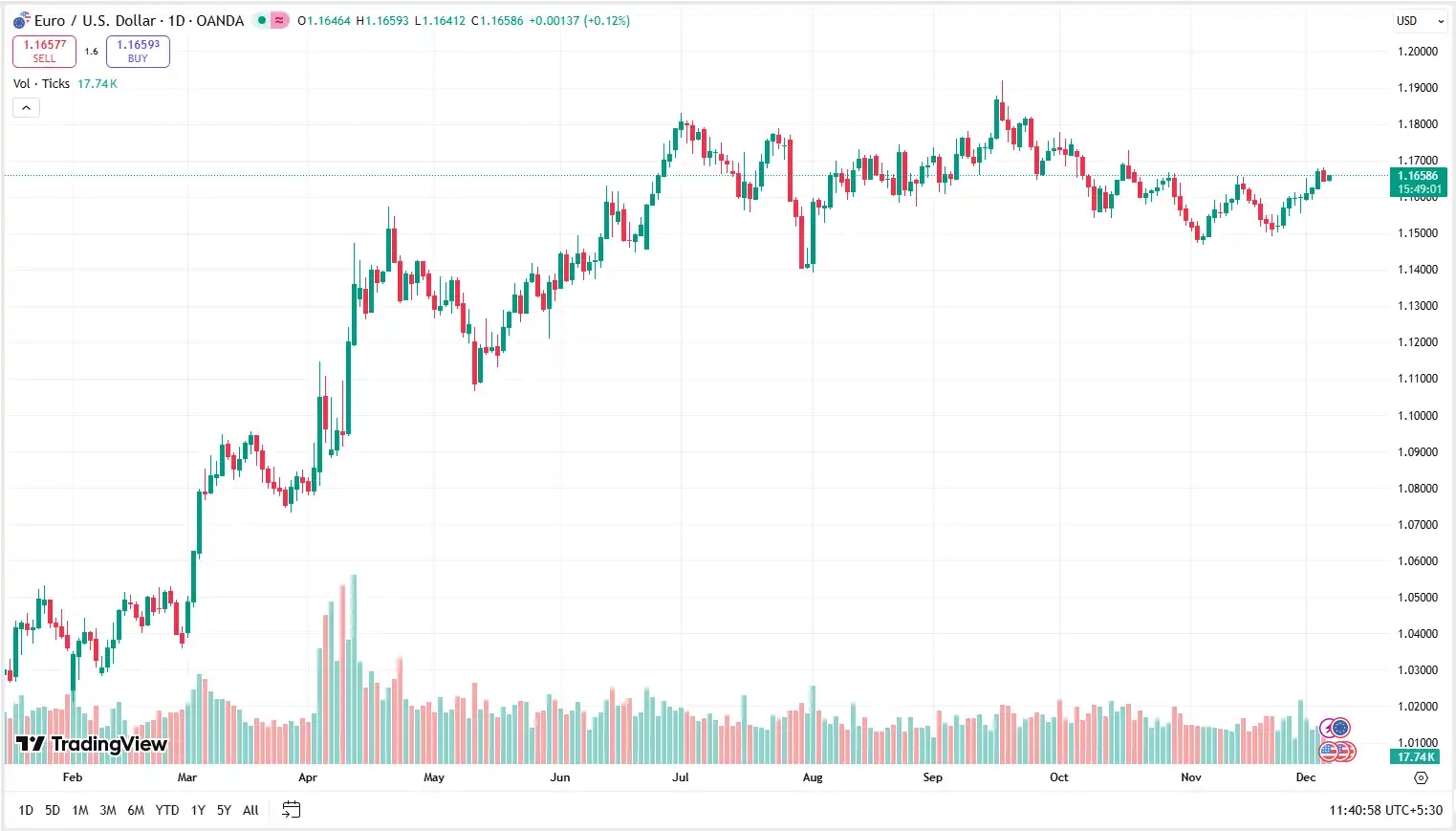
The EUR/USD pair traded near 1.1659[1] in Friday's early Asian session, regaining positive momentum as fresh dip-buyers stepped in after Thursday’s pullback from 1.1680. This level was its strongest since mid-October. The pair looks set to record a second consecutive weekly rise, supported by softer US dollar sentiment and steady Eurozone policy outlook[2].
Market reports[3] indicate that despite strong US labour market data released on Thursday, the US dollar has struggled to build on its six-week low recovery. Market participants still favour a dovish Federal Reserve (Fed)[4] stance, with futures pricing implying a high chance of another rate cut at next week’s meeting. The possibility of cheaper borrowing is reducing the greenback’s yield edge and curbing safe-haven demand, thus creating a positive outlook for the pair in the short term.
Market watchers say the euro is supported by rising confidence that the European Central Bank (ECB)[5] has concluded its easing phase. Remarks from President Christine Lagarde[6] earlier this week, signalling inflation should stabilise close to the 2% target, strengthening the case for a policy pause. This has helped maintain the pair's upward momentum after it recently broke above the 100-day moving average. That move continues to confirm a broadly improving technical outlook.
Analysts[7] suggest traders remain cautious ahead of the release of the US PCE Price Index, the Fed’s preferred inflation gauge. Any sign of persistent price pressures could temper hopes for aggressive rate cuts, boost demand for the dollar, and raise renewed downside risks for the pair over the medium term. The EUR/USD exchange rate is poised to extend its upward momentum as softer dollar sentiment and a steady ECB outlook continue to support the pair.
USD/CAD Holds Steady Awaiting Labour Market Signals
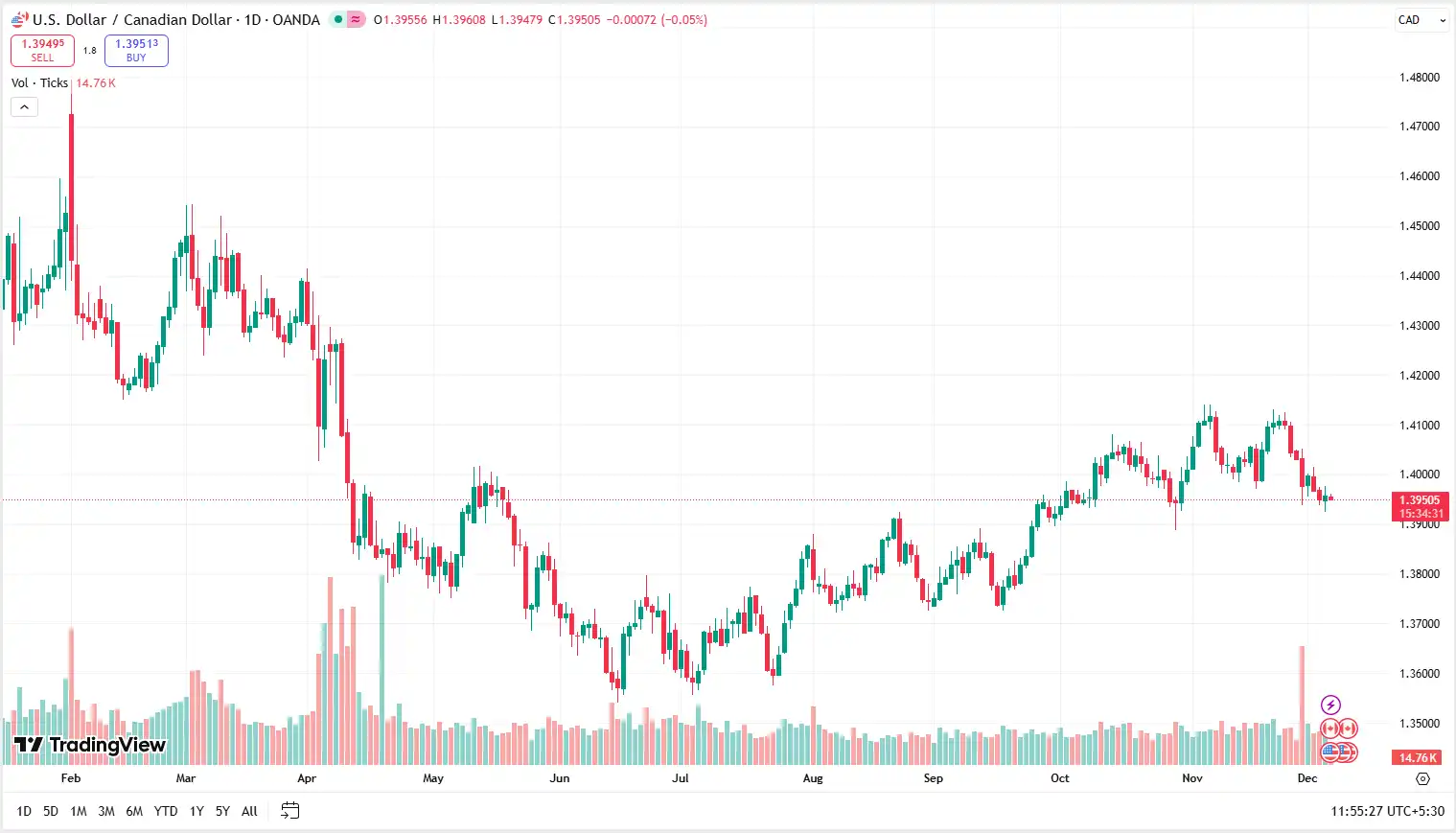
The USD/CAD pair traded within a narrow range close to 1.3950[8] in Friday’s early trading hours. The pair is believed to have remained inside Thursday’s band as markets awaited November’s Canadian labour market report. The loonie stayed steady but vulnerable before the data release. Investors hoped the report would confirm if easing by the Bank of Canada (BoC)[9] is justified. Consensus predicts flat job growth after October’s strong 66.6k rise[10]. The unemployment rate is expected to increase slightly to 7.0%. Any downside surprise would likely pressure the Canadian dollar and offer short-term support to the pair.
Market reports[11] indicate that the US dollar is trading cautiously after the DXY slipped to a fresh five-week low. This drop is due to increasing expectations of a 25-basis-point Fed rate cut at December's meeting. The CME FedWatch tool shows markets assign an 87%[12] chance of this cut. Weaker US labour data and easing inflation concerns support the case for loosening policy. These developments have curbed the US dollar’s gains and kept the pair range-bound despite risks specific to Canada.
Analysts[13] suggest that upcoming US economic releases will continue to be a key influence going forward. Any further weakness in job data or consumer confidence would keep downward pressure on the dollar, limiting the pair’s rallies. By contrast, stabilisation in US data might curb the pair’s upside potential, particularly if Canadian numbers remain strong.
Market commentators[14] indicate that the pair holds a mildly bid tone short term amid uncertainty around Canada’s labour outlook and the BoC’s policy stance. Medium-term risks remain as stronger expectations of Fed easing continue to weigh on overall US dollar sentiment. The USD/CAD exchange rate retains a mildly bullish tone as soft Canadian labour expectations and cautious US dollar sentiment keep the pair modestly supported.
NZD/USD Dips as Dollar Stabilises Ahead Key Indicators
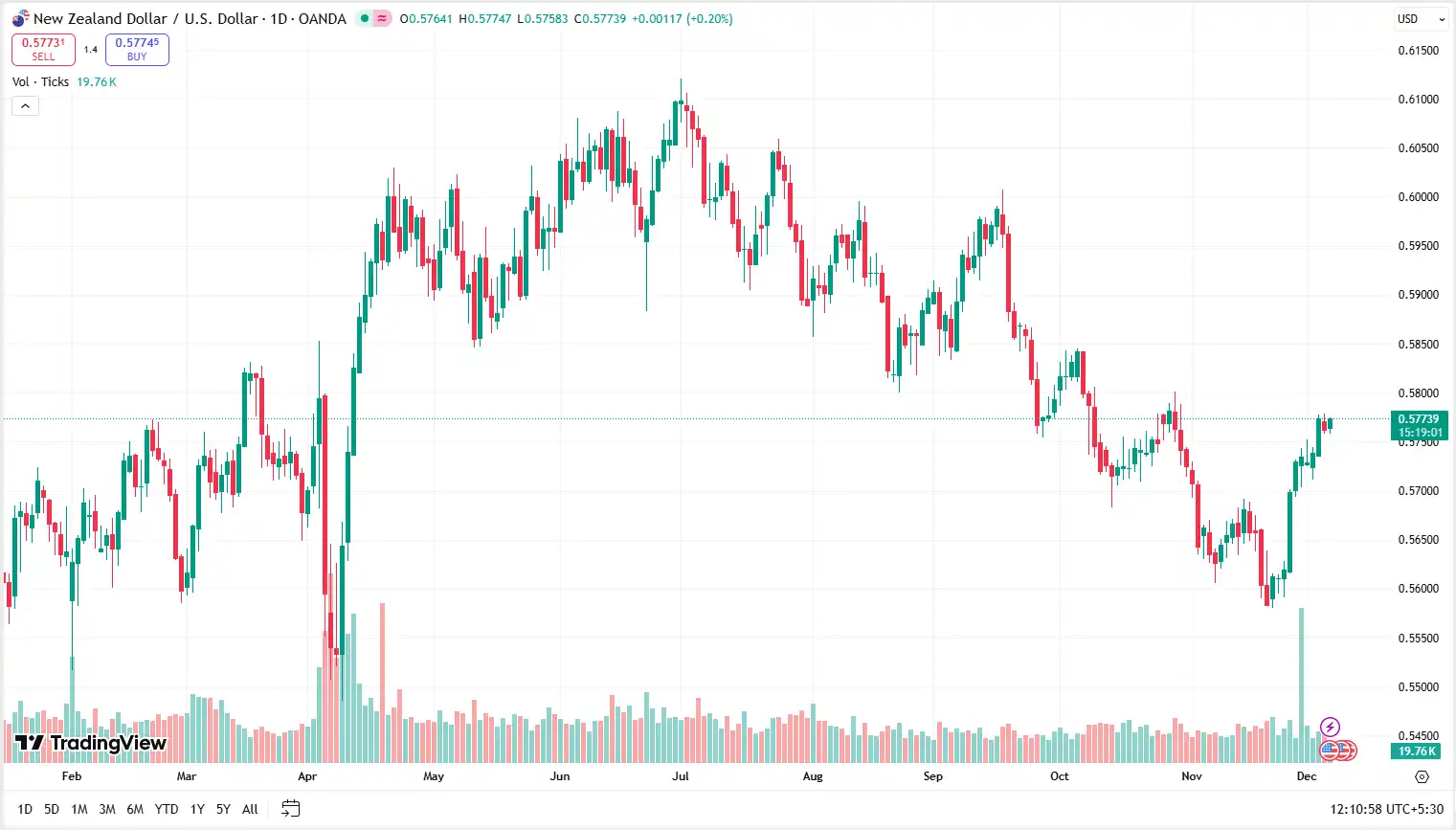
The NZD/USD pair remained slightly weaker, trading around 0.5770[15] in Friday's early Asian trading, as the US dollar found some footing. This modest pullback follows a firm rebound in the greenback, driven by rising US Treasury yields and repositioning ahead of key US data. The delayed US Personal Consumption Expenditures (PCE) Price Index[16] for September is at the centre of market attention. Downside pressure persists within the day, but the pair’s decline seems contained, as markets grow more certain of a Fed rate cut. Fed funds[17] futures now suggest nearly an 89% chance of easing at next week’s December meeting, reflecting softer labour market data. This probability also reflects several dovish comments from Fed policymakers, underscoring expectations of accommodative monetary policy soon.
The domestic market reports indicate the New Zealand dollar found underlying support after the Reserve Bank of New Zealand (RBNZ)[18] cut the Official Cash Rate to 2.25% last week, as expected. Although this move continued the easing cycle, the RBNZ’s guidance showed limited appetite for more cuts soon, helping to stabilise the currency after recent losses.
The market reports highlight that attention now shifts to the US PCE inflation release[19]. Consensus expects a 2.8% YoY rise in headline inflation and 2.9% for the core. A hotter reading than expected could strengthen the dollar by reducing chances of aggressive Fed easing. This would weigh on the currency pair. On the other hand, softer inflation might weaken the US dollar[20] and provide short-term relief. Analysts suggest near-term stabilisation is possible. However, medium-term risks remain skewed lower as US data continue shaping the broader market trend. The NZD/USD exchange rate drifted lower as renewed US dollar strength and upcoming inflation data kept sentiment cautious.
AUD/USD steadies Amid Diverging Policy Outlooks
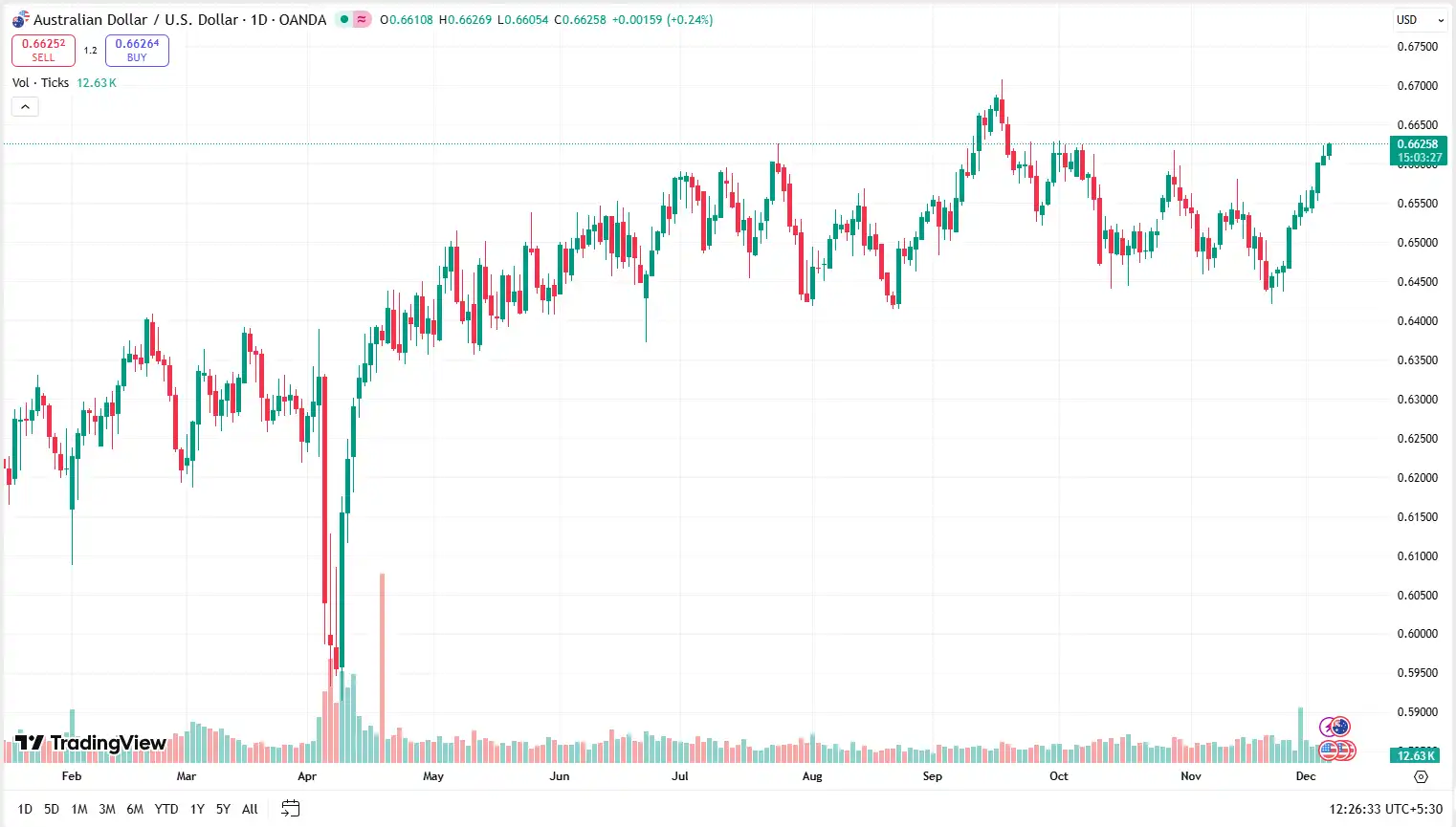
The AUD/USD pair traded within a tight consolidation range near 0.6626[21] in Friday's early Asian session, staying just below Thursday’s almost two-month high. The pair’s steady level highlights ongoing demand for the Australian dollar amid growing policy divergence between the Fed and the Reserve Bank of Australia (RBA)[22]. Nonetheless, traders remain cautious ahead of the US Personal Consumption Expenditure (PCE) Price Index[23], which could bring fresh volatility to US dollar movements.
The fresh US data[24] has reinforced views that economic momentum is easing, shown by softer labour-market signs and calmer activity, indicating inflation pressures are easing. This has boosted market belief the Fed might cut interest rates as soon as December, with futures pointing to a strong chance of a 25-basis-point cut. These expectations have limited the greenback’s efforts[25] to make a meaningful comeback, helping to keep the pair steady on downward moves.
Market commentators highlight that on the domestic front, RBA Governor Michele Bullock’s remarks earlier this week have further supported the Aussie. The governor restated that inflation has not yet sustainably settled within the 2–3% target[26] band and stressed that ongoing price pressures might require more policy tightening in 2025. This approach contrasts with the Fed’s dovish stance, reinforcing the medium-term upside bias in the pair.
Analysts[27] suggest that in the short term, the immediate direction depends on the PCE report. A softer-than-expected result might weaken the US dollar and allow the pair’s two-week uptrend to continue. Conversely, a stronger inflation figure could bring corrective pressure on the pair, though downside risks might stay limited due to the changing policy environment. The AUD/USD exchange rate maintained a bullish tone as policy divergence and steady Aussie demand kept the pair supported ahead of the key US PCE release.
Stay Ahead in the Currency Game
Whether you're a daily FX trader or handle international transactions regularly, our 'Currency Pulse' newsletter delivers the news you need to make more informed decisions. Receive concise updates and in-depth insights directly in your LinkedIn feed.
Subscribe to 'Currency Pulse' now and never miss a beat in the currency markets!
Ready to act on today’s insights? Get a free quote or give us a call on: +44 (0)20 7740 0000 to connect with a dedicated portfolio manager for tailored support.
Important Disclaimer: This blog is for informational purposes only and should not be considered financial advice. Currency Solutions does not take into account the investment objectives, financial situation, or specific needs of any individual readers. We do not endorse or recommend any specific financial strategies, products, or services mentioned in this content. All information is provided “as is” without any representations or warranties, express or implied, regarding its accuracy, completeness, or timeliness.